Luther Monson, Founding Engineer at Gas City

Luther Monson

Open Source · AI · Containers · VMs · Kubernetes · Windows · Go by way of PHP

A 1 TB Test: Building a Memory Watchdog for go test

A runaway test binary hit about 1 TB of commit charge and took my desktop down. Here's the PowerShell and POSIX sh wrapper I put around go test, and the bug in it that the Windows box couldn't show me.
8-Minute Read

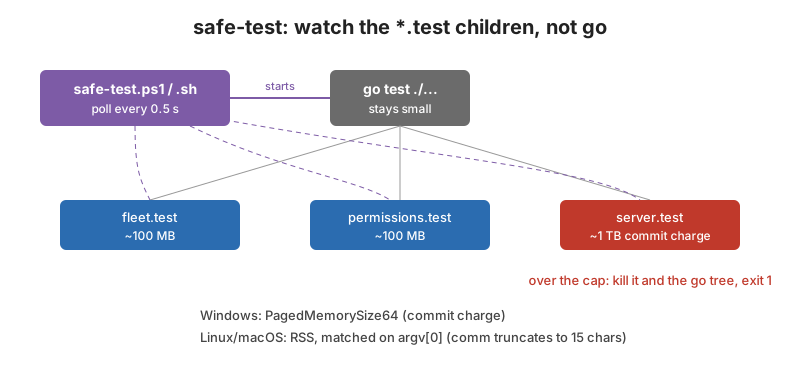
go test process tree with per-package test binaries watched by the safe-test wrapper

On August 16th a server.test.exe from shipmates climbed to roughly 1 TB of commit charge on my Windows workstation. Windows Terminal was hosting several agent sessions in tabs. It hard-faulted with E_OUTOFMEMORY, and every one of those sessions died at the same moment. It wasn’t the first time either. An earlier one hit about 236 GB through an infinite filepath.Dir loop.
Calling Rust From PHP Without a Socket, Part 2: Making Existing Code Use It

Thirteen Composer packages let existing Redis and database code in WordPress, Laravel and Symfony use ePHPm's built-in versions. This post covers what's in them and the bugs they turned up.

8-Minute Read

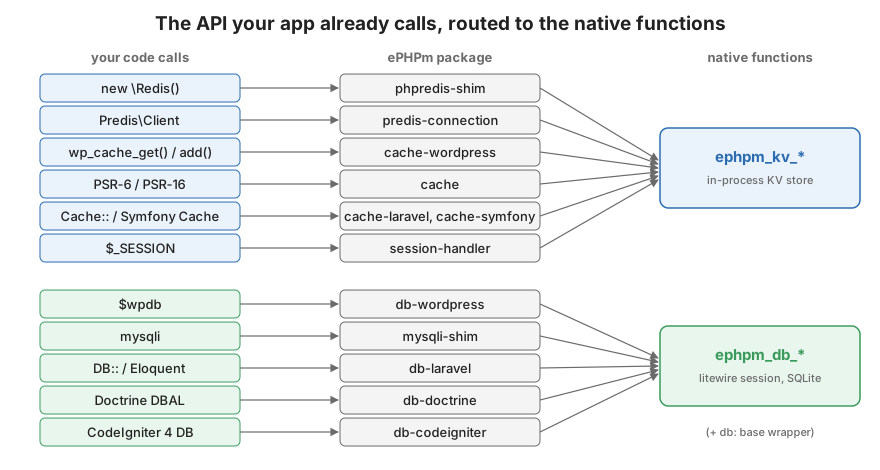
The APIs PHP apps already call, mapped through ePHPm wrapper packages onto ephpm_kv_* and ephpm_db_*

Part 1 covered the plumbing. ePHPm registers ephpm_kv_* and ephpm_db_* functions that call straight into Rust. A cache read through one costs about a tenth of a microsecond instead of a loopback round trip. That’s nice and also useless on its own. Nobody is going to rewrite their WordPress object cache or their Laravel cache store around a function called ephpm_kv_set(). Applications talk to existing APIs instead:

os/exec's StdoutPipe Footgun: How cmd.Wait() Ate My Last Frame (Twice)

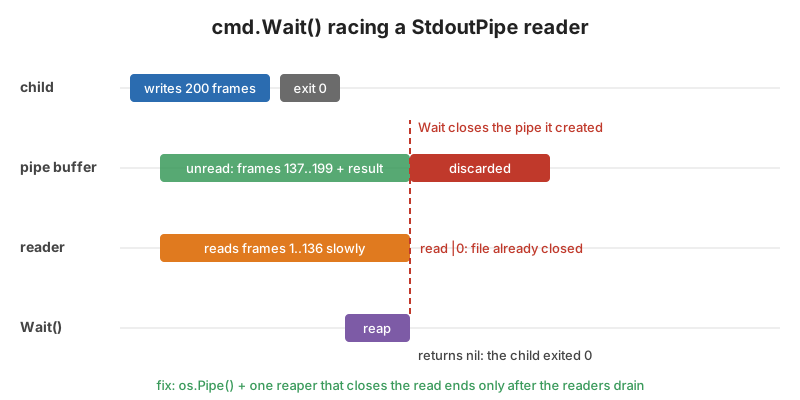
Calling Wait while a StdoutPipe reader is still draining throws away the child's last output. I shipped this bug twice in shipmates.

9-Minute Read

Timeline of a child process exiting, Wait closing the pipe, and the reader losing buffered frames

shipmates spends most of its life spawning claude (and codex) processes and reading newline-delimited JSON off their stdout. The last frame of a turn is the important one. It’s a result frame with the cost, the model and the final text. Stderr matters too, because that’s where Claude Code tells you Invalid API key · Please run /login. For a while I was throwing both away under load. The cause is documented right there in the os/exec godoc. I fixed it in one package and then found the…

The Bugs Were Our Own Linker Wraps: Making a PHP Timeout Actually Time Out

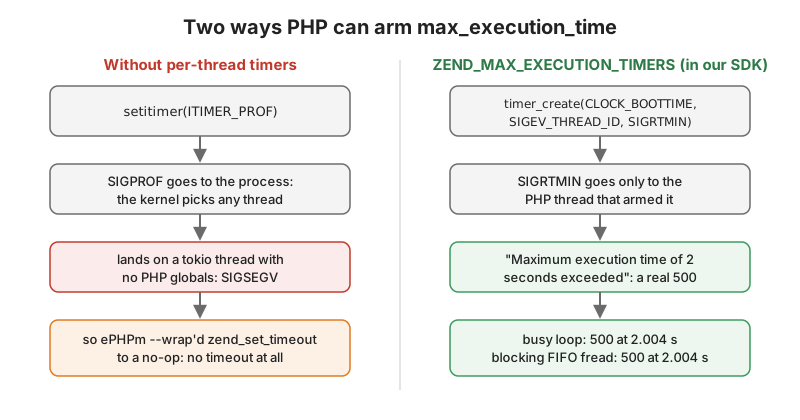
max_execution_time did nothing in ePHPm because we had wrapped zend_set_timeout to a no-op. The SDK already had per-thread timers. We just had to stop switching them off.

8-Minute Read

Side by side: a process-wide SIGPROF timer that can land on the wrong thread, versus a per-thread POSIX timer that delivers SIGRTMIN to the PHP thread that armed it

In the stack guard post the villain was a -Wl,--wrap linker flag that turned off PHP’s C-stack overflow guard. It wasn’t the only one. Until August, max_execution_time did nothing in ePHPm on Linux, for the same reason. We had wrapped the function that arms it to a no-op. A runaway script ran until the HTTP layer’s request timeout gave up on it and sent a 504. The PHP thread kept burning CPU after that.

Clustered SQLite in ePHPm, Part 3: CDC Over the Cluster Channel

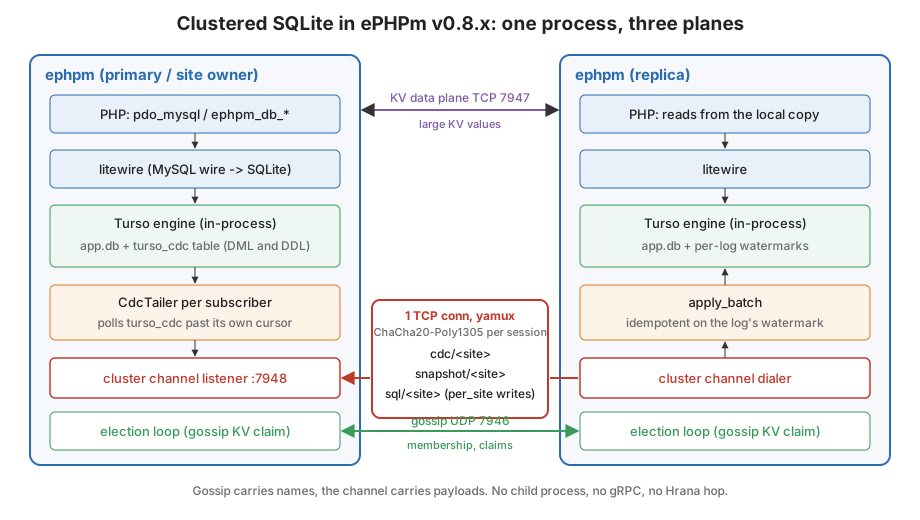
ePHPm ships Turso's change data capture stream between nodes over one authenticated, multiplexed TCP connection. This covers how that works and the two failover bugs that showed up when the e2e suite killed the primary.

15-Minute Read

Two ePHPm nodes connected by gossip on UDP 7946, the KV data plane on TCP 7947 and the cluster channel on TCP 7948 carrying cdc, snapshot and sql streams

By the end of Part 2 ePHPm v0.7.0 ran exactly one SQLite engine in process. That was Turso, for single-node and clustered mode alike. The sidecar was gone. What I skipped over is how a replica actually gets the primary’s writes, and what happens when the primary dies with data on it. That’s this post.

Calling Rust From PHP Without a Socket, Part 1: The Native Functions

How ePHPm exposes its in-process KV store and SQLite bridge to PHP as plain functions, and what it took to make that safe under ZTS.

14-Minute Read

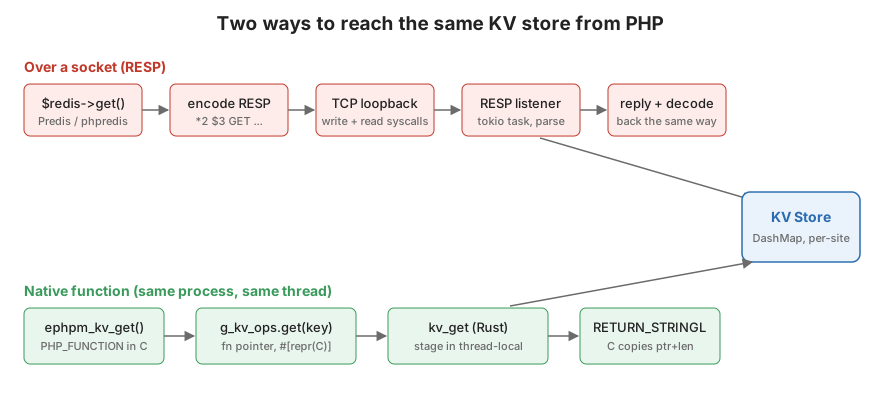
Two paths from PHP to the ePHPm KV store: over a RESP socket, or through a native function and a function pointer table

ePHPm is a single Rust binary that embeds PHP. It carries its own KV store and its own SQLite-backed database in the same process. For a long time PHP code could only reach that KV store the same way it reaches Redis. It opened a TCP socket to the RESP listener ePHPm runs on localhost, encoded a command and waited for the reply. That works, and every PHP Redis client in existence already speaks it. But it is a strange thing to do when the hash map you’re talking to lives a few pointers…

Every Way a Tenant Escaped: A Cross-Tenant Breakout Field Guide

Eight ways one site broke out of its sandbox on a multi-tenant PHP server, all found by attacking it on purpose, all fixed.

10-Minute Read

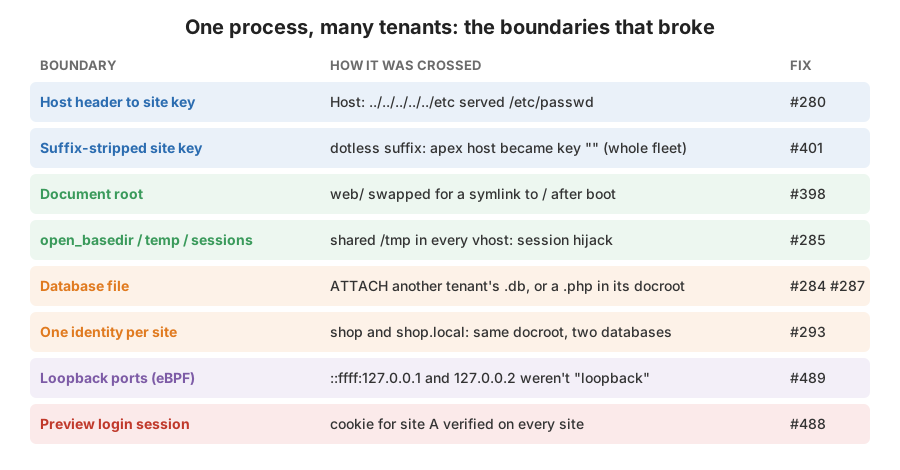
Table of tenant isolation boundaries in ePHPm, how each was crossed, and the PR that fixed it

ePHPm can serve a directory full of sites out of one process. Point sites_dir at a folder and every subdirectory is a virtual host. The Host header decides which one you get. That’s how the PR preview environment runs. Every pull request gets a subdomain, and the code behind it is whatever somebody pushed. One process holding many tenants means ePHPm enforces every per-tenant boundary itself, in-process. There’s no container wall between site A and site B unless you add one.

shipmates Short Ones: 8 Minutes Extracting Go, and Three Voice-Loop Bugs

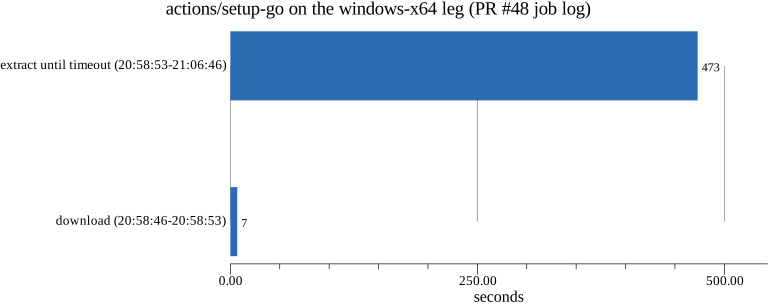
Four small stories from shipmates, starting with setup-go stuck extracting on Windows CI and Cloudflare's 100 second timeout. The other two are a voice loop that transcribed itself and events lost to a timestamp watermark.

5-Minute Read

setup-go on Windows CI: 7 seconds to download, 473 seconds extracting before the timeout

A few shipmates bugs don’t need a whole post each. They were too good to leave in commit messages, though.

Making ephpm php Byte-for-Byte Indistinguishable From php-cli

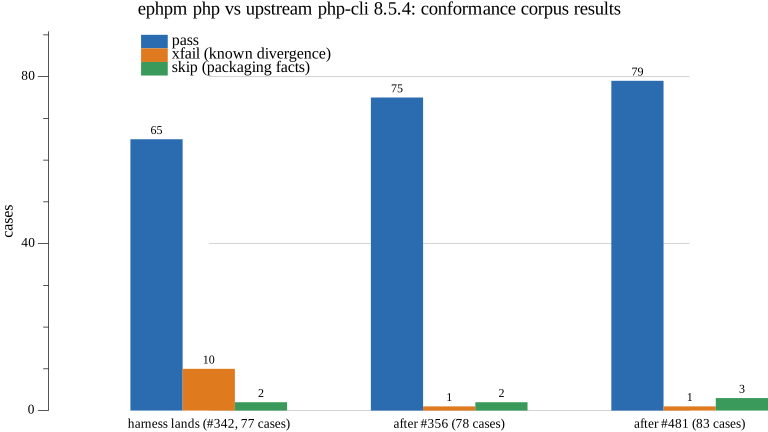
A differential test harness against upstream php, and the bugs it found in an embedded PHP CLI on day one.

9-Minute Read

Bar chart of conformance corpus results: 65 pass and 10 xfail when the harness landed, 79 pass and 1 xfail after the fixes

ePHPm embeds PHP into a single Rust binary. The obvious follow-up question from anybody deploying it is “do I still need a php on the box?” Composer, WP-CLI, artisan, PHPUnit and every build script in the world call php. If ephpm php can stand in for it then the answer is no. The single binary really means a single binary. “Mostly works” isn’t good enough for that though. These tools parse PHP’s output, check its exit codes and re-invoke it. So the goal was…

Recent Posts

Categories

About

Luther is a 20+ year software veteran specializing in backend APIs and architecting products. Founding engineer at Gas City building open-source AI software factories on Beads, the durable work graph for coding agents.