
ePHPm Odds and Ends: OOM-Killed Links, Opcode Scanning, WebSockets and a 44 ms Stall
Four smaller ePHPm stories that didn't need a post each but were too useful to leave in PR descriptions.
Not every fix in ePHPm earns a full write-up. A few of the smaller ones have stuck with me because the lesson in each was bigger than the diff. Here are four from this summer.
A release build the OOM killer kept eating
ePHPm statically links libphp, ICU and a pile of other C libraries into one Rust binary. It ships for four targets.
For the v0.4.2 performance release I set the release profile to lto = "fat" with codegen-units = 1
(#171). Fat LTO pulls every crate’s LLVM IR into one module in one process
and optimizes it as a unit. One codegen unit removes the parallelism that would otherwise spread that memory out.
That’s one very large process at the final link.
The linux-aarch64 legs died first. rustc was killed with (signal: 9, SIGKILL) during the link on three consecutive
matrix runs. That included one where the leg had the host to itself. The fix ladder:
- Thin LTO for arm64 (#181). Enough for about ten days.
- LTO off for arm64 and Windows (#198) once the Turso engine landed and grew the IR past what thin LTO fit into. The git history made the tipping point obvious. Windows built fine on fat LTO through v0.5.0 and started OOMing in v0.5.1, the first release with Turso linked in.
RUST_MIN_STACK=32MiBon Windows (#199). With LTO off, the Windows build got far enough to hit a different wall.sqlparser’s deeply recursive AST types overflowed rustc’s default thread stack (STATUS_STACK_OVERFLOW). Only on MSVC. arm64 compiled it fine.- The same fix for nightly (#203), which had failed arm64 for eight straight runs. In most of those the OOM killer took the runner agent too. So GitHub reported “the self-hosted runner lost communication with the server” instead of a build error. Same failure, different hat. That’s exactly why it had been read as flaky infrastructure.
One detail from #203 I’ll repeat to anybody who touches a workflow file. The value is quoted, "off". Bare off in
YAML is boolean false, and Cargo’s lto = false means thin-local, not off.
Every one of those PRs said codegen-units = 1 was a contributing factor, and nobody had measured it. So instead of
changing release CI on reasoning, #249 added an opt-in workflow_dispatch
probe. It builds the same commit with lto and codegen_units as inputs and records two numbers:
- Total peak memory, which is what the OOM killer acts on.
- The largest single process, which is what
rustc-LLVM ERROR: out of memoryis about.
The first successful Windows run was LTO off with one codegen unit. It peaked at 5.58 GiB total and 2.66 GiB for rustc
alone, with a 1001-second build on a 10 GiB host. That’s the baseline any change to codegen-units now has to beat.
Using the embedded Zend compiler as a static analyzer
ephpm analyze (#502) is a fail-closed gate you run before deploying PHP.
It has an analyzer framework, a policy engine and SARIF output. Some analyzers shell out to existing tools (composer
audit, semgrep, YARA). Any analyzer error, timeout or panic floors the verdict at quarantine. A run where something
that should have spoken didn’t can never be an “allow”.
The interesting one is opcode-scan (#509). PHPStan, Psalm and semgrep all
re-implement PHP parsing. ePHPm already has PHP’s actual compiler linked in. So opcode-scan compiles each file with
zend_compile_file under ZEND_COMPILE_WITHOUT_EXECUTION, the opcache_compile_file() model. Then it walks the opcode
stream for dangerous calls. Nothing executes. It looks for two things:
ZEND_INCLUDE_OR_EVALwithZEND_EVAL.- Statically named calls through the
INIT_FCALLfamily tosystem,exec,shell_exec,passthru,proc_open,popen,create_function,assertandunserialize.
It checks every op_array. That means functions, methods, closures, arrow functions and conditional declarations.
Asking the compiler beats a text scan in both directions. Opcodes have no comments and no strings-as-code, so system
in a docblock produces nothing. And the compiler lowers things a text scan can’t see. Backticks arrive as a genuine
shell_exec call. So findings are reported as confirmed rather than suspected. Some boring details matter for a
scanner that runs inside a server process:
- The whole compile-and-walk runs inside
zend_try/zend_catchso a fatal never longjmps into Rust. - A file that doesn’t compile is a gating error. Code that can’t compile can’t be vouched for.
- Class and function table registrations get pruned after each file, so two files declaring the same symbol both scan.
My favorite footnote is in #502’s review notes. The test fixtures assemble webshell-shaped strings at runtime. Windows
Defender had quarantined earlier fixture source files as Backdoor:PHP/*. If your security scanner’s tests don’t trip
the antivirus at least once, are they even testing anything?
WebSockets where PHP never holds the socket
#304 added native WebSockets, but not the Swoole or ReactPHP way. Rust owns
the socket and PHP runs once per event. That’s the API Gateway ($connect/$disconnect/message) shape. An idle
connection costs a registry entry and some reactor memory, not a PHP process. So ten thousand idle connections cost no
PHP at all. You do have to raise max_connections_per_site first. It defaults to 1,000 and counts a single-site server
as one site. Every event goes through the same handle_php path as an HTTP request. The per-site database, KV
keyspace, open_basedir sandbox and crash guard all apply without a parallel implementation to keep in sync.
One script, websocket.php at the vhost’s document root, routes on $_SERVER['WS_EVENT']:
<?php
$event = $_SERVER['WS_EVENT'];
$conn  = $_SERVER['WS_CONNECTION_ID'];

switch ($event) {
    case 'connect':
        // a non-2xx response refuses the upgrade, verbatim
        if (verify_token($_GET['token'] ?? '') === null) {
            http_response_code(401);
            return;
        }
        ephpm_ws_subscribe('lobby');
        http_response_code(200);
        return;

    case 'message':
        $payload = json_decode(file_get_contents('php://input'), true);
        ephpm_ws_broadcast('lobby', json_encode(['text' => $payload['text'] ?? '']));
        return;
}
The connect event runs on the real upgrade request, before the handshake completes. So it sees the cookies and query
string that auth needs, and it can refuse with a real 401. There are two decisions I’d copy elsewhere. First, the
implicit ephpm_ws_send() called from an ordinary HTTP request throws rather than returning false. A push API that
silently succeeds is the worst possible failure mode. Second, every bound is a bound. Each connection has a fixed
outbound queue, and on overflow the socket closes with 1013 instead of buffering. One slow reader costs one connection,
never the server’s memory.
The 44 ms stall, and the fix that got reverted
The single most productive class of performance bug in ePHPm has been TCP_NODELAY on small-response paths. The worst
case was the MySQL wire frontend in litewire. PHP talks to the in-process SQLite
over pdo_mysql. Single-row INSERTs took about a millisecond and SELECTs were pinned at a fixed ~44 ms. That asymmetry
is the fingerprint of Nagle plus delayed ACK. A one-packet response (INSERT OK) can’t trigger it, but a multi-packet
result set can. A fixed timer value is a timer, not a slow query.
The non-obvious part is that setting TCP_NODELAY on the server side alone did not fix it. The mysqlnd client’s side
of the exchange mattered too. The real fix was coalescing the whole result set into a single write. Here’s the lab’s
v0.4.1 retest, with ten sequential PDO queries per request:
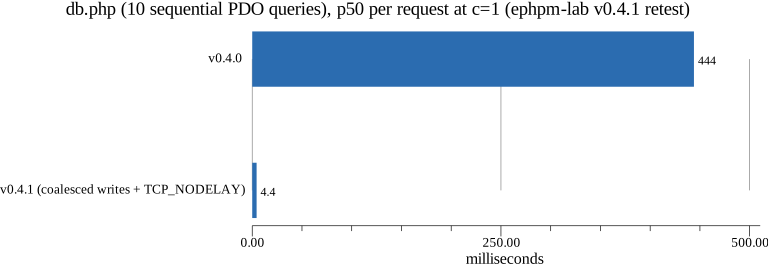
That’s 444.0 ms p50 down to 4.4 ms at c=1, and 35 to 106 requests per second at c=16. The same audit found the main HTTP listener didn’t set nodelay either, on the assumption that hyper does it. It doesn’t.
This next part changed how I release things. A rebase conflict during a stacked-PR merge silently dropped the litewire
set_nodelay lines. The commit was in history, but its changes had been overwritten by a --theirs resolution. CI was
green. The DB benchmark on the release candidate still showed the full 44 ms stall. That’s the only reason it didn’t
ship as a headline that was false on the flagship path. “The code merged and CI is green” isn’t the same claim as “the
fix is in the binary”. Measure the release candidate.




