
os/exec's StdoutPipe Footgun: How cmd.Wait() Ate My Last Frame (Twice)
Calling Wait while a StdoutPipe reader is still draining throws away the child's last output. I shipped this bug twice in shipmates.
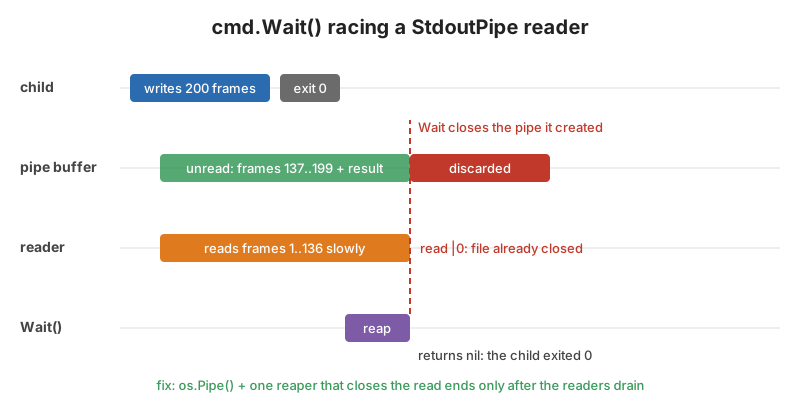
shipmates spends most of its life spawning claude (and
codex) processes and reading newline-delimited JSON off their stdout. The last frame of a turn is the important one.
It’s a result frame with the cost, the model and the final text. Stderr matters too, because that’s where Claude Code
tells you Invalid API key · Please run /login. For a while I was throwing both away under load. The cause is
documented right there in the os/exec godoc. I fixed it in one package and then found the exact same bug again a
month later in another.
The symptoms
It started as a flaky test. TestSpawnCapturesChildStderr failed on the linux-arm64 CI leg with a terminal event
that had no stderr in it, just exited exit status 1. It passed 20 times in a row locally. The issue I
filed blamed a 2 second drain grace:
if ok && p.stderrDone != nil {
    select {
    case <-p.stderrDone:
    case <-time.After(stderrDrainGrace): // = 2 * time.Second
    }
}
The theory was that on a loaded runner the stderr reader didn’t finish inside 2 seconds. So the terminal event went out with an empty tail. That’s plausible, and it’s wrong. Raising the timeout would have made the flake rarer and fixed nothing.
There was a second symptom that looked unrelated. Every so often the stdout scanner died with
read |0: file already closed, which the read loop reported as a framing failure. That meant the terminal event got
published as a string instead of the Terminal struct consumers expected. Anything type-switching on the payload
quietly took a different branch. A third test in the codex adapter reported unexpected_eof for a frame the child had
definitely written.
Same race, three different losers.
What the docs actually say
Both packages read the child with cmd.StdoutPipe() and cmd.StderrPipe(). The supervisor called cmd.Wait() on its
own goroutine, concurrently with the readers. Here’s the StdoutPipe doc:
Wait will close the pipe after seeing the command exit, so most callers need not close it themselves. It is thus incorrect to call Wait before all reads from the pipe have completed.
os/exec owns the parent’s end of any pipe it creates for you. Wait closes it the moment the child is reaped.
Whatever the kernel still had buffered in that pipe goes with it. The child’s last words weren’t late. They were gone.
io.Copy had already returned with os.ErrClosed before the drain grace was even consulted. That’s why a longer
timeout couldn’t help. stderrDone was closing early, with nothing in it.
It’s very easy to write. You start the process and kick off a goroutine per pipe. Somebody has to call Wait
eventually so you don’t leak a zombie. If that somebody isn’t sequenced after the readers, you have this bug.
A reproducer you can run
I wanted to see it fail on demand, not once a week on an arm64 runner. The child writes 200 JSON lines with a result
frame last and exits immediately. The parent reads slowly, at 1 ms per frame, standing in for real work. It calls
Wait concurrently, the same shape shipmates had.
// go run . stdoutpipe   # the footgun
// go run . ospipe       # own the pipe, drain, then Wait
package main

import (
	"bufio"
	"fmt"
	"os"
	"os/exec"
	"time"
)

const frames = 200

func child() {
	w := bufio.NewWriter(os.Stdout)
	for i := 0; i < frames-1; i++ {
		fmt.Fprintf(w, `{"type":"assistant","seq":%d}`+"\n", i)
	}
	fmt.Fprintln(w, `{"type":"result","cost_usd":0.42}`)
	w.Flush()
	os.Exit(0) // everything is sitting in the pipe buffer now
}

func consume(sc *bufio.Scanner) (n int, sawResult bool, err error) {
	for sc.Scan() {
		time.Sleep(time.Millisecond) // a consumer that does real work per frame
		n++
		if sc.Text() == `{"type":"result","cost_usd":0.42}` {
			sawResult = true
		}
	}
	return n, sawResult, sc.Err()
}

func main() {
	if len(os.Args) > 1 && os.Args[1] == "child" {
		child()
	}
	mode := "stdoutpipe"
	if len(os.Args) > 1 {
		mode = os.Args[1]
	}
	cmd := exec.Command(os.Args[0], "child")

	type result struct {
		n   int
		ok  bool
		err error
	}
	done := make(chan result, 1)

	switch mode {
	case "stdoutpipe":
		out, _ := cmd.StdoutPipe()
		if err := cmd.Start(); err != nil {
			panic(err)
		}
		go func() {
			n, ok, err := consume(bufio.NewScanner(out))
			done <- result{n, ok, err}
		}()
		werr := cmd.Wait() // concurrent with the reader: documented as incorrect
		r := <-done
		fmt.Printf("%-10s wait=%v frames=%d/%d result=%v scanErr=%v\n", mode, werr, r.n, frames, r.ok, r.err)

	case "ospipe":
		pr, pw, _ := os.Pipe()
		cmd.Stdout = pw // an *os.File goes straight to the child; os/exec never closes our end
		if err := cmd.Start(); err != nil {
			panic(err)
		}
		pw.Close() // the child has its own copy; ours must go or we never see EOF
		go func() {
			n, ok, err := consume(bufio.NewScanner(pr))
			done <- result{n, ok, err}
		}()
		werr := cmd.Wait() // reaping no longer touches the read end
		r := <-done        // the reader ends at a clean EOF
		pr.Close()         // closed by us, after the drain
		fmt.Printf("%-10s wait=%v frames=%d/%d result=%v scanErr=%v\n", mode, werr, r.n, frames, r.ok, r.err)
	}
}
On Linux (WSL2, kernel 6.18, built with Go 1.26.5):
stdoutpipe wait=<nil> frames=136/200 result=false scanErr=read |0: file already closed
stdoutpipe wait=<nil> frames=136/200 result=false scanErr=read |0: file already closed
stdoutpipe wait=<nil> frames=136/200 result=false scanErr=read |0: file already closed
ospipe     wait=<nil> frames=200/200 result=true scanErr=<nil>
ospipe     wait=<nil> frames=200/200 result=true scanErr=<nil>
ospipe     wait=<nil> frames=200/200 result=true scanErr=<nil>
The reader gets whatever the scanner had already pulled into its buffer before Wait closed the pipe. Then it gets
file already closed. The result frame, the one with the cost in it, never arrives. Note that Wait returns nil
because the child exited 0. Nothing at the process level tells you anything went wrong.
One thing surprised me. The PR that fixed this in shipmates says the flakes were Linux-only. The reasoning was that on
Windows internal/poll defers CloseHandle until a blocked read returns. That holds when the reader is parked inside
Read at the moment of the close. In this reproducer the reader is sleeping between frames. There’s no read in flight
to protect it, and Windows 11 with Go 1.26.5 loses the same frames:
stdoutpipe wait=<nil> frames=136/200 result=false scanErr=read |0: file already closed
ospipe     wait=<nil> frames=200/200 result=true scanErr=<nil>
So don’t count on the platform to save you. A reader that does any work between reads is exposed everywhere.
The fix: own the pipes, one reaper closes them
The fix in PR #44 is the ospipe branch above, grown up. Create
the pipes with os.Pipe() and wire the write ends onto cmd.Stdout and cmd.Stderr. When you hand os/exec an
*os.File, it passes it straight to the child and never tracks it. So Wait can’t close it. Close your copies of the
write ends right after Start. The read ends hit a clean EOF once every writer is gone.
From internal/runtime/claude/claude.go:
stdoutR, stdoutW, err := os.Pipe()
if err != nil {
	return nil, err
}
stderrR, stderrW, err := os.Pipe()
if err != nil {
	closeFiles(stdoutR, stdoutW)
	return nil, err
}
cmd.Stdout = stdoutW
cmd.Stderr = stderrW
handle, err := r.supervise.Start(cmd)
if err != nil {
	closeFiles(stdoutR, stdoutW, stderrR, stderrW)
	return nil, err
}
// The child holds its own duplicates of the write ends now; ours have to go
// or the read ends would never reach EOF.
closeFiles(stdoutW, stderrW)
Then exactly one goroutine is allowed to close the read ends, and only after both readers say they’re done:
func (r *Runtime) reapPipes(p *proc) {
	select {
	case <-p.termDone:
		// The process is gone. Anything still holding a write end is a
		// descendant that inherited it, not the child, so bound the wait.
		t := time.NewTimer(readerDrainGrace)
		defer t.Stop()
		waitClosed(p.stdoutDone, t.C, r.stopFan)
		waitClosed(p.stderrDone, t.C, r.stopFan)
	case <-r.stopFan:
		// Explicit shutdown: Close must not sit through a drain window.
	}
	p.closePipes()
}
There’s a cost, and it’s the reason StderrPipe gets picked in the first place. With your own pipe, EOF needs every
writer gone. A grandchild that inherited the child’s stdout can hold it open long after the child is dead.
readerDrainGrace is 10 seconds and exists only for that case. In the normal path the child has been reaped and the
pipe is already at EOF. Draining takes microseconds. If the backstop does fire, the terminal event now says “stderr not
collected” instead of implying the child said nothing. Those used to be spelled the same way.
Two smaller pieces finished it off:
- A scan error that is
os.ErrClosedorio.ErrClosedPipeis classified as EOF, not a malformed stream. A genuinely broken stream still shows up asbufio.ErrTooLongor a real I/O error. - The read loop waits on
stderrDoneunconditionally once the terminal event arrives. The leftover timeout is a deadlock guard, not a budget.
Each symptom got a test with the timing forced instead of hoped for.
TestReadLoopWaitsForTheStderrDrainBeforePublishing holds the stderr reader past the old 2 s bound.
TestReapDoesNotDiscardFramesTheChildAlreadyWrote puts the frame in the pipe and completes the reap. Only then does it
start the read loop. Both fail on the old code.
Twice
That was mid-August and went out in v0.5.0. Then a cross-platform sweep after v0.6.0 turned up
PR #60. The server’s own spawn path for live crew members,
spawnCrewLive, still used StdoutPipe/StderrPipe with a concurrent Wait. Same bug, different file. On the resume
path a claude -p that exited would lose its final result frame and the tail of its stderr.
It had a second bug riding along. Wait was only called on the resume path. Every fresh spawn was never reaped. That’s
a zombie per mate on Unix and a leaked process handle on Windows, piling up for the life of a long-running ship. The fix
mirrors reapPipes. A single reapLive goroutine is the only caller of cmd.Wait() and the only closer of the read
ends. It starts unconditionally so both paths get reaped.
// The single reaper: the ONLY caller of cmd.Wait() and the ONLY closer of
// the pipe read ends. Started here so it runs on BOTH the fresh and resume
// paths.
go s.reapLive(lp)
The test for that one uses a fake claude (via TestMain) that writes a terminal result frame and exits
immediately. It asserts the frame arrives on both paths and that the fresh child gets reaped.
What I took away from it
- If you call
Waitfrom anywhere other than “after every reader returned”, don’t useStdoutPipe/StderrPipe. Useos.Pipeorcmd.Stdout = someWriterand letos/execdo the copying. - One goroutine owns
Waitand one goroutine owns closing the read ends. Ideally the same one. - A timeout around a drain is a deadlock guard. If it’s the thing that decides whether you have the data, you have a race, not a slow reader.
- When you fix a bug class, grep for the rest of it. I fixed
internal/runtime/claudeandinternal/codexapp. I didn’t look atinternal/server, which had been doing the same thing the whole time.
How I measured
I built the reproducer above with Go 1.26.5 on Windows 11 Pro (AMD Ryzen 9 5950X, 128 GB). I also cross-compiled it for Linux and ran it under WSL2 (kernel 6.18.33.2-microsoft-standard-WSL2). That was three runs of each mode on Linux and one of each on Windows. Every run produced the same numbers shown above.
Links
- shipmates issue #41 and PR #44 (the first fix)
- shipmates PR #60 (the twin in
spawnCrewLive) os/execCmd.StdoutPipe docs




