
Fourth Place in Worker Mode, and Why It Wasn't PHP
ePHPm placed fourth in worker mode on the Yii3 benchmark. The slow part was the Rust layer, not PHP, and three fixes cut most of the gap.
We added ePHPm to the Yii3 runtime benchmark. It runs the same Yii3 API app on a bunch of PHP runtimes and compares them. Our fork with the ePHPm runner is ephpm/app-api.
Most of the results were good. ePHPm came first in classic mode and first on the database endpoint in both modes. Classic mode is the PHP-FPM style, where every request starts fresh.
Worker mode was the surprise. In worker mode the app boots once and stays in memory, like Octane or FrankenPHP’s worker mode. We came fourth of ten at about 50.7k requests a second. Workerman (~65k) and Swoole (~62k) were ahead.
First I checked that the numbers were worth trusting. Our ranking of the other runtimes closely matched the suite maintainer’s published results. Repeat runs were within 1.5% of each other. So the gap was real.
None of this is released yet. The fixes are merged and will ship in the upcoming v0.12.0 release.
It wasn’t PHP
My first guess was PHP itself. It wasn’t. Per request, ePHPm’s PHP threads did almost exactly as much work as Workerman’s. The difference was that ePHPm’s PHP threads spent a lot of time waiting. Under full load they were only busy about 70% of the time.
If PHP is waiting while requests pile up, the problem is in ePHPm’s Rust code. That means the HTTP server and the step that hands each request to a PHP thread. The thread pool post explains why ePHPm runs PHP on its own threads.
The fixes
A batch of small fixes (#575). Profiling pointed straight at a few things. Simple GET requests were handled as if they might have an upload attached. That cost an extra round trip for nothing. Finding the file for each request checked the disk more often than it needed to. And idle PHP threads went to sleep the instant they ran out of work. The next request was usually a fraction of a millisecond away.
The same runs also turned up a leak. Since PHP 8.4, persistent connections weren’t cleaned up when a worker thread was replaced. A long-running server slowly piled up open connections to its cache. After about 10 million requests there were 979 of them. That’s fixed too.
One queue per PHP thread (#578). This is the big one. Every request used to go into one shared line, and all 20 PHP threads pulled from it. Under load they spent real time getting in each other’s way. Now a request goes straight to a free thread. It only waits in line when every thread is busy, and it’s still served in order.

A different memory allocator (#577). Worker mode used around 300 MiB. That looked high. Most of it was memory the standard Linux allocator holds on to after worker threads are replaced. ePHPm’s Rust code already used mimalloc, a faster allocator. Now PHP and its extensions use it too. This is on for Linux only. macOS and Windows stay as they were.
Results
Every runtime ran the same app on the same machine under the same load. Each number is the average of three runs.
| Version | Requests/sec | Slowest 1% of requests | Peak memory |
|---|---|---|---|
| Before | 50,855 | 1,586 ms* | 307 MiB |
| Small fixes (#575) | 56,629 | 30.5 ms | 305 MiB |
| + one queue per thread (#578) | 59,064 | 15.9 ms | 308 MiB |
| + #578 and mimalloc (#577) | 58,122 | 14.2 ms | 170 MiB |
| Swoole | 61,580 | 35.5 ms | 838 MiB |
| Workerman | 64,521 | 198.7 ms | not measured the same way |
* Before the fixes, ePHPm was already past its limit at this load. Requests kept piling up.
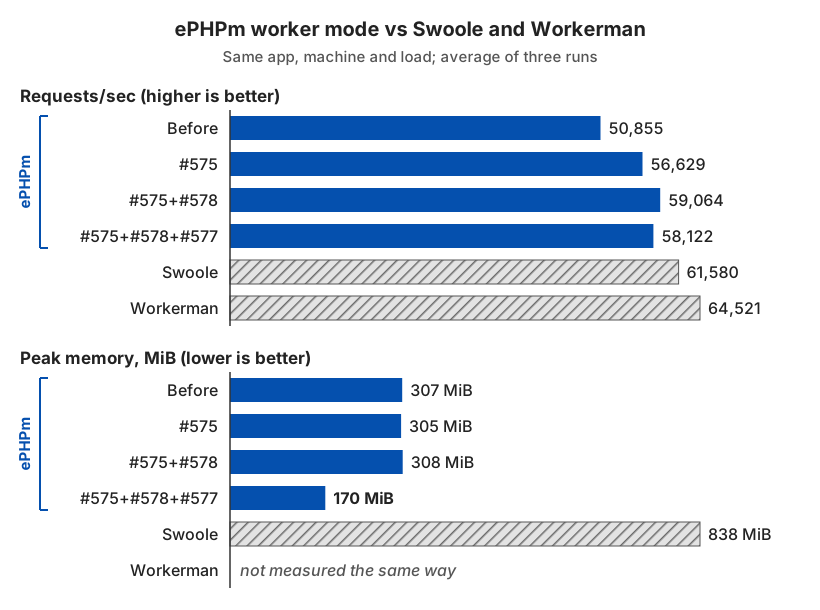
In short:
- About 15% faster than before. The slowest requests are answered far sooner.
- About 45% less memory. That’s roughly one fifth of what Swoole uses.
- No errors from ePHPm at any load we tried, up to 200k requests a second. Workerman dropped requests to reach its numbers. It had 9,427 errors in the main test.
- The database endpoint and classic mode didn’t get faster, because other limits apply there. Classic mode does use less memory.
The queue change alone is about 1% faster than the queue plus mimalloc. I’d rather give back that 1% for half the memory. The plan is to ship both.
Why Workerman is still faster
Workerman is written in PHP. It reads and handles each request in the same process that runs the app. Nothing is handed over between threads.
That’s a different trade-off, not cheating. ePHPm puts a Rust HTTP server in front of PHP. That server handles TLS, HTTP/2 and HTTP/3, static files, middleware and clustering. Handing each request from it to a PHP thread is the price of those features. This work makes that price smaller without dropping any of them. At a slightly lighter load of 60k requests a second, all three were within about 1% of each other.
What’s next
ePHPm is now 4–7% behind Swoole and 9–12% behind Workerman. PHP threads are busy about 80% of the time. What’s left is the cost of each request, not waiting.
Next up:
- Trim per-request overhead in the HTTP layer.
- Wake threads less often.
- Tune how many PHP threads to run.
- Rerun the comparison on PHP 8.5.11, now that #574 has landed.
Caveats
- One benchmark machine. Your absolute numbers will differ. The relative gains are the point.
- PHP versions. In this run ePHPm used PHP 8.5.7 and the others used 8.5.11. The upgrade (#574) has since been merged.
- Not released yet. #575, #577 and #578 are merged and will ship in the upcoming v0.12.0 release. The current v0.11.3 doesn’t have them.
Links
- Yii3-Benchmarks/app-api: the benchmark suite
- ephpm/app-api: our fork with the ePHPm runner
- #575: the small fixes and the connection leak
- #578: one queue per PHP thread
- #577: mimalloc for the whole process on Linux
- #574: PHP 8.5.11



