Luther Monson, Staff Software Engineer at SUSE

Luther Monson

Go by way of PHP · Containers · VMs · Windows · Kubernetes

Composer Without PHP: Embedding vivacity in ePHPm

I embedded vivacity, a pure-Rust Composer-compatible installer, in ePHPm so one binary can install a PHP app's dependencies without PHP. This is what it took upstream and in ePHPm, and how it does against Composer on Windows.

10-Minute Read

Bar chart comparing Composer 2.10.3 and ephpm composer on a Laravel install on native Windows

The pitch for ePHPm is one binary in place of php-fpm, nginx and Redis. There was always a hole in it though. To deploy a PHP app you still need to run composer install. That drags PHP and composer.phar back onto the box or into the container build, just for that one step. ephpm composer install now runs a pure-Rust, Composer-compatible installer called vivacity inside the ePHPm binary. One binary serves the app and installs its dependencies. On Windows that works with no PHP installed at all.…

A Lock Is Only as Good as Its Release

SETNX gets all the attention, but most of the bugs in ePHPm's KV locks were on the release side. This is how blind deletes, a missing compare-and-delete and a cluster where two nodes could both win got fixed.

9-Minute Read

Timeline: request A's lock expires, B acquires it, A's blind DEL frees B's lock and C gets in

Every “build a lock on Redis” tutorial spends its time on acquisition: SET key value NX PX 30000, one winner, done. The release gets one line, DEL key. That line is where most of the lock bugs I’ve had in ePHPm lived. Over about three months the same mistake showed up in three places. First the native session handler, then two of the Composer wrapper packages, and finally the cluster. Each time it wore a slightly different costume.

Step Debugging a Worker That Never Ends

A persistent PHP worker never finishes its request, so Xdebug never sees your trigger. Here's how ePHPm routes the debugged request to its own fresh worker instead of trying to reset anything.

12-Minute Read

Diagram of the ePHPm router sending untriggered requests to the warm worker pool and Xdebug-triggered requests to a one-request debug lane

Persistent workers are the big performance win in modern PHP. You boot Laravel or Symfony once, keep the container in memory, and serve thousands of requests out of the same process. ePHPm has had a worker mode for a while. Like most worker runtimes it had a quiet hole in it. You couldn’t step debug a request with Xdebug. I wanted that fixed without patching Xdebug and without giving up the warm pool. The answer ended up being to stop fighting the constraint and route around it. The debug…

WebSockets in ePHPm, From Zero to a Working Chat

How to run WebSockets in ePHPm with a single PHP file. It covers turning them on, sharing the login session, pushing messages from normal HTTP requests, serving over TLS and the limits to know about.

14-Minute Read

Diagram: browsers hold sockets to ePHPm's Rust session tasks and registry; each connect, message and disconnect runs websocket.php once on the PHP thread pool, and ordinary HTTP requests push through ephpm_ws_broadcast

I covered the design of ePHPm’s native WebSockets in a few paragraphs of the odds and ends post. Rust owns the socket and PHP runs once per event. An idle connection never costs you a PHP thread. That was the why. This post is the how. We’ll build a small chat app with login, per-user push notifications from ordinary HTTP requests and a browser client. Then we’ll serve it over TLS. Last come the limits, the sharp edges and how to debug it when the browser only tells you 1006.

An Upstream PHP JIT Use-After-Free, and Why Our Default Flipped Twice

ePHPm turned PHP's tracing JIT on by default, then off three days later when stock Laravel died after three requests. The bug was upstream, and this is the bisect, the root cause and where the fix landed.

10-Minute Read

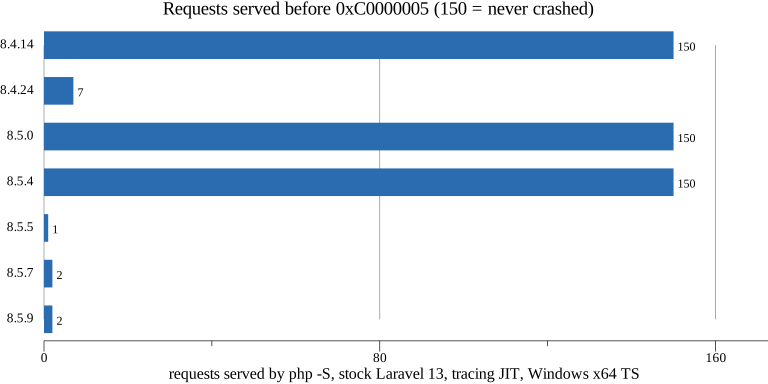
Bar chart of requests served before a crash per PHP version: 8.4.14, 8.5.0 and 8.5.4 never crash; 8.4.24 dies at 7, 8.5.5 at 1, 8.5.7 and 8.5.9 at 2

In August, ePHPm turned PHP’s tracing JIT on by default in single-site serve mode. Three days later it went back off on every platform, and it’s still off. The reason turned out to be a use-after-free in PHP’s tracing JIT that has nothing to do with ePHPm. Stock php -S with a stock Laravel skeleton dies on it in a couple of requests. The fix is now released upstream. So this seemed like the right time to write up how we got there, and what still has to happen before the default…

Calling Rust From PHP Without a Socket, Part 2: Making Existing Code Use It

Thirteen Composer packages let existing Redis and database code in WordPress, Laravel and Symfony use ePHPm's built-in versions. This post covers what's in them and the bugs they turned up.

8-Minute Read

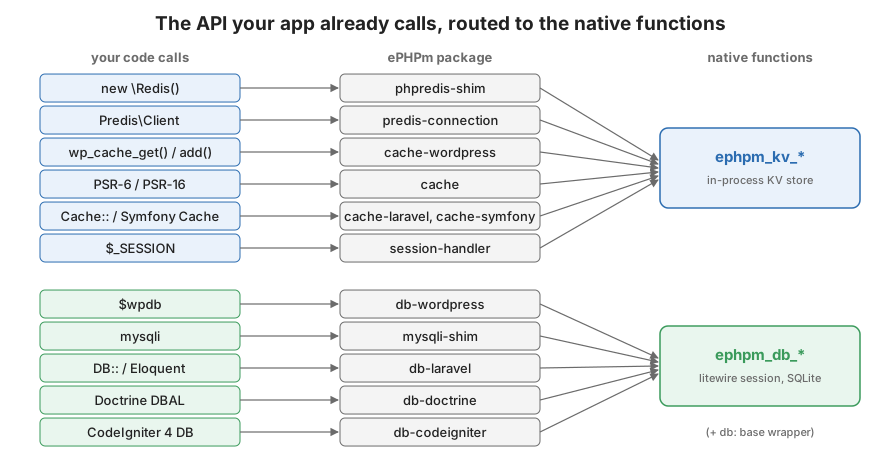
The APIs PHP apps already call, mapped through ePHPm wrapper packages onto ephpm_kv_* and ephpm_db_*

Part 1 covered the plumbing. ePHPm registers ephpm_kv_* and ephpm_db_* functions that call straight into Rust. A cache read through one costs about a tenth of a microsecond instead of a loopback round trip. That’s nice and also useless on its own. Nobody is going to rewrite their WordPress object cache or their Laravel cache store around a function called ephpm_kv_set(). Applications talk to existing APIs instead:

The Bugs Were Our Own Linker Wraps: Making a PHP Timeout Actually Time Out

max_execution_time did nothing in ePHPm because we had wrapped zend_set_timeout to a no-op. The SDK already had per-thread timers. We just had to stop switching them off.

8-Minute Read

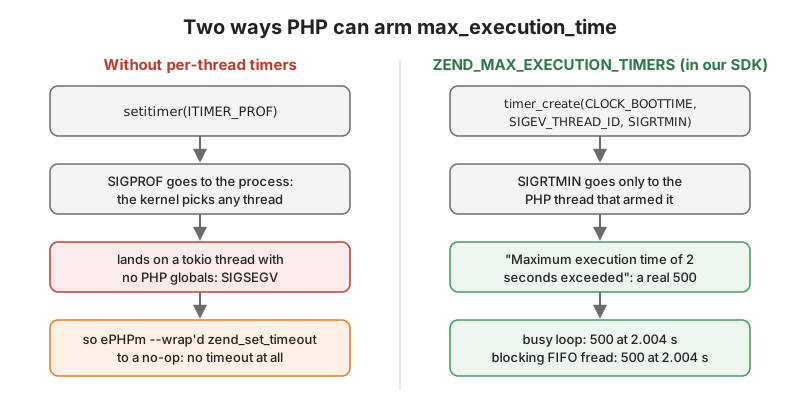
Side by side: a process-wide SIGPROF timer that can land on the wrong thread, versus a per-thread POSIX timer that delivers SIGRTMIN to the PHP thread that armed it

In the stack guard post the villain was a -Wl,--wrap linker flag that turned off PHP’s C-stack overflow guard. It wasn’t the only one. Until August, max_execution_time did nothing in ePHPm on Linux, for the same reason. We had wrapped the function that arms it to a no-op. A runaway script ran until the HTTP layer’s request timeout gave up on it and sent a 504. The PHP thread kept burning CPU after that.

Clustered SQLite in ePHPm, Part 3: CDC Over the Cluster Channel

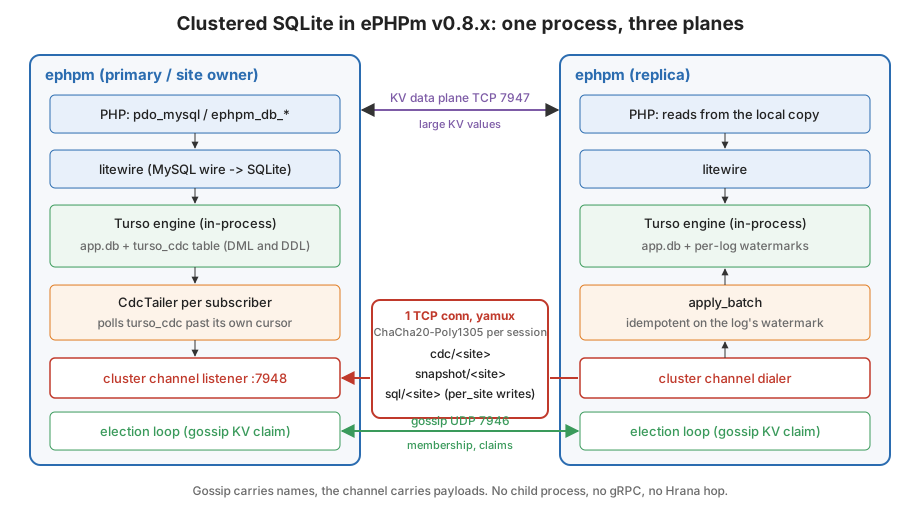
ePHPm ships Turso's change data capture stream between nodes over one authenticated, multiplexed TCP connection. This covers how that works and the two failover bugs that showed up when the e2e suite killed the primary.

15-Minute Read

Two ePHPm nodes connected by gossip on UDP 7946, the KV data plane on TCP 7947 and the cluster channel on TCP 7948 carrying cdc, snapshot and sql streams

By the end of Part 2 ePHPm v0.7.0 ran exactly one SQLite engine in process. That was Turso, for single-node and clustered mode alike. The sidecar was gone. What I skipped over is how a replica actually gets the primary’s writes, and what happens when the primary dies with data on it. That’s this post.

Recent Posts

Categories

About

Luther is a 20+ year software veteran specializing in backend APIs and architecting products. Employed at SUSE as the Team Lead for the Containers on Windows Team working on Rancher + Kubernetes