
Calling Rust From PHP Without a Socket, Part 1: The Native Functions
How ePHPm exposes its in-process KV store and SQLite bridge to PHP as plain functions, and what it took to make that safe under ZTS.
ePHPm is a single Rust binary that embeds PHP. It carries its own KV store and its own SQLite-backed database in the same process. For a long time PHP code could only reach that KV store the same way it reaches Redis. It opened a TCP socket to the RESP listener ePHPm runs on localhost, encoded a command and waited for the reply. That works, and every PHP Redis client in existence already speaks it. But it is a strange thing to do when the hash map you’re talking to lives a few pointers away in the same address space.
So ePHPm registers its own PHP functions: ephpm_kv_get(), ephpm_kv_set(), ephpm_db_query() and friends. Calling one
is a C function call that hops through a function pointer into Rust and back. This is part one of two. This post is the
plumbing:
- how the functions get registered
- how C and Rust share a table of function pointers
- who owns which bytes
- the thread-teardown bugs that came with it
Part 2 is the 13 Composer packages that let phpredis, Predis, WordPress and Laravel code use them without being rewritten.
Is it worth it?
Before writing a post about avoiding a socket I wanted my own numbers, not the ones in the docs. I took the
ephpm-lab KV harness and ran it against the v0.10.6 release. The harness is one PHP
request that loops over the operation and times it with hrtime(). I pointed the same raw-socket RESP client at two
servers. One was ePHPm’s own RESP listener and the other was a stock Redis 7 in a container.
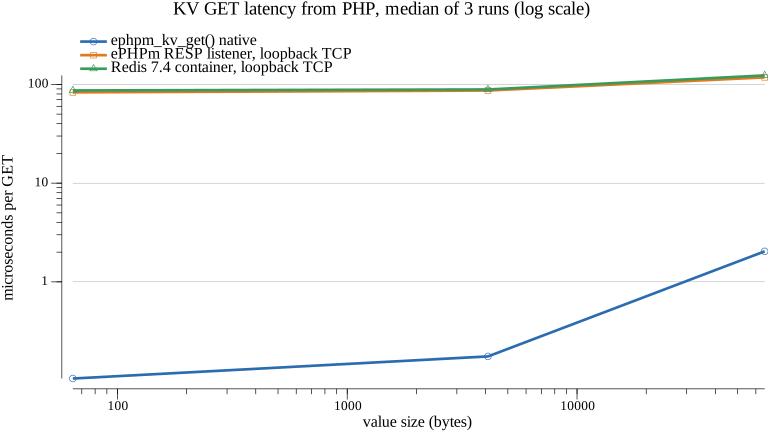
Medians of three interleaved runs:
| 64 B | 4 KB | 64 KB | |
|---|---|---|---|
ephpm_kv_get() |
0.105 µs | 0.176 µs | 2.04 µs |
ephpm_kv_set() |
0.165 µs | 0.210 µs | 1.19 µs |
| GET over RESP to ePHPm | 83.0 µs | 86.7 µs | 117.8 µs |
| GET over RESP to Redis 7.4 | 86.8 µs | 88.9 µs | 123.3 µs |
A small get through the native function is about 105 ns. The same get over a socket is about 83 µs. That’s roughly
790 times slower, and it barely matters which server is on the other end. Real Redis comes in within 5% of ePHPm’s own
listener. That’s the useful result. The cost isn’t the server, it’s the round trip.
I’d be careful with the absolute socket number. It’s high because this is WSL2, where a loopback round trip is
expensive. To check it wasn’t my PHP client, I ran redis-benchmark -c 1 inside the Redis container. That’s plain C
with no PHP involved, and it got a p50 of 79 µs. On bare-metal Linux loopback is a lot cheaper, so expect the gap to
shrink by some factor there. It doesn’t go away, though. A native call doesn’t have a round trip at all.
The other thing the table shows is that “no serialization” isn’t “no copy”. At 64 KB the native get is memcpy-bound at
about 2 µs. The value is copied out of the store and then copied again into a PHP string.
What PHP sees
Everything is registered from one macro in ephpm_wrapper.c. The server and the CLI mode, ephpm php, get the same
list:
#define EPHPM_COMMON_FUNCTION_ENTRIES \
    PHP_FE(ephpm_kv_get,       arginfo_ephpm_kv_get) \
    PHP_FE(ephpm_kv_set,       arginfo_ephpm_kv_set) \
    PHP_FE(ephpm_kv_setnx,     arginfo_ephpm_kv_setnx) \
    PHP_FE(ephpm_kv_del,       arginfo_ephpm_kv_del) \
    PHP_FE(ephpm_kv_del_if_eq, arginfo_ephpm_kv_del_if_eq) \
    /* ... exists, incr, decr, incr_by, expire, ttl, pttl, flush_all, wait */ \
    PHP_FE(ephpm_db_query,          arginfo_ephpm_db_query) \
    PHP_FE(ephpm_db_execute,        arginfo_ephpm_db_execute) \
    PHP_FE(ephpm_db_run,            arginfo_ephpm_db_run) \
    /* ... columns, in_transaction, available, errno, error */ \
    PHP_FE(ephpm_ws_send,           arginfo_ephpm_ws_send) \
    /* ... eight more ephpm_ws_* */ \
    PHP_FE(ephpm_middleware_config, arginfo_ephpm_middleware_config)
That’s 14 KV functions, 8 database functions, 9 WebSocket functions and the middleware config accessor. On top of those
there’s a small module with the \Ephpm\Worker\* functions for worker mode. There’s also a native session save handler
you turn on with session.save_handler = ephpm. Every one of them follows the same pattern, so I’ll stick to the KV and
DB side.
One function worth calling out is ephpm_kv_wait(). It blocks until a key’s version changes. You can’t do that over
RESP without pub/sub. It replaced a poll-and-usleep loop in the Datastar demo. In
#184 eight idle SSE clients went from 0.35% of a core to 0.02%. Event latency
went from a p50 of 100 ms, the poll interval, to 1.2 ms.
Getting the functions registered at all
This took three tries. The first two looked fine in the code and failed in the e2e suite.
The obvious move is to set additional_functions on the SAPI module struct before calling php_embed_init(). That does
nothing. php_embed_init() overwrites php_embed_module.additional_functions with its own one-entry array, just
dl(). That happens at sapi/embed/php_embed.c:219, after sapi_startup() and before module startup. Every request
died with “Call to undefined function ephpm_kv_get()”.
The second attempt (752890eb) called zend_register_functions() right after php_embed_init() returned. On a non-ZTS
build that’s fine. But ePHPm runs PHP threaded (ZTS). In ZTS, zend_post_startup() runs at the tail of
php_module_startup(). It copies the main thread’s CG(function_table) into a static GLOBAL_FUNCTION_TABLE and frees
the original. Every new PHP thread builds its function table by copying from GLOBAL_FUNCTION_TABLE in
compiler_globals_ctor. Register a function after that point and it lands in a table no worker thread will ever look
at.
The window that works is “after the embed SAPI wipes additional_functions, before php_module_startup() reads it”.
php_embed_init() rewrites additional_functions but leaves the startup hook alone. So the fix (a50a69ba) swaps the
startup hook for a shim:
static int ephpm_module_startup(sapi_module_struct *sm)
{
    sm->additional_functions = g_cli_mode ? ephpm_cli_functions : ephpm_kv_functions;

    /* worker module goes in as php_module_startup's additional_module so its
     * functions land in CG(function_table) DURING zend_startup */
    int ret = php_module_startup(sm, &ephpm_worker_module_entry);

    /* after: ext/session's MINIT has to have run. Before the embed init
     * returns: under ZTS that is the last moment new threads will see it */
    if (ret == SUCCESS) {
        (void)php_session_register_module(&ps_mod_ephpm);
    }
    return ret;
}

void ephpm_pre_init(void)
{
    php_embed_module.startup = ephpm_module_startup;
}
The same window turned out to be the right place for several later things. The CLI’s -d directives and PHP_BINARY
are spliced in there too. That says something about how much of the embed SAPI’s setup happens in that one call.
The ops table
The C side doesn’t know anything about Rust types. It declares a struct of function pointers and keeps one static copy:
typedef struct {
    int  (*get)(const char *key);
    void (*get_result)(const char **ptr, size_t *len);
    int  (*set)(const char *key, const char *val, size_t val_len, long long ttl_ms);
    int  (*set_nx)(const char *key, const char *val, size_t val_len, long long ttl_ms);
    long (*del)(const char *key);
    /* ... exists, incr_by, expire, pttl, flush_all, wait ... */
    /* Must stay LAST-appended: the layout mirrors kv_bridge.rs. */
    int  (*del_if_eq)(const char *key, const char *token, size_t token_len);
} EphpmKvOps;

static EphpmKvOps g_kv_ops = {0};

void ephpm_set_kv_ops(const EphpmKvOps *ops)
{
    if (ops) {
        g_kv_ops = *ops;
    }
}
Rust mirrors it field for field as a #[repr(C)] struct of Option<unsafe extern "C" fn(...)> and fills in a
static. An Option of a function pointer has the same layout as a nullable C pointer:
#[repr(C)]
pub struct EphpmKvOps {
    pub get: Option<unsafe extern "C" fn(key: *const c_char) -> c_int>,
    pub get_result: Option<unsafe extern "C" fn(ptr: *mut *const c_char, len: *mut usize)>,
    // ...
    pub del_if_eq: Option<unsafe extern "C" fn(key: *const c_char, token: *const c_char, token_len: usize) -> c_int>,
}

pub static KV_OPS: EphpmKvOps = EphpmKvOps {
    get: Some(kv_get),
    get_result: Some(kv_get_result),
    // ...
    del_if_eq: Some(kv_del_if_eq),
};

// at startup, before any PHP thread runs a script
unsafe { ffi::ephpm_set_kv_ops(&kv_bridge::KV_OPS) };
The table is copied into the C global once, before any PHP thread runs. It’s never written again. That’s the entire
thread-safety story. A struct that’s read-only after startup needs no lock, no atomics, nothing. Each PHP_FUNCTION
checks its pointer for NULL first. A build where the KV store isn’t wired returns a miss instead of crashing.
C and Rust each declare the layout by hand, so the rule is append-only. New operations go at the end. The last field
carries a “must stay LAST-appended” comment on both sides. wait was added after flush_all, and del_if_eq after
wait. The DB table has the same comment on available. It’s the same discipline as ePHPm’s native middleware ABI.
It’s boring on purpose.
No malloc crosses the boundary
This is the rule I care about most. Memory allocated by Rust is freed by Rust. Memory allocated by PHP is freed by PHP. Nothing crosses.
For a get, Rust copies the value into a thread-local buffer and returns 1. C then asks for a pointer and length into
that buffer and copies the bytes into a PHP string:
PHP_FUNCTION(ephpm_kv_get)
{
    char *key; size_t key_len;
    ZEND_PARSE_PARAMETERS_START(1, 1)
        Z_PARAM_STRING(key, key_len)
    ZEND_PARSE_PARAMETERS_END();

    if (!g_kv_ops.get) { RETURN_NULL(); }
    if (!g_kv_ops.get(key)) { RETURN_NULL(); }

    const char *ptr; size_t len;
    g_kv_ops.get_result(&ptr, &len);
    RETURN_STRINGL(ptr, len);
}
The borrowed pointer is valid until the next get on the same thread. PHP is single-threaded per request, so there is
no next get until this one returns. That’s one copy out of the store into the buffer and one copy into the zval. It’s
why a 64 KB value costs a couple of microseconds and a 64-byte value doesn’t.
The DB side stages more. A statement’s rows go in one thread-local. finish() releases them as soon as C has turned them
into zvals. The metadata goes in a separate “last call” record that survives finish(). That covers whether it returned
rows, the column names and declared types, affected rows and last insert id. Any error goes in that record too. That
split is what made #357 possible. ephpm_db_errno() still works after the
exception was caught. ephpm_db_columns() can describe a SELECT that matched zero rows.
Errors stay on the C side
Rust callbacks never call into Zend. That’s deliberate. A PHP fatal unwinds with longjmp. A longjmp through Rust
frames skips their destructors, which is undefined behavior. So errors come back as return codes and C decides what to
do with them. For the DB functions that means throwing an exception, which doesn’t longjmp:
int rc = g_db_ops.run(sql, sql_len);
if (rc == -2) {
    zend_throw_exception(zend_ce_exception, EPHPM_DB_UNAVAILABLE_MSG,
                         EPHPM_DB_ERR_UNAVAILABLE);
    return EPHPM_DB_THREW;
}
if (rc < 0) {
    g_db_ops.error_info(&code, &sqlstate, &msg, &msg_len);
    zend_throw_exception_ex(zend_ce_exception, (zend_long)code,
        "SQLSTATE[%.5s]: %.*s", sqlstate ? sqlstate : "HY000",
        (int)msg_len, msg ? msg : "");
    g_db_ops.finish();
    return EPHPM_DB_THREW;
}
SQL errors carry the MySQL server error code litewire mapped them to. That’s 1062 for a duplicate key and 1064 for a syntax error. Infrastructure failures use 2000 through 2004:
- no database configured
- no site context
- can’t connect
- unbindable parameter
- thread shutting down
Those sit in MySQL’s client-error range, which a server never sends. An adapter can tell “your SQL is wrong” from “the bridge isn’t there” by number instead of by matching message text.
Which keyspace?
ePHPm can serve many sites from one process, and each site gets its own KV store. The C side never sees that. Before PHP
runs, the router calls set_site_store() for the request. Every Rust callback resolves its store through a
thread-local:
fn effective_store() -> Option<Arc<Store>> {
    KV_SITE_STORE
        .try_with(|s| {
            let site = s.borrow();
            if let Some(ref store) = *site {
                Some(Arc::clone(store))
            } else {
                KV_STORE.get().cloned()
            }
        })
        .unwrap_or(None)
}
The DB bridge does the same with the site key. In per-site mode a query with no site context fails instead of falling back to a shared database.
This had a bug that’s worth knowing about if you build something similar. #208
found two separate MultiTenantStore instances. The router built one for the PHP path and the RESP listener built the
other. Each lazily created its own per-hostname Store. So in vhost mode ephpm_kv_set() from PHP and a Predis SET for
the same site landed in different keyspaces. Neither could see the other’s writes. Single-site mode was fine, which is
why it lived for a while. The fix is the obvious one: build it once and hand the same instance to both.
Thread teardown
The nastiest bugs in the bridge weren’t in calls. They were in thread exit.
The DB bridge keeps one litewire session per PHP thread, in a thread_local!. When tokio retired an idle blocking
thread, that thread-local’s destructor set off a chain of drops:
- it dropped the session
- the session dropped the Turso connection
- the connection dropped pager buffers
Buffer::droprecycles into Turso’s own thread-local buffer cache
TLS destructors run in reverse registration order. Turso’s cache was registered after ours, inside our first query. So it
was already gone. LocalKey::with on a destroyed thread-local panics. A panic in a TLS destructor aborts the process, and
every tenant on the box went down. #300 was found by an overload test where
3 of 10 flooded instances died this way. They died at different points: mid-flood, during the post-flood cooldown and at
SIGTERM.
There’s no try_with I can add to fix that. The panicking with is several frames down inside Turso. What I can do is
not run that drop on a dying thread. The session is parked in a process-wide “graveyard” instead. The next request on
any live thread drains and drops it. In steady state the graveyard is empty and the drain is a single relaxed atomic
load.
#269 is the mirror image. Thread exit runs php_request_shutdown(). That
runs register_shutdown_function() callbacks and destructors. Those can call ephpm_kv_* or ephpm_db_* after the
bridge’s own thread-locals are destroyed. Every access reachable from PHP now uses try_with and degrades. A KV call
reports a miss. A DB call returns -3 and C throws a distinctly worded exception. And it fails closed. When the per-site
slot is gone, effective_store() returns None, not the global store. Falling back to the global store would let one
tenant’s shutdown function write into another tenant’s keyspace.
The DB bridge
ephpm_db_* goes through the same litewire Session the MySQL wire frontend uses. The same MySQL-dialect translation,
SHOW/DESCRIBE emulation and transaction tracking apply. There’s one session per PHP thread per site. A thread that
moves to a different site gets a new session.
Session::query is async and PHP callbacks are synchronous. So the bridge pins the server’s tokio Handle and uses
block_on. That’s only legal because these callbacks always run on PHP OS threads, never inside an async task. If one
ever did, tokio would panic. That’s a much better failure than a deadlock.
Thread-scoped sessions have one obvious trap, and I fell into it. The session outlives the request. A script that ran
BEGIN and then fataled left the transaction open on that thread. So did one that just forgot to COMMIT. The next
unrelated request on the same thread silently joined it. Its writes could later be rolled back with someone else’s.
#258 added on_request_end(). It runs at request teardown in both execution
modes and rolls back whatever is still open, with a warning in the log.
A worked example: the session handler
The native session handler (17493149) shows the whole thing end to end. It’s written in C against the ops table
directly, with no PHP in between. Sessions live at session:<sid>. The TTL comes from session.gc_maxlifetime. GC is a
no-op because the store expires keys itself.
Two details took real debugging. session.lazy_write is on by default. With it on, PHP calls update_timestamp instead
of write when the data didn’t change. The handler refreshes the TTL with expire instead of rewriting the blob. And
open has to set *mod_data to something non-NULL:
static int ephpm_session_mod_data_marker = 0;

PS_OPEN_FUNC(ephpm)
{
    (void)save_path;
    (void)session_name;
    *mod_data = (void *)&ephpm_session_mod_data_marker;
    return SUCCESS;
}
ext/session only calls a handler’s write and close when PS(mod_data) is set. A native handler that keeps no state
and leaves it NULL never gets written. There’s no error. You get a warning that it failed to write session data, and
nothing persisted. The marker is never dereferenced. It just has to exist.
Known limitations
Keys cross the boundary as C strings. PHP_FUNCTION parses the key with Z_PARAM_STRING, which gives a pointer and a
length. But only the pointer goes through the ops table. Rust reads it with CStr::from_ptr and then requires valid
UTF-8:
let key_str = unsafe { CStr::from_ptr(key) };
let Ok(key_str) = key_str.to_str() else {
    return 0;
};
So a key with an embedded NUL byte ("a\0b") addresses the key "a". A key that isn’t valid UTF-8 comes back as a
miss or a failed write with no error. Values are binary-safe, since they go through as pointer and length. Real
application keys are almost always ASCII. But if you hash something into a raw binary key, hex it first.
How I measured
- Hardware: AMD Ryzen 9 5950X, WSL2 on Windows 11 (kernel 6.18.33.2-microsoft-standard-WSL2, 32 vCPU, 62 GiB).
- ePHPm: the published v0.10.6 release,
ephpm-v0.10.6+php8.5.7-linux-x86_64. It ran as a bare process inper_requestmode, with[kv.redis_compat]listening on127.0.0.1and no AUTH or compression. - Redis:
redis:7-alpine(7.4.11) under Podman with--network host, persistence off. - Harness: the
kv/fixtures/kv_sapi.phpandkv_resp.phpscripts from ephpm/lab. The native lane is 200,000 ops per loop, timed withhrtime()inside a single request. It’s a bare-loop number with no request dispatch in it. The socket lanes are 20,000 strict ping-pong round trips over one raw PHP stream socket withtcp_nodelay. The same fixture is pointed at each port. Client libraries like Predis add their own overhead on top. - Each fixture checks the value it read back. A loop that got optimized into nothing would fail instead of looking fast. Three reps, lanes interleaved, median reported.
What’s next
The functions are only half of it. Nobody wants to rewrite their WordPress object cache or their Laravel cache store
around ephpm_kv_set(). Part 2 covers the wrapper
packages. They make existing phpredis, Predis, WP_Object_Cache and wpdb code use the native path unmodified. It
also covers the semantics bugs that showed up once real applications ran on them.
Links
- ephpm/ephpm,
crates/ephpm-php/ephpm_wrapper.c,kv_bridge.rsanddb_bridge.rs - #184 ephpm_kv_wait()
- #208 the vhost keyspace split
- #258 rollback at request end
- #300 SIGABRT on thread retirement and #269 try_with at teardown
- #357 bridge API for adapters
- ephpm/lab kv-micro harness




