
Every Way a Tenant Escaped: A Cross-Tenant Breakout Field Guide
Eight ways one site broke out of its sandbox on a multi-tenant PHP server, all found by attacking it on purpose, all fixed.
ePHPm can serve a directory full of sites out of one process. Point sites_dir at
a folder and every subdirectory is a virtual host. The Host header decides which one you get. That’s how the PR preview
environment runs. Every pull request gets a subdomain, and the code behind it is whatever somebody pushed. One process
holding many tenants means ePHPm enforces every per-tenant boundary itself, in-process. There’s no container wall
between site A and site B unless you add one.
So I spent a couple of weeks attacking it. Every item below was found by deliberately trying to break out. Each one was reproduced against a real PHP-linked binary, and each one is fixed. I’m writing them up together because they’re a better checklist than any I could have written from scratch. They also cluster into a handful of patterns that apply to any multi-tenant runtime.
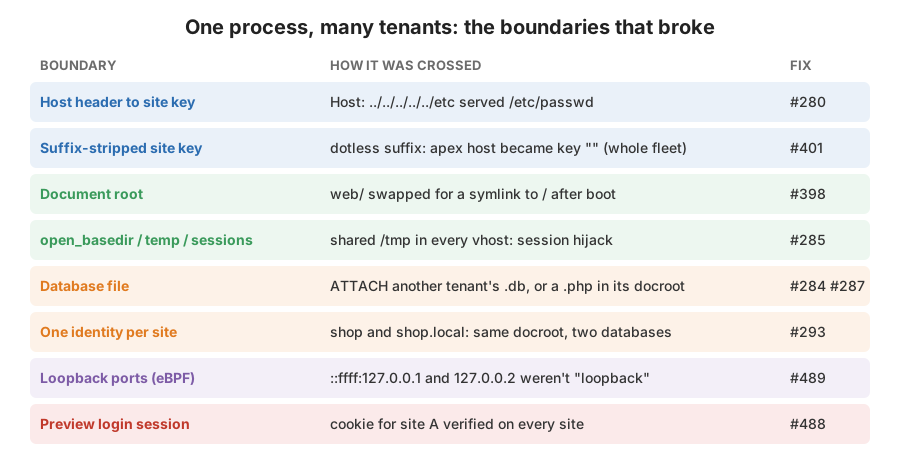
One note before the list. ePHPm’s own docs say plainly that open_basedir is an in-process boundary, not a container
boundary. Untrusted per-PR code still deserves real per-preview isolation. None of what follows changes that advice.
It’s about making the in-process boundary hold.
1. The Host header was a path
In sites_dir mode the document root was sites_dir.join(raw_host), with no sanitization of the Host header. The
downstream containment checks were anchored to that root. So they canonicalized to the escaped directory and passed.
Pre-auth, no tenant code needed:
| Request | Result before the fix |
|---|---|
Host: ../../../../../etc, GET /passwd |
200, served /etc/passwd |
Host: ../../../../../ETC. (trailing dot + case) |
200, served /etc/passwd |
Host: ../single, GET /pwn.php |
200, executed PHP from an arbitrary docroot |
The only prior mitigation was trusted_hosts. It’s empty by default and exact-match only, so it’s unusable for
per-PR hostnames.
The fix (#280) validates the normalized host as a strict DNS-label
allowlist: [a-z0-9._-], and no empty label. That one “no empty label” rule rejects ., .., a..b, and leading or
trailing dots in a single test. /, \ and NUL fall outside the charset. After that, sites_dir.join(key) can only
ever name a direct child. A malformed host is a 404 before any filesystem join.
The fix is lexical on purpose. The obvious alternative is canonicalize().starts_with(sites_dir). But the router
deliberately supports a site directory that’s a symlink to a release tree outside sites_dir. That’s the
atomic-deploy layout. A canonical containment check would break that. Once the label can’t contain traversal
primitives, a direct child is all you need.
2. The suffix that collapsed every tenant into one
Preview hosts look like pr-123.preview.example.com. sites_domain_suffix strips the shared suffix to get the site
key. The validation from #1 ran on the host before stripping. The stripped result was used without being checked
again. Take a dotless suffix like localhost. The request Host: localhost stripped to the empty string, and
sites_dir.join("") is sites_dir itself. That’s one virtual host whose document root and open_basedir are the
entire tenant fleet, with read and write to every site. The empty key also selected DB file .db, KV keyspace ""
and the override lookup. The whole tenant identity collapsed.
#401 re-validates the stripped key. An empty or invalid key falls through to
the default site, never to a sites_dir-rooted basedir. It also rejects a suffix without a leading dot at config load.
A legitimate suffix always starts with ., so a dotless one has no valid use.
3. Swapping your own web root for a symlink
Sites can declare a document root override. document_root = "web" serves <site>/web while PHP can still require
upward into the site’s container. The override was validated with starts_with(container) once, at load. But the
resolved root got re-canonicalized every couple of seconds, following symlinks, with no containment re-check. And the
static file path’s only boundary is that root. It has no open_basedir backstop.
The tenant can’t plant the link from PHP. symlink() checks both the link path and its target against open_basedir.
So symlink('/', 'web') from a tenant script just fails with an open_basedir warning. But PHP isn’t the only thing that
writes into a site directory. On the preview environment the site is a checkout of whatever somebody pushed. Git stores
symlinks as symlinks:
git rm -r web
ln -s / web
git add web && git commit -m 'tidy' && git push
The same goes for an archive the deploy unpacks, SFTP or a shell on the box. Once a link like that exists after the override was validated, nothing looked at it again. The test for the fix plants it from outside PHP the same way. On a Windows test box the next static requests looked like this:
| Request (static) | Before | After |
|---|---|---|
GET /Windows/win.ini |
200, ; for 16-bit app support |
404 |
GET /.../sites/victim.test/secret.db |
200, the other tenant’s DB | 404 |
GET /index.txt (legit) |
200 | 200 |
#398 re-asserts canonical_document_root.starts_with(canonical_container)
on every resolve. It checks against the operator-chosen container that no override can change. It fails closed with a
static 404 or a PHP 403. When no override is in play the second canonicalize is skipped, so it costs nothing on normal
sites. This one never shipped in a release. It was caught between the override feature merging and the next tag.
4. Everybody’s /tmp
Every vhost’s open_basedir included the same system temp directory. session.save_path, sys_temp_dir and
upload_tmp_dir were never set per tenant. So every site’s sessions sat in one shared directory that was inside every
site’s sandbox:
# from site-b:
CROSS_READ_site_a_session_file (/tmp/sess_bb469cd9...) =>
  READ: 'site_a_session_secret|s:20:"SITE_A_SESSION_VALUE";'
sess_glob_own_tmp=[7 other tenants' sess_* files]
That’s session hijack and tamper across tenants. #285 gives each vhost a
private state root, <temp>/ephpm-vhosts/<label>-<digest>. It’s derived from the already-validated document root, with
tmp/ and sessions/ underneath at 0700. open_basedir becomes the document root plus that state root only.
Fixing it exposed a second bug. Per-request ini overrides were applied after php_request_startup(). But
php_request_startup() is where the multipart parser writes uploaded files. It uses upload_tmp_dir as it is at that
moment. Uploads kept landing in shared /tmp, now outside open_basedir, so move_uploaded_file() failed. The ini
replay now runs both before and after startup.
5. ATTACH DATABASE as a filesystem primitive
This was the worst one, filed as #274 after live exploitation. The embedded SQLite engine runs inside the ePHPm
process, not under any tenant’s open_basedir. In multi-site mode every vhost shared one database. From a hostile
vhost:
mysqli_connectwith junk credentials connected (the proxy didn’t validate them) and read another site’swp_users.user_pass.ATTACH DATABASE '.../site-b.db'read and wrote another tenant’s database.ATTACH DATABASE '.../sites/site-a/shell2.php'wrote a PHP file into another tenant’s docroot, where PHP’s ownfile_put_contentshad been correctly denied.GET /shell2.phpwith that tenant’s Host executed it as them. Full cross-tenant RCE.- The same
ATTACHworked through the always-on nativeephpm_db_*bridge, so firewalling the TCP proxy wouldn’t have closed it.
#284 made the database file the tenant boundary, since the engine has no
per-schema ACLs. [db.sqlite] dir gives every site its own <key>.db, required and fail-closed in multi-site mode. The
shared wire listeners don’t start in multi-site mode at all. One listener for all tenants is the original bug. ATTACH,
DETACH, VACUUM and path PRAGMAs are rejected on the tenant path with ePHPm’s own error, independent of the
engine’s defaults. #351 pins it with an end-to-end test from real PHP
userland on both the native and wire paths.
The follow-up pentest found the screen matched on a statement’s leading keyword. So EXPLAIN ATTACH DATABASE '...'
sailed past it. Only the engine’s “ATTACH is experimental” default stopped it.
#287 peels EXPLAIN and EXPLAIN QUERY PLAN before checking the verb. That
handles them stacked and with comments in between. A denylist has to see the statement the way the engine will see it.
6. Two names, one docroot, two databases
The same pentest round found the derivations disagreeing with each other. Docroot lookup stripped the domain suffix and
the DB key didn’t. So Host: shop.local and Host: shop shared a document root and a session directory but wrote to
different databases. The KV keyspace used the raw Host, so ALICE and alice were different keyspaces on the same
site. #293 didn’t patch the DB key. It made resolve_site return the key it
matched. Everything else is derived from that one value: DB file, wire credential, KV keyspace, OPcache vhost and temp
root. A host that matches no site mints no identity at all.
7. Loopback has more than one address
The per-vhost eBPF policy lets a tenant run a sidecar on localhost. It stops other tenants from connecting to its
ports. The cgroup/connect classifier recognized exactly 127.0.0.1 and ::1 as loopback. Linux treats all of
127.0.0.0/8 as loopback. An IPv4-mapped IPv6 address reaches the same IPv4 stack. Anything the classifier didn’t
call loopback skipped the port-ownership check:
| Vector (Bob to Alice’s sidecar) | Before | After |
|---|---|---|
127.0.0.1:port |
EPERM | EPERM |
::ffff:127.0.0.1:port |
connected, read Alice’s secret | EPERM |
127.0.0.2:port (Alice on 0.0.0.0) |
connected | EPERM |
::ffff:127.0.0.2:port |
connected | EPERM |
#489 puts one shared classifier behind both connect4 and connect6:
static __always_inline int is_loopback4_be(__u32 ip_be)
{
    return (ip_be & bpf_htonl(0xff000000)) == bpf_htonl(0x7f000000);
}

static __always_inline int is_loopback6(const __u32 ip6[4])
{
    // ::1 (network order: high 96 bits zero, low word == 1).
    if (ip6[0] == 0 && ip6[1] == 0 && ip6[2] == 0 && ip6[3] == bpf_htonl(1))
        return 1;
    // ::ffff:0:0/96 — IPv4-mapped: first 80 bits zero, next 16 bits 0xffff.
    if (ip6[0] == 0 && ip6[1] == 0 && ip6[2] == bpf_htonl(0x0000ffff))
        return is_loopback4_be(ip6[3]);
    return 0;
}
Deprecated IPv4-compatible addresses (::a.b.c.d) are deliberately not folded in. Linux doesn’t route them onto v4
loopback. Treating that prefix as “classify by embedded v4” would misclassify ::1 itself.
8. A login cookie that worked on every site
Previews sit behind a GitHub OAuth gate. One module does the OAuth round trip at login and mints an HS256 session with
a site claim. A second module verifies that session on every request. The issuer always set site. The verifier never
checked it, so a session for preview A verified on every preview on the node.
#488 passes the request’s canonical site key into the verifier as
expected_site. A missing, non-string or mismatched claim fails closed. The issuer now takes its site from the same
canonical key instead of re-normalizing the raw Host. The two agree by construction.
The patterns
Looking back at the list, almost none of these were exotic. They fall into four groups:
- The identity of a tenant was derived more than once. Host to docroot, host to DB file, host to KV keyspace, issuer versus verifier. Every time two pieces of code derived “which tenant is this” separately, they eventually disagreed (#1, #2, #6, #8). The fix that stuck was one derivation, passed to every consumer.
- A check ran once and the thing it checked kept changing. Validate-at-load with live symlink resolution (#3), and validate-before-strip (#2). If a value can change after you check it, check it where you use it.
- The boundary was in the wrong layer.
open_basedirdoesn’t cover the SQLite engine (#5) or the static file path (#3). Any component running inside the process but outside PHP needs its own boundary. - “Loopback” and “keyword” aren’t single values. Address families and statement prefixes (#5, #7). Match the way the kernel or the engine will interpret it, not the way you’d write it.
The other habit that paid off was writing each fix with a test that fails on the old code. Several of the PRs above say exactly that in their test sections. Some temporarily reverted the fix to watch the test go red. When the subject is security, a test you’ve never seen fail isn’t telling you much.




