
shipmates Short Ones: 8 Minutes Extracting Go, and Three Voice-Loop Bugs
Four small stories from shipmates, starting with setup-go stuck extracting on Windows CI and Cloudflare's 100 second timeout. The other two are a voice loop that transcribed itself and events lost to a timestamp watermark.
A few shipmates bugs don’t need a whole post each. They were too good to leave in commit messages, though.
setup-go spends 8 minutes extracting Go on Windows CI
shipmates CI runs on my own ephemerd runners. On Windows those jobs run
inside a Hyper-V utility VM. The windows-x64 leg kept timing out in actions/setup-go. Here’s the log from
PR #48:
20:58:46  Setup go version spec 1.26.6
20:58:46  Attempting to download 1.26.6...     <- tool-cache MISS
20:58:48  Acquiring 1.26.6 from ...zip
20:58:53  Extracting Go...
21:06:46  ERROR: The action 'Run actions/setup-go@v5' has timed out after 8 minutes
Seven seconds from the start of the step to Extracting Go.... Then almost eight minutes extracting until the step
timeout killed it.
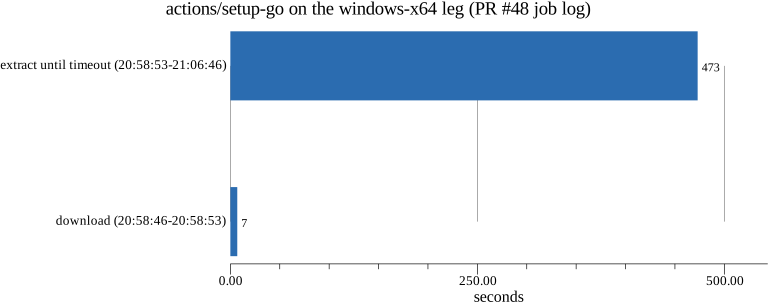
(Durations computed from the timestamps in the PR #48 job log above.)
The Go toolchain is about 15,000 small files. Every write under _work crosses a VSMB share from the VM to the host.
Small-file metadata over that share is brutally slow, and no timeout or retry in the workflow fixes it. The toolchain
has to stop being installed per job.
The plan was to take Go from the job’s container image instead. ephemerd intercepts container: on every platform. On
Linux it’s an ordinary container. On Windows and macOS the image layers are extracted onto the VM disk. GitHub’s own
runner only supports it on Linux. Here’s what changed:
- Linux x64 and arm64 got
container: golang:1.26.6-bookworm.library/golangis a real multi-arch manifest, so the same tag resolves natively on the arm64 runner. - Windows x64 got
container: golang:1.26.6-windowsservercore-ltsc2025. - macOS keeps
setup-go. There’s no upstream image, and it wasn’t the problem leg. setup-gois skipped on the containerized legs, not left to no-op. It never looks atPATH. It probesRUNNER_TOOL_CACHEand installs on a miss, so a toolchain already in the image wouldn’t have stopped it.
A nice side effect is that the race job lost its ~30 line “Ensure a C toolchain” step. golang:*-bookworm is built on
buildpack-deps and already has gcc. No more run-time apt-get. No more negotiating whether the runner came up as
root, a sudo user, or neither.
Keep the image tag in lockstep with go.mod, by the way. The Linux images set GOTOOLCHAIN=local. A go.mod bump past
the image fails loudly instead of quietly downloading a toolchain, which is what you want.
Now the honest part. The Linux legs went green. The Windows leg didn’t get Go from the image. It failed at
Initialize containers in 13 seconds:
##[error]Container operations are only supported on Linux runners
That message is the actions runner’s own Linux-only check. On that leg the job never got as far as the image. The 8 minute timeout became a 13 second failure. That’s better for the queue and still not a passing build. The fix belongs on the ephemerd side, not in the shipmates workflow.
PR #26 also has a note worth repeating if you’re thinking about self-hosted runners. A public repo on self-hosted runners lets a fork PR run code on your hardware. I did it on purpose. ephemerd exists to make that safe and shipmates is part of testing that. But it’s a decision and it’s written down as one.
Surviving Cloudflare’s 100 second edge timeout
Fleet Command sits behind cloudflared. The Commodore’s conversation endpoint runs an LLM tool-calling loop. A multi-tool turn on a CPU model can take longer than Cloudflare’s 100 second proxy limit. The operator got a raw 524 HTML page dumped into a chat bubble.
The fix (bb93111) streams whitespace while the model
thinks. Bytes on the wire reset the edge timer, and JSON.parse ignores leading whitespace. So the client didn’t change
at all:
w.Header().Set("Content-Type", "application/json")
w.Header().Set("X-Accel-Buffering", "no")
fl, canFlush := w.(http.Flusher)
heartbeat := make(chan struct{})
go func() {
	ticker := time.NewTicker(15 * time.Second)
	defer ticker.Stop()
	for {
		select {
		case <-heartbeat:
			return
		case <-ticker.C:
			if canFlush {
				_, _ = w.Write([]byte(" "))
				fl.Flush()
			}
		}
	}
}()
finish := func(v conversationResponse) {
	close(heartbeat)
	_ = json.NewEncoder(w).Encode(v)
}
The catch is that once the first space goes out, the headers are committed with a 200. An http.Error(w, …, 502)
later does nothing useful. So errors moved into the JSON body ("error": "llm: …") and ride the 200. In the same
commit the client started sending only the last 12 history messages. The prompt was growing every turn and making the
slow turns slower.
The voice loop that transcribed itself
In hands-free mode the browser runs a loop:
- listen with a voice activity detector
- send your speech to STT
- send the transcript to the Commodore
- play the reply through TTS
Then it listens again. Except it started transcribing its own replies back as my input. One of them came back as “I’m always here ready to exist”, which is a better line than anything I wrote that week.
speak() was fire-and-forget. The loop checked if (audioEl.paused || audioEl.ended) resumeListening() right after
sending. Playback hadn’t started yet, so the element was still paused. The mic reopened immediately and caught the
assistant’s voice from the speakers. 9350c68 made
speak() resolve when playback finishes. That’s on ended, error, or pause, since an interrupted reply counts as
done. sendMessage awaits it, and the loop resumes 350 ms later to let the speaker tail die out.
Same-second events, gone
The bridge streams each captain’s event log to the browser over server-sent events. It deduplicated with a watermark on the event timestamp. That timestamp was a string at one second resolution:
for _, e := range events {
	if e.Time <= high {
		continue
	}
	// send e
	high = e.Time
}
Any batch of events in the same second delivered only the first one. That’s exactly what a broadcast produces. Tell
three mates something and you saw one tell and one reply. The log is append-only, so
2e317d5 switched to an index watermark, which is exact. It
resets when the log shrinks, which means the lead restarted:
if len(events) < sent {
	sent = 0 // lead restarted and its log reset; replay from the top
}
for _, e := range events[sent:] {
	// send e
}
sent = len(events)
If your log is append-only, the position is the cursor. Timestamps are for humans.
Links
- shipmates PR #48 (Go from the job image) and PR #26 (CI on ephemerd)
bb93111,9350c68,2e317d5- Cloudflare error 524




