
shipmates: Persona-Based AI Coding Crews That Remember
shipmates is a Go CLI and daemon that runs crews of AI coding agents across machines. It adds per-project memory, a shared task graph, voice control and a real permission model.
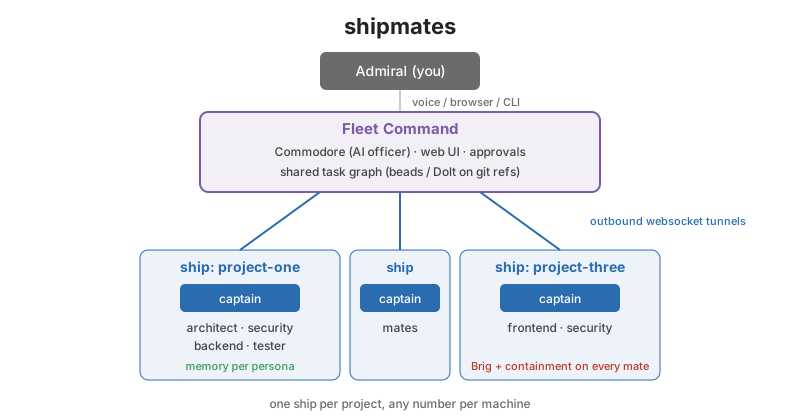
Since June most of my evenings have gone into shipmates, a Go CLI and daemon for running crews of AI coding agents. I tagged v0.5.0 on August 17th. That was two months and about 240 commits after the first architecture doc. So it’s a good time to write down what it is and why it exists.
The problem
I run a lot of agent sessions. On a normal night this workstation has four or five projects going at once. Each has a few Claude Code sessions doing different jobs: one reviewing, one writing tests, one chasing a bug. Two things kept annoying me.
First, every session starts from zero. The “security reviewer” prompt you found on the internet is a headless expert: a role description and a tool allowlist. It doesn’t remember that you rejected a pattern three weeks ago. It doesn’t know which constant is load-bearing for reasons the code doesn’t explain. You end up re-explaining the project in every prompt. And the reviewer gives you generic best-practice advice you mostly already knew.
Second, coordination. I had several projects on more than one machine, and I was the message bus between all of them. I’d alt-tab through terminals to see who was waiting on a permission prompt.
The pitch
Each persona gets a per-project memory directory. It reads it at session start and writes to it as it learns. Two weeks in, the architect reviewing a PR doesn’t just see the diff. It sees the diff against a remembered project: “this re-introduces the pattern we rejected in #45, has anything changed?”
Then Fleet Command adds the second dimension. You coordinate ships on multiple machines from one browser, dispatch work across them and talk to the whole fleet by voice.
The naval bit
I leaned into the metaphor because it maps cleanly onto roles:
- Admiral: me, giving direction.
- Fleet Command: one coordinator node that hosts the web UI, the voice loop and the shared task graph.
- Commodore: the AI officer at Fleet Command. It turns spoken orders into fleet tool calls like list captains, tell a captain, assign work or approve a pending request.
- Ship: one per project. A machine can run several.
- Captain: the per-ship lead persona, coordinating that ship’s crew.
- Mates: the individual agents,
architect,security,frontend,backend,testerand so on.
Single ship
You don’t need any of the fleet parts. Install the binary (the persona catalog is embedded), then in a project:
cd my-project
shipmates init --crew captain,architect,security,frontend,backend,tester
That does four things:
- Vendors persona files into
.claude/agents/<name>.md, which Claude Code reads natively. - Seeds each persona’s memory under
.shipmates/memory/<name>/. - Drops a
policy.yamloverlay for the personas that ship one. - Wires a
SessionStarthook into.claude/settings.json.
The hook shells out to shipmates hook load-memory, which reads the persona’s memory and injects it as session
context. That’s deliberate. Memory loading shouldn’t depend on the model deciding to go read a file first.
Then you talk to the crew three ways:
# one-shot delegation; resumes the persona's session, so it remembers
shipmates ask security "review the diff for auth regressions"

# a live crew member you can message while it works
shipmates tell security "double-check PR 10"
shipmates feed

# an interactive session as the persona
shipmates open captain
There’s also shipmates bridge, a tabbed terminal UI (Bubble Tea) over every live mate on the machine. It has a live
PTY per tab and one-key approvals.
The fleet
Ships open outbound websocket tunnels to Fleet Command. Nothing on the ship side is exposed, and it works from behind NAT. The tunnels are rancher/remotedialer, which I know well from my Rancher days. (It also produced the first real bug story of the project. More on that soon.) Fleet Command can sit behind cloudflared or any TLS proxy.
Coordination between ships goes through a shared task graph called beads. It’s a Dolt-backed SQL database that rides on hidden git refs inside the project’s own repo. The fleet’s work is versioned and merge-safe. It’s stored somewhere I already trust instead of in another service.
In the browser you get every captain in a sidebar and a live terminal per mate. There’s also an event stream per captain, the task graph and an approval queue. You can drag a screenshot in and it lands in the target ship’s inbox. The mate reads it with Claude Code’s own multimodal Read tool.
Voice is the part that makes it feel like a fleet. Press the mic and speak an order. It goes through speech-to-text (whisper.cpp or anything OpenAI-compatible). Then it goes into an LLM backend that plays the Commodore and calls fleet tools. The answer comes back out through text-to-speech (Kokoro, Edge voices or OpenAI-compatible). Every stage is a pluggable endpoint, so the whole voice stack can run on a local GPU.
Permissions, the Brig, and containment
Agents running shell commands on my machines need a real permission model, not vibes. shipmates evaluates every tool call through layered rules in Claude Code’s own syntax:
- A fleet-wide deny list pushed from Fleet Command. It binds even personas running in bypass mode.
- Per-persona policy.
- Project settings.
- User settings.
Deny beats ask beats allow.
On top of that sits the Brig. Fifteen “Ship’s Articles” are bound to every persona the moment it’s installed. Examples
are no piped execution, no self-escalation and stay aboard. Ten of them are compiled into deny and ask rules. There’s
also shipmates freeze, which stops every write-class tool call across a ship without killing sessions. And there’s
an append-only denial log.
And every agent process runs under containment: Windows Job Objects, Unix process groups and an RSS/CPU watchdog. A turn that ends takes its whole process tree with it. An optional memory or CPU budget gets enforced too.
What v0.5.0 added
The v0.5.0 release was big:
- Voyages:
plan,commissionandsail. A multi-task plan executed by a Go orchestrator. Dependencies, retries, model-tier escalation and state live in code, and the model is spent only on the tasks. - Multi-runtime:
--runtime claude|codex|openaiacross the command surface. Claude Code is still the main one, but Codex and any OpenAI-compatible endpoint work too. - The Brig landed in this release.
- A security pass that changed where several settings are allowed to live. Persona execution config moved out of
the checkout into
~/.shipmates/personas.yaml. That config covers which binary to spawn and whether to skip permissions. It moved because anything in the repo arrives withgit cloneand is attacker-controlled on an unreviewed repo. The captain’s local API now requires a token. Plaintext fleet URLs to non-loopback hosts are refused. And the permission gate stopped trusting the first word of a shell command.
If you run a GitHub-routed crew on a public repo, everything an outsider can write is treated as data to evaluate, never instructions to follow. That covers issue titles, bodies, comments, diffs and branch names.
How it’s built
It’s all Go (1.26), a single binary for macOS, Linux and Windows on amd64 and arm64. It’s released with goreleaser. CI runs on my own ephemerd runners across linux-x64, linux-arm64, macOS arm64 and Windows x64, with a dedicated race-detector job. Development happens on Windows first. That has turned out to be a great way to find cross-platform bugs, and a terrible way to find the ones that only show up on Linux.
One install caveat for now. go install github.com/luthermonson/shipmates@latest doesn’t work, because shipmates pins a
fork of remotedialer with a replace directive. Grab a release binary
or git clone and go build -o shipmates ..
What’s next
I’ve got a backlog of posts out of the last two months, mostly about the things that broke. Next up is the data race in
remotedialer that my CI found and how I managed to pin only two-thirds of my own fix. After that comes NTFS and atomic
file replacement, then a fun one about os/exec.
Links
- github.com/luthermonson/shipmates (MIT)
- v0.5.0 release notes
- docs/PHILOSOPHY.md, the longer “why”
- docs/security.md
- beads




