
Making ephpm php Byte-for-Byte Indistinguishable From php-cli
A differential test harness against upstream php, and the bugs it found in an embedded PHP CLI on day one.
ePHPm embeds PHP into a single Rust binary. The obvious follow-up question from
anybody deploying it is “do I still need a php on the box?” Composer, WP-CLI, artisan, PHPUnit and every build
script in the world call php. If ephpm php can stand in for it then the answer is no. The single binary really means
a single binary. “Mostly works” isn’t good enough for that though. These tools parse PHP’s output, check its exit codes
and re-invoke it. So the goal was simple to state: ephpm php should be indistinguishable from php-cli.
Getting to “drop-in” the first time
The first pass (#306) made ephpm php do six things:
- report
PHP_SAPI === "cli", set beforephp_embed_init()so OPcache’s startup verdict sees it - read programs from stdin
- honor
-d,-cand-n - support line mode (
-B,-R,-F,-E) - define the
STDIN/STDOUT/STDERRconstants WP-CLI needs - implement the
--rf/--rc/--re/--rz/--rireflection flags, which had been declared and silently did nothing
composer.phar create-project laravel/laravel completed clean. wp-cli.phar --version was byte-identical to the
system php.
A couple of things are honest errors rather than fakes. -S isn’t aliased to ephpm serve. The embedded libphp.a
contains zero php_cli_server_* symbols, and pretending otherwise would just move the surprise. -a says “not
supported” because the interactive shell isn’t linked into the embed build.
The second pass (#317) was the tedious one. It checked every rule against
sapi/cli/php_cli.c and every output against a real php 8.5.4. It fixed these:
- stdin programs with
--args $argv[0]being"Standard input code", not"-". Our docs had claimed the dash matched php-cli, and it never did.- exit codes taken from
EG(exit_status)unconditionally. Before that,exit(3), fatals and uncaught exceptions all reported 0. -wand-sreading stdin instead of silently executing a piped program$argibeing 1-based
That PR was verified with a throwaway diff script over 55 cases. Throwaway is the problem. The next regression wouldn’t get caught by anything.
The differential harness
#342 turned that into a real harness. tests/cli-conformance/ holds the
corpus. The 0xx cases cover the language and runtime surface. That’s var_dump of every type, float formatting,
INF/NAN, sprintf, mbstring, sort stability, JSON edge cases, serialize, preg backtrack limits, uncaught exception
format, shutdown and destructor ordering, enums, readonly and so on. The 1xx cases cover CLI behavior. That’s exit
codes, -r with and without --, -l, -d, $argv/$argc/$_SERVER in every mode, PHP_BINARY, shebang
stripping, line mode, -w, -s, -v and --rf. A case is a .php file or an .args file, optionally with .stdin
and .meta:
# 115-php-binary.args
-r
echo PHP_BINARY === '' ? "(empty)" : PHP_BINARY, "\n"; var_dump(is_string(PHP_BINARY));
The runner is cargo xtask cli-conformance --php <upstream> --ephpm <bin>. It runs each case against both binaries
with an identical minimal environment: TZ=UTC, LC_ALL=C and a per-side scratch directory. Then it compares stdout,
stderr and exit code byte for byte. Any unexplained mismatch prints a unified diff and fails the run. A nightly workflow
runs it over PHP 8.3, 8.4 and 8.5 against the matching upstream php from the ondrej PPA.
Three design choices in the runner are the reason I trust it.
It checks the binary’s identity before running anything. <ephpm> php -n -v has to print a PHP banner first.
Handing a plain php to --ephpm fails immediately. This isn’t paranoia. A $VAR expansion bug in the WSL bridge
had repeatedly made earlier harnesses test the system php against itself. That passes beautifully.
Expected failures are marked, and a stale marker fails the run. A known divergence gets an xfail with a reason
and an issue number. If an xfail case starts matching, the runner reports XPASS. It goes red until somebody deletes the
marker. Markers can’t quietly rot into lies.
Normalization is a tiny, justified registry. There are exactly four normalizers: strip-versions,
strip-zts-marker, strip-distro-banner and strip-binary-path. Every use has to explain itself in the .meta
file:
# 115-php-binary.meta
# strip-binary-path: the two sides are different executables by definition,
# so each side's own binary path is folded to <BINARY>; the case then proves
# PHP_BINARY is a non-empty string naming the invoked binary on BOTH sides.
normalize = ["strip-binary-path"]
Some things are packaging facts rather than behavior. The -m extension list of a static SDK versus a distro php is
one. --ini search paths are another. Those get skip with a reason.
What it found on day one
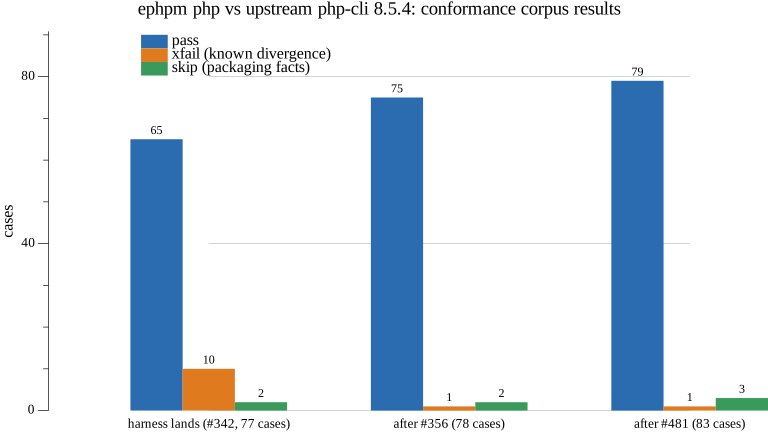
Against a build of main, the first real run was total 77: 65 pass, 0 fail, 2 skip, 10 xfail. Seven of those xfails
were new, real divergences, all filed as issues:
| Issue | Divergence |
|---|---|
| #334 | register_shutdown_function callbacks and end-of-script destructors never ran |
| #335 | --rf on a missing symbol exited 0 (php-cli: 1) |
| #336 | an unknown option (-Z) was silently ignored, exit 0 |
| #337 | -d of unregistered ini entries invisible to get_cfg_var() |
| #338 | CLI $_SERVER lacked environment variables and DOCUMENT_ROOT |
| #339 | PHP_BINARY was "" |
| #340 | STDIN/STDOUT/STDERR lacked php:// wrapper metadata |
The first one is the scary one. A CLI that never runs shutdown functions or destructors breaks every tool that flushes
a buffer or writes a lock file on the way out. The root cause (#347) was
that ephpm_cli_main never called php_request_shutdown(). Teardown ran invisibly at process exit. Its output went
into the discarded HTTP capture buffer, after the exit code had already been taken. The fix runs shutdown in php-cli’s
exact order, with nested-bailout protection. It takes the exit status afterwards, so exit() inside a shutdown
function works.
The fixes, checked against php_cli.c
#356 took the next five. A few of them are worth the detail.
-Z was accepted silently. The flag fell through both getopt passes and no mode got selected. The CLI read empty
stdin as a program. A typo’d flag ran nothing and reported success. Now php_getopt is called with show_err = 1
like php-cli’s main(). Stderr gets the exact Error in argument 2, char 2: option not found Z and the exit is 1.
That had a consequence. The option table is now load-bearing. Any option php-cli accepts that the table lacks turns a
working command line into a failure. So the table was diffed against php-src’s OPTIONS[]. The one missing entry was
added. That’s --syntax-highlighting, the long spelling of -s. The one deliberate gap is php-cli’s internal
--repeat, which php-src itself labels a testing option. Accepting and ignoring it would silently run a script once
when the caller asked for N times.
PHP_BINARY was empty on Unix. On Windows php_binary_init() asks the OS, which is why it looked fine there. On
every other platform it reads sapi_module.executable_location. php_embed_init() assigns that argv[0], which ePHPm
passes as the bare string "ephpm". PHP then searches PATH for something named ephpm, finds nothing and leaves it
NULL. The trap is where to set it. Set it before php_embed_init() and it gets overwritten. Set it after
php_module_startup() and it’s too late. The only window is inside ePHPm’s startup shim, right before it hands off:
static int ephpm_module_startup(sapi_module_struct *sm)
{
    sm->additional_functions = g_cli_mode ? ephpm_cli_functions : ephpm_kv_functions;

    /* PHP_BINARY: php_embed_init() has just overwritten executable_location
     * with argv[0] ("ephpm"), and php_module_startup() below both copies *sm
     * into sapi_module and calls php_binary_init(). NULL outside `ephpm php`,
     * so the server's PHP_BINARY is unchanged. */
    if (cli_executable_location) {
        sm->executable_location = cli_executable_location;
    }
    /* ... -d splice, worker module ... */
}
The first cut set the field pre-init and built clean. It passed on Windows while staying broken on every other platform.
The Linux binary is what caught it. That’s a good argument for running the harness on the platform where the code path
differs. The value recorded is std::env::current_exe(). It names this binary rather than whatever ephpm is first
on PATH.
That same ephpm_module_startup() window is where -d now goes too (#341).
OPcache decides once, at module startup, whether it will ever be active in the CLI. We were applying -d after
php_embed_init(). So ini_get('opcache.enable_cli') said 1 while opcache_get_status() said false. The fix
splices the -d entries into ini_entries right there, after the embed SAPI’s hardcoded block. That gives php-cli’s
exact precedence. It also means -d extension= and -d zend_extension= genuinely load now.
$_SERVER in the CLI lacked the environment. php-cli imports the process environment into $_SERVER. The “S” of
EGPCS in a CLI process is its environment. It also registers an empty DOCUMENT_ROOT. That’s now done, but only on
the CLI path. ephpm serve is multi-tenant and the process environment holds cross-tenant material. It must never reach
a web request’s $_SERVER. That was verified by starting the server with a probe variable in its environment. No
request could see it. Being byte-compatible doesn’t mean copying every php-cli behavior into the server.
After #356 the run was total 78: 75 pass, 0 fail, 2 skip, 1 xfail. The remaining xfail is permanent and intentional.
The usage screen says Usage: ephpm php and omits flags this build doesn’t implement. The part that matters is the
stderr diagnostic and exit status. An e2e test pins those byte-for-byte from the ePHPm side.
The last mile: reflection flags
The most recent fix (#481) is a good example of how literal “byte for
byte” gets. --rf ArrayObject::count was printing Exception: Function ArrayObject::count() does not exist and exiting
- php-cli prints the method and exits 0. On 8.5 it also prints this first, on stdout:
Deprecated: Calling ReflectionMethod::__construct() with 1 argument is deprecated,
use ReflectionMethod::createFromMethodName() instead in Unknown on line 0
That’s php-cli’s own deprecation, from php-cli’s own code. Matching it meant giving up on evaluating an
echo new ReflectionX($name) snippet. php-cli constructs the reflection object under a zeroed execute-data frame.
That frame is exactly what produces in Unknown on line 0. Evaluated code stamps the eval’s filename and line. So no
zend_eval_string shape can produce those bytes. The five reflection flags now run php_cli.c’s algorithm in C. That
includes --ri main printing the core ini table and --ri nosuchext exiting 1. The corpus is at 83 cases:
79 pass, 3 skip, 1 xfail.
What’s still open
PHP_BINARY now names the ephpm executable. That’s correct, and it creates the next problem. Some tools re-invoke
PHP through it, like PHPUnit process isolation, Symfony’s PhpExecutableFinder and Composer @php scripts. They run
PHP_BINARY script.php, and ephpm script.php isn’t a PHP CLI. For now that’s documented with a wrapper-script
workaround. Making ephpm answer as php when it’s re-invoked that way is next on the list.
The harness is the part I’d reuse on any project that claims compatibility with something else:
- diff against the real thing
- compare bytes, not vibes
- make the binary prove its identity
- make every exception to the rule explain itself in a file that fails the build when it stops being true




