
A 1 TB Test: Building a Memory Watchdog for go test
A runaway test binary hit about 1 TB of commit charge and took my desktop down. Here's the PowerShell and POSIX sh wrapper I put around go test, and the bug in it that the Windows box couldn't show me.
On August 16th a server.test.exe from shipmates climbed to
roughly 1 TB of commit charge on my Windows workstation. Windows Terminal was hosting several agent sessions in
tabs. It hard-faulted with E_OUTOFMEMORY, and every one of those sessions died at the same moment. It wasn’t the
first time either. An earlier one hit about 236 GB through an infinite filepath.Dir loop.
The machine has 128 GB of RAM. Commit charge doesn’t care. It’s backed by the page file, and Windows will happily let a process reserve-and-commit until the commit limit is gone. Then everything else on the desktop starts failing allocations too.
I wanted the worst case to be a killed test process instead of a dead desktop.
Watch the children, not go
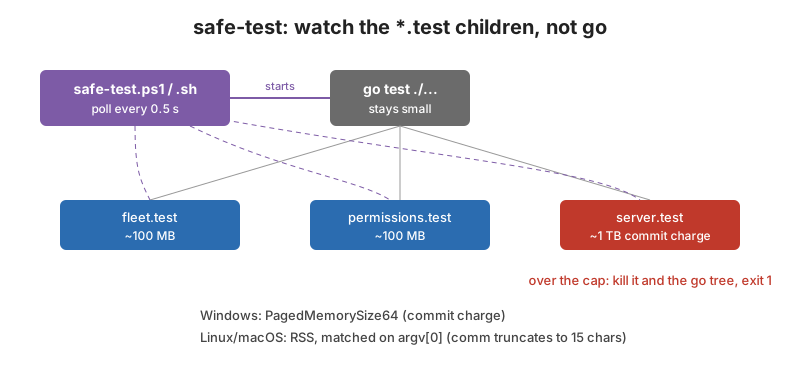
go test ./... builds one test binary per package and runs it as a child: server.test.exe,
permissions.test.exe and so on. A test that allocates without bound blows up in that child. The parent go process
stays small the entire time. So anything that watches go misses it. That includes a job limit on the shell, a
ulimit on the parent’s RSS, or eyeballing Task Manager for go.exe.
So PR #54 added two scripts with the same contract.
scripts/safe-test.ps1 is for Windows and scripts/safe-test.sh is for Linux, macOS and CI:
- Start
go test -count=1 <target>with output captured to a temp file outside the repo. - Every 0.5 s, walk the process tree from that
gopid down and pick out the*.testbinaries. A siblinggo testrunning for another agent is left alone, which matters on a box running four or five crews. - Record a per-package peak.
- If a child crosses the cap (default 2000 MB), kill it and the whole
gotree. Print which package tripped and the tail of its output, then exit 1.
The Windows tree walk is a Win32_Process snapshot and a stack:
function Get-Descendants($snapshot, [int]$root) {
    $desc = [System.Collections.Generic.HashSet[int]]::new()
    $stack = [System.Collections.Generic.Stack[int]]::new()
    $stack.Push($root)
    while ($stack.Count -gt 0) {
        $cur = $stack.Pop()
        if ($snapshot.ChildrenOf.ContainsKey($cur)) {
            foreach ($c in $snapshot.ChildrenOf[$cur]) {
                if ($desc.Add($c)) { $stack.Push($c) }
            }
        }
    }
    return $desc
}
Commit charge on Windows, RSS everywhere else
The two scripts deliberately measure different things.
On Windows the runaway was commit charge. Working set is the physical RAM actually in use. It could stay small while
commit ran to a terabyte, because the pages were committed but mostly never touched. So the PowerShell side reads
PagedMemorySize64, which is the process’s page-file-backed committed memory:
# PagedMemorySize64 is the process's committed (page-file-backed)
# memory -- the commit charge, which is what the OOM was about. Working
# set (physical RAM) would have stayed small while commit ran to a TB.
$commit = [int64]$gp.PagedMemorySize64
$pkg = $proc.Name -replace '\.test\.exe$', ''
On Linux the equivalent number is useless. Every Go process reserves a big chunk of virtual address space up front,
and Linux overcommits by default. So VSZ is large and harmless. What takes a Linux box down is resident memory, so the
sh script reads RSS from ps.
Validating it the right way
The 1 TB test itself is the more interesting part of the story. It was a test of a bounded behavior, the ring-buffer
or event-log-cap kind. To prove the cap mattered, it exercised the “fails without the guard” case by disabling the
bound and running unbounded. That turns a bounded test into an unbounded allocator. The rule that went into
CONTRIBUTING.md:
When you test that a limit holds, do not verify the “fails without the guard” case by disabling the bound and running unbounded. Assert against an injected small cap instead (fill a 4-slot buffer, prove the 5th is dropped), or run under the watchdog with a low cap.
The watchdog got the same treatment. You don’t prove a kill switch works by letting something run away and hoping. The
PR validated it against a throwaway allocator with -CapMB 300. A healthy ./internal/server/... run peaked at 104.3
MB and passed. The allocator tripped the kill at 300.2 MB and exited 1.
I reran the same idea for this post with a test that grows by 16 MiB every 50 ms. It touches every page so it shows up in RSS too. It stops itself at 1.5 GiB, so a watchdog that misses it can’t hurt anything:
func TestRunaway(t *testing.T) {
	var keep [][]byte
	for i := 0; i < 96; i++ {
		b := make([]byte, 16<<20)
		for j := 0; j < len(b); j += 4096 {
			b[j] = 1
		}
		keep = append(keep, b)
		time.Sleep(50 * time.Millisecond)
	}
	runtime.KeepAlive(keep)
}
On Windows:
safe-test: go test -count=1 ./permissions/...
safe-test: cap=300 MB  timeout=15 min  poll=0.5 s
------------------------------------------------------------
exit status 0xffffffff
FAIL	runaway/permissions	1.365s
FAIL

------------------------------------------------------------
safe-test: per-package peak commit charge
     354.0 MB  permissions
------------------------------------------------------------

WATCHDOG: package 'permissions' (pid 55232) crossed the 300 MB cap at 354 MB commit charge.
WATCHDOG: killed it and the parent 'go' process. This is the runaway -- fix the test before re-running the full suite.
It overshoots the cap by 54 MB because it samples. At 16 MiB per 50 ms, a half-second poll can miss about 160 MB of growth between looks. That’s the honest limit of this design, and it’s spelled out in the contributing guide now. The watchdog catches runaway growth, which is what has actually taken this machine down. It is not a hard per-allocation ceiling. If you want that on Windows, a Job Object memory limit is the tool. That’s what shipmates uses for the agent processes themselves. It deserves its own post.
The bug the Windows box hid
You may have noticed the package in my runaway test is named permissions. That’s on purpose.
A review of the watchdog before #54 merged found a hole in the sh version. The PR sat open from mid-August to
mid-September, so the fix (166d208) went out with the
rest of it in v0.6.0. The sh script matched test children with ps -o comm=. Linux truncates comm to 15 characters
(TASK_COMM_LEN is 16 including the NUL). Here’s a binary named permissions.test:
comm=[permissions.tes]
args=[./permissions.test]
permissions.tes doesn’t match \.test$, so the watchdog never saw it. Same for personaname and containment, which
are of course the security-sensitive packages. PowerShell’s Process.Name isn’t truncated, so the Windows script was
fine. And I only ever ran the Windows script at my desk.
Here’s the original sh script (from 291f29e) and the fixed one against the same runaway test under WSL2:
# before: matched on comm
safe-test: go test -count=1 ./permissions/...
safe-test: cap=300 MB  timeout=15 min  poll=1 s
------------------------------------------------------------
ok  	runaway/permissions	6.180s

------------------------------------------------------------
safe-test: per-package peak resident memory
  (no *.test child observed -- packages may have had no tests, or ran faster than one poll)
------------------------------------------------------------

safe-test: clean pass.
A 1.5 GiB test against a 300 MB cap, reported as a clean pass with exit 0. That’s the worst thing a guardrail can do. After the fix:
safe-test: go test -count=1 ./permissions/...
safe-test: cap=300 MB  timeout=15 min  poll=0.5 s
------------------------------------------------------------

------------------------------------------------------------
safe-test: per-package peak resident memory
     229.7 MB  permissions
------------------------------------------------------------

WATCHDOG: package 'permissions' (pid 405042) crossed the 300 MB cap at 373 MB resident.
WATCHDOG: killed it and the parent 'go' process. This is the runaway -- fix the test before re-running the full suite.
(The peak line is the last sample under the cap. The breaching sample is the one in the WATCHDOG line.)
The fix reads args instead, which comes from /proc/<pid>/cmdline and isn’t truncated. It takes argv[0] and
basenames it. The whole tree walk and filter is one awk pass:
snapshot() {
    ps -Ao pid=,ppid=,rss=,args= | awk -v root="$1" '
    {
        pid=$1; ppid=$2; rss=$3; exe=$4;   # exe = argv[0], first token of args
        RSS[pid]=rss; EXE[pid]=exe;
        kids[ppid] = kids[ppid] " " pid;
    }
    END {
        n=0; queue[n++]=root;
        for (i=0; i<n; i++) {
            m=split(kids[queue[i]], a, " ");
            for (j=1; j<=m; j++) if (a[j] != "") { desc[a[j]]=1; queue[n++]=a[j]; }
        }
        for (p in desc) {
            c=EXE[p]; sub(/.*\//, "", c);
            if (c ~ /\.test$/) { pkg=c; sub(/\.test$/, "", pkg); print pkg, p, RSS[p]; }
        }
    }'
}
The same commit dropped the default poll from 1 s to 0.5 s to shrink the window between samples.
The lesson is the same one twice. Test the guardrail against a deliberately small cap, and test it on the platform it’s
going to run on. The commit message for the fix even says the live Linux ps behavior “can’t be exercised on this
Windows dev box”. It could. It just needed WSL and five minutes.
Using it
powershell -ExecutionPolicy Bypass -File scripts\safe-test.ps1
powershell -ExecutionPolicy Bypass -File scripts\safe-test.ps1 -Target ./internal/server/... -CapMB 500
scripts/safe-test.sh
scripts/safe-test.sh -t ./internal/server/... -c 500
Both exit non-zero if they kill anything or if go test fails, so they work as a pre-push hook. CI still calls
go test directly. The runners are ephemeral VMs, and a runaway there only hurts itself.
How I measured
Windows 11 Pro on an AMD Ryzen 9 5950X with 128 GB RAM, Windows PowerShell 5.1, Go 1.26. Linux runs were under WSL2
(kernel 6.18.33.2, procps-ng 4.0.4, Go 1.26.0). The runaway module lives in a scratch directory with a single
permissions package containing the test above. Commands:
powershell -NoProfile -ExecutionPolicy Bypass -File safe-test.ps1 -Target ./permissions/... -CapMB 300
sh safe-test-old.sh -t ./permissions/... -c 300   # git show 291f29e:scripts/safe-test.sh
sh safe-test-new.sh -t ./permissions/... -c 300   # scripts/safe-test.sh at 166d208
The 104.3 MB healthy peak and 300.2 MB trip are from the PR #54 description, not my runs.
Links
- shipmates PR #54 (the watchdog)
166d208(argv[0] instead ofcomm)scripts/safe-test.ps1andscripts/safe-test.sh- proc(5):
/proc/pid/comm




