
Bind Mounts Across Mount Namespaces: Four PRs and a Container Escape
Making GitHub Actions container: jobs work through ephemerd's Docker API shim took four tries, then a TOCTOU race turned the working version into an escape.
GitHub Actions has a container: key that runs a job’s steps inside an image of your choosing. It’s popular because
it gives you a reproducible toolchain without building a custom runner image. On a self-hosted runner it works by
having the runner drive Docker. On ephemerd, “Docker” is a shim that
speaks the Docker API and creates containers in containerd. Getting bind mounts right through that shim took four PRs
in a week. A couple of months later the version that worked turned out to be an escape.
What the runner asks for
For a container: job the runner does a docker create of a sibling container with a long list of binds. Then it
runs every step as docker exec sh -e /__w/_temp/<uuid>.sh:
-v /home/runner/_work:/__w
-v /home/runner/_work/_temp:/__w/_temp
-v /home/runner/_work/_actions:/__w/_actions
-v /home/runner/externals:/__e:ro
-v /var/run/docker.sock:/var/run/docker.sock
...
Every one of those source paths is a path inside the runner’s container. The runner writes the step script into its
own _temp and expects the sibling to see it at /__w/_temp. But the Docker API server is ephemerd, and it runs on
the host in a different mount namespace. There /home/runner/_work doesn’t exist. Translating “a path in container
A’s filesystem” into “something I can bind into container B” is the whole problem.
#82: binds were silently dropped
The first version of the shim os.Stat’d each bind source on its own filesystem. It quietly skipped any that didn’t
exist. None of them existed from the host’s point of view, so every bind was dropped. The sibling started fine, and
the first step died with:
sh: 0: cannot open /__w/_temp/<uuid>.sh: No such file
That’s confusing, because the script very much exists. #82 added a
translation layer. The runtime registers the runner’s snapshot and its own bind table with the shim. The bind table
holds docker.sock, /etc/hosts and the runner directory. Each -v source resolves against these, in order:
- the bind table, by longest prefix
- the overlayfs upperdir (read-write)
- the lowerdirs (read-only, since image layers are shared between jobs)
A source that matches none of them gets a 400 instead of a silent drop.
#83: the wrong layer
That got the first script running. Then actions/checkout failed:
exec: "/__e/node20/bin/node": stat /__e/node20/bin/node: no such file or directory
The resolver returned the first lowerdir that had the requested path. In the runner image, /home/runner/externals/
exists as a directory entry in one layer, but node20/bin/node lives in a later one. Binding the first match gave the
sibling an empty tree. Overlay merging is the kernel’s job, and I was doing it badly by hand.
#83 let the kernel do it: use /proc/<runner-pid>/root/<src>. That magic
link walks into the runner’s mount namespace and sees the merged overlay exactly as the runner does.
#84: mount(2) won’t cross namespaces
That works perfectly for reading. It doesn’t work at all as a bind source:
error mounting "/proc/<pid>/root/home/runner/_work/_temp/_github_workflow"
to rootfs ... MS_BIND|MS_REC: invalid argument
A bind source has to resolve within the calling process’s mount namespace. /proc/<pid>/root resolves into somebody
else’s. #84 switched to os.Readlink("/proc/<pid>/root") once at
registration. That should return the host path of the bundle rootfs where runc mounted the merged overlay. That’s a
normal directory in the host namespace, and it has every layer’s content.
#85: readlink says “/”
Inside the Linux VM, that readlink returned /. Every time, before and after task.Start. I never fully traced why.
The log line was enough:
runner rootfs registered ... rootfs_path=/ bind_table_entries=3
So every source resolved to itself on the VM’s root filesystem and got rejected. #85 stopped asking procfs. It built the path from containerd’s own state layout instead. ephemerd embeds containerd, so it fully controls that layout:
runnerRootfsPath := filepath.Join(r.cfg.DataDir, "containerd", "state",
	"io.containerd.runtime.v2.task", namespace, id, "rootfs")
That’s where the runc shim mounts the merged overlay, every time. A probe workflow wrote a script into _temp from
the runner. It ran the script from a sibling via docker run -v and got HELLO_FROM_SIBLING back. container: jobs
worked.
The escape
Here was the design at that point:
- take the job’s source path and join it to the runner’s rootfs path
os.Statit and check that it’s still inside the rootfs- put the resulting path string into the sibling’s OCI spec
Then runc walks that string again to do the mount. It does that in its own process, some milliseconds later.
The job owns every byte of the runner’s rootfs. So between ephemerd’s check and runc’s walk, the job can rename the validated directory and drop a symlink in its place. runc follows the symlink and mounts whatever it points at. That’s issue #125. #173 reproduced it against real runc 1.3.4, the same version ephemerd embeds:
A  path-string source (the code at the time)   runc rc=0  CONTAINER-SAW: SWAPPED   <- escape reproduced
B  /proc/<pid>/fd/N                             mount ... : invalid argument
C  staging bind                                 runc rc=0  CONTAINER-SAW: PINNED
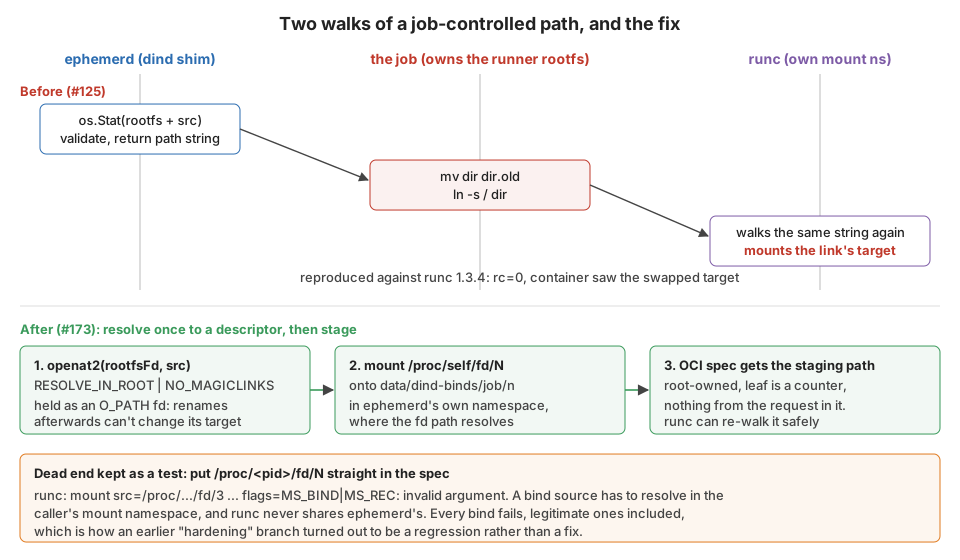
Case B is worth a moment. The textbook TOCTOU fix is to resolve once and hold a file descriptor. Then you hand over
the descriptor instead of the name. There was even a “hardening” branch that did exactly that, putting
/proc/<pid>/fd/N in the spec. It fails for the same reason #84 did. runc runs in its own mount namespace, and the fd
path doesn’t resolve there as a bind source. So every bind fails, legitimate ones included. That branch wasn’t a
fix. It was a regression that nobody had run against a real runc. The test that proves this is kept in the repo on
purpose (TestBindStaging_RealRunc_ProcFdSourceIsRejected).
The fix: pin it, then stage it
Two steps, and both are needed.
Resolve once, to a descriptor, with the kernel enforcing containment. openat2(2) with RESOLVE_IN_ROOT treats
the rootfs fd as / for the whole walk. So .. and absolute symlinks clamp inside it rather than escaping. The
result is held as an O_PATH fd. Renaming things afterwards can’t change what the fd points at:
how := &unix.OpenHow{
	Flags:   unix.O_PATH | unix.O_CLOEXEC,
	Resolve: unix.RESOLVE_IN_ROOT | unix.RESOLVE_NO_MAGICLINKS,
}
fd, err := unix.Openat2(rootFd, strings.Join(comps, "/"), how)
I used openat2 rather than Go’s os.Root on purpose. os.Root rejects absolute symlinks outright. Merged-usr
images (/bin -> /usr/bin) are full of them, so it would break every Ubuntu runner image. RESOLVE_IN_ROOT
reinterprets them relative to the root. That’s what a symlink inside a container rootfs means. Kernels older than 5.6
get an O_PATH|O_NOFOLLOW component-by-component walk instead. A test asserts both resolvers land on the same inode.
Stage it, because a descriptor can’t go in the spec. ephemerd does the bind itself onto a directory it owns. It
does that in its own mount namespace, where /proc/self/fd/N does resolve. The spec gets the staging path:
target := filepath.Join(m.dir, strconv.FormatUint(m.seq, 10))
// ... create a dir or empty file to match the source type ...

// /proc/self/fd/<n> is resolvable here because this IS the process that
// opened it and this IS its mount namespace — the two conditions runc
// cannot satisfy.
src := "/proc/self/fd/" + strconv.Itoa(p.fd)
if err := unix.Mount(src, target, "", unix.MS_BIND|unix.MS_REC, ""); err != nil {
	_ = os.Remove(target)
	return "", fmt.Errorf("staging bind source %s at %s: %w ...", p.logical, target, err)
}
runc still walks a path, but now it’s <data>/dind-binds/<job>/<n>. The leaf is a bare counter. Nothing from the
request ends up in the name. Every directory above it has to be root-owned and not group- or world-writable.
ensureTrustedAncestry checks that rather than assuming it. There’s nothing left for the job to swap.
The validation is the part I’d point other people at. The privileged tests run real runc against real containerd in a
root shell. The swap test contains its own control. It runs the old path-string code in the same test and asserts it
does see SWAPPED. Without the control, a green run proves nothing. That’s precisely how the fd branch got through
review.
Deleting through a live bind mount
One detail in #173 deserves its own heading. The obvious place for the staging dir was under the job’s directory,
<data>/jobs/<job-id>/. But the runtime’s orphan sweep os.RemoveAlls that tree. Recursively deleting a directory
that contains a live bind mount deletes the files you see through the mount. Here that’s the runner’s own rootfs. So
three things changed:
- Staging lives at
<data>/dind-binds/. - The teardown refuses to remove a directory that still has mounts under it.
- The startup sweep unmounts staged binds before sweeping containers and snapshots. A leaked staging mount also pins the rootfs, so the snapshot can’t be removed.
Pins are held for the container’s whole life, not just until the task starts. docker restart makes runc read the
spec again.
#201: sweeping someone else’s staging dir
That startup sweep came back to bite me. A later change added a periodic reaper for dead job containers. It called the
whole-tree SweepStagedBinds on every pass. That function’s own doc comment said “startup only”, for exactly this
reason: it doesn’t know which jobs are live.
The symptom was jobs running several docker run -v "$PWD":/w steps failing partway through:
docker: Error response from daemon: bind mount /home/runner/_work/ephpm/ephpm -> /w rejected:
  creating bind staging mountpoint /var/lib/ephemerd/dind-binds/ephemerd-github-ephpm-sure_hopper/2:
  mkdir /var/lib/ephemerd/dind-binds/... : no such file or directory
The /2 was the tell. Binds 0 and 1 staged fine. Then a reaper tick for some unrelated dead container wiped every
job’s staging directory, including this one. Already-running containers didn’t notice, since their mounts live in
their own namespaces. But the next docker run -v couldn’t create its mountpoint.
#201 scopes the periodic sweep to the container actually being reaped.
The test asserts the live job’s directory survives.
What I’d tell myself in May
- Paths are names, and names can change between when you check and when somebody else uses them. If a job controls any component of a path, that path can’t cross a process boundary as a string.
- Mount namespaces are the constraint for every one of these bugs.
/proc/<pid>/root,/proc/<pid>/fd/Nand a readlink that says/are all the same lesson about which namespace a path resolves in. - Security fixes need a test that fails on the unfixed code, run against the real thing. Mocks of runc don’t have mount namespaces.
Links
- PRs: #82, #83, #84, #85, #173, #201
docs/arch/dind-bind-translation.md- openat2(2)




