
Cross-Platform Process Containment: Job Objects vs Process Groups vs cgroups
How shipmates bounds and tears down agent process trees on Windows, Linux and macOS. It also covers why I deleted 1,206 lines of cgroup code and the grandchild that escaped the memory cap everywhere except my dev box.
Every turn a shipmates crew member takes is a subprocess. It’s
claude or the codex app-server. That in turn spawns shells, go test, npm or whatever the task calls for. Two
things have to be true about that tree. When a turn ends or gets killed, the whole tree goes, including the
grandchildren. And if somebody sets a memory or CPU budget, the budget applies to the whole tree, not just the
process I happened to start.
Each OS gives you a different primitive for that, and they’re not equivalent. shipmates ended up using Job Objects on Windows and process groups plus sampling on Linux and macOS. This post covers how that happened and why the cgroup path got deleted. It also covers the bug that only existed on the platforms I wasn’t sitting in front of.
The three primitives
| Windows Job Object | Unix process group | Linux cgroup v2 | |
|---|---|---|---|
| Who’s in it | every descendant, automatically, unless it breaks away | every descendant that doesn’t call setpgid/setsid |
every descendant, can’t leave without privileges |
| Tree kill | TerminateJobObject, or KILL_ON_JOB_CLOSE when the last handle closes |
kill(-pgid, SIGKILL) |
cgroup.kill (5.14+) |
| Memory cap | kernel-enforced, JobMemoryLimit on committed memory |
none, you sample and kill | kernel-enforced, memory.max |
| Process count cap | kernel-enforced, ActiveProcessLimit |
none | pids.max |
| Privileges | none | none | a delegated subtree (systemd scope, or root) |
On paper cgroups win. In practice, “a delegated subtree” is where it falls apart for a tool you install with a single binary:
- on a desktop you need a systemd user scope with the right controllers delegated
- in a container you usually don’t get one at all
- macOS doesn’t have cgroups
Job Objects need nothing. Process groups need nothing.
Deleting the cgroup launcher
The codex runtime originally carried its own Linux-only, cgroup-delegating launcher inside internal/codexapp. It was
reachable only through the codex transport, and only when an operator set containment.mode: cgroup. Its single real
test was gated behind SHIPMATES_REAL_CONTAINMENT_TEST=1. Which meant it had never run in CI. When I
moved CI to ephemerd I even wrote down that the delegated-scope job
was the gap. Everywhere else, and by default, codex ran with no containment at all.
24bd788 deleted it. That’s 1,206 lines across these files:
containment_linux.gocgroup_discovery_linux.go- their tests
containment_pidfd_linux.gocontainment_other.go
Codex now spawns its app-server through the same containment.Watcher that Claude uses. Every runtime gets the same
bounds on every OS.
The part I care most about is what happens to configs that still say cgroup. The old docs said it “degrades to
watchdog with a warning”. Now the config fails to resolve, with config.ErrCgroupModeRemoved:
containment mode "cgroup" has been removed: shipmates now contains every runtime with the portable
watchdog (RSS/CPU sampling plus process-tree teardown on Linux, macOS and Windows). Use mode: watchdog
— your memory_limit_mb, cpu_limit_seconds and other limits carry over unchanged
An operator who asked for kernel enforcement and quietly got polling has been told something untrue about their own
deployment. A warning in a log nobody reads is still a lie. The same reasoning applies to Caps.Containment. It’s now
derived from whether the supervisor bounds anything, so the none watcher can’t report that it contains.
Windows: suspended, assigned, resumed
On Windows the watchdog creates the child suspended. It puts the child in a Job Object before it runs a single instruction, then resumes it. Assigning a running process leaves a window where it can spawn a child outside the job.
func prepare(cmd *exec.Cmd, _ containment.Limits) error {
	if cmd.SysProcAttr == nil {
		cmd.SysProcAttr = &syscall.SysProcAttr{}
	}
	cmd.SysProcAttr.CreationFlags |= windows.CREATE_SUSPENDED | windows.CREATE_NEW_PROCESS_GROUP
	return nil
}
Then attach creates the job with JOB_OBJECT_LIMIT_KILL_ON_JOB_CLOSE and layers on whatever limits were asked for:
info := windows.JOBOBJECT_EXTENDED_LIMIT_INFORMATION{
	BasicLimitInformation: windows.JOBOBJECT_BASIC_LIMIT_INFORMATION{
		LimitFlags: windows.JOB_OBJECT_LIMIT_KILL_ON_JOB_CLOSE,
	},
}
if limits.MaxRSSBytes > 0 {
	info.BasicLimitInformation.LimitFlags |= windows.JOB_OBJECT_LIMIT_JOB_MEMORY
	info.JobMemoryLimit = uintptr(limits.MaxRSSBytes)
}
if limits.MaxProcesses > 0 {
	info.BasicLimitInformation.LimitFlags |= windows.JOB_OBJECT_LIMIT_ACTIVE_PROCESS
	info.BasicLimitInformation.ActiveProcessLimit = limits.MaxProcesses
}
Each flag is guarded on a non-zero limit. Setting a LimitFlags bit without its paired value is a no-op at best. And a
caller who asked for nothing shouldn’t silently get kernel enforcement. KILL_ON_JOB_CLOSE is always on. Even if
shipmates itself dies, closing the last job handle takes the tree with it. That’s the closest thing Windows has to
Linux’s Pdeathsig.
JobMemoryLimit is committed memory across every process in the job. The kernel enforces it when the allocation
happens. To see it, I put a Go “agent” in a job with a 256 MiB limit. It spawned a “tool” grandchild that commits 16 MiB
at a time:
parent: agent in a job with a 256 MiB limit
tool: 16 MiB committed
tool: 32 MiB committed
...
tool: 208 MiB committed
tool: 224 MiB committed
runtime: VirtualAlloc of 16777216 bytes failed with errno=1455
fatal error: out of memory
Errno 1455 is ERROR_COMMITMENT_LIMIT. My code never touched the grandchild. It just inherited the job, and the kernel
stopped it short of the budget the parent was given. The agent and the Go runtime overhead eat the rest. No polling gap.
Linux and macOS: process groups and a sampler
On Unix the child is started as a process group leader with Setpgid. Its pid is the pgid and every descendant
inherits the group. Teardown signals the group:
func killTree(cmd *exec.Cmd, kill bool) error {
	if cmd.Process == nil {
		return nil
	}
	sig := syscall.SIGTERM
	if kill {
		sig = syscall.SIGKILL
	}
	pgid, err := syscall.Getpgid(cmd.Process.Pid)
	if err != nil {
		pgid = cmd.Process.Pid
	}
	return syscall.Kill(-pgid, sig)
}
There’s no kernel memory cap here. A sampler polls RSS and CPU time on an interval and calls killTree when the budget
is exceeded. Which brings us to the bug.
The bug my dev box hid
A cross-platform sweep after v0.6.0 found it (PR #58). The Unix
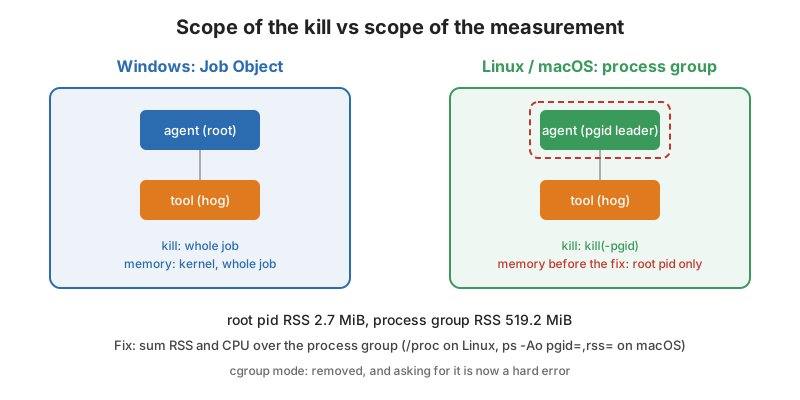
sampler measured RSS and CPU for cmd.Process.Pid, the root, and nothing else. The kill covered the whole process
group. So the scope of measurement and the scope of enforcement didn’t match. A tool subprocess that hogged memory
or spun CPU was invisible to the sampler, and the cap never fired.
On Windows the Job Object enforces memory across the whole tree in the kernel, so the bug simply doesn’t exist there. I develop shipmates on Windows. Every manual check I’d ever done of the memory cap passed.
Here’s a small Linux program showing exactly what the old sampler saw. The “agent” is a tiny Go process that runs a “tool” child which touches 512 MiB:
t=0.5s  root pid RSS:    2.7 MiB   process group RSS:  519.2 MiB (2 procs)
t=1.0s  root pid RSS:    2.7 MiB   process group RSS:  519.2 MiB (2 procs)
t=1.5s  root pid RSS:    2.7 MiB   process group RSS:  519.2 MiB (2 procs)
t=2.0s  root pid RSS:    2.7 MiB   process group RSS:  519.2 MiB (2 procs)
With a 256 MB cap, the old sampler would read 2.7 MiB forever.
The fix (1642864) makes the Unix samplers measure the
group. On Linux that’s a walk of /proc. It reads field 5 of each /proc/<pid>/stat (the pgrp) and sums statm RSS
and utime+stime for the members. Field parsing has to count from the last ). The comm field is parenthesized and
can itself contain spaces and parentheses:
func parseProcStatPgrp(s string) (int, error) {
	closeIdx := strings.LastIndex(s, ")")
	if closeIdx < 0 {
		return 0, fmt.Errorf("watchdog: malformed stat: %q", s)
	}
	after := strings.Fields(s[closeIdx+1:])
	if len(after) < 3 {
		return 0, fmt.Errorf("watchdog: stat missing pgrp field")
	}
	pgrp, err := strconv.Atoi(after[2]) // state ppid pgrp ...
	if err != nil {
		return 0, fmt.Errorf("watchdog: bad pgrp: %w", err)
	}
	return pgrp, nil
}
macOS has no /proc, and ps has no dependable “select by process group” flag. So it snapshots every process with
ps -Ao pgid=,rss= (and pgid=,time= for CPU) and sums the rows whose pgid matches. Both versions treat “no processes
found in the group” as a failed sample, not a zero. A gone group leader skips the tick rather than reporting a reading
comfortably below the cap.
The summation logic is factored into pure functions so it’s unit tested on every platform. There’s also a
linux || darwin test that spawns a memory-hogging grandchild and fails against the old root-only sampler.
What’s still uneven
The Windows sampler is still root-only, on purpose. Memory is enforced tree-wide by the job, so the sampler there is
defense in depth. CPU seconds are the exception. The Job Object doesn’t express a CPU-seconds budget the way the
watchdog does. So cpu_limit_seconds on Windows is approximated from the root process’s times. A grandchild spinning
CPU on Windows escapes that cap today. The cheap fix is probably QueryInformationJobObject with
JobObjectBasicAccountingInformation. It reports total user and kernel time for everything that has ever run in the
job, with no tree walk required. That’s next.
And sampling is sampling. A process group can grow between two polls. Anything that calls setsid leaves the group
entirely. For an agent’s tool calls that’s an acceptable trade for a single binary that needs no privileges. If you need
a hard wall on Linux, run the ship inside a systemd scope or a container with memory.max set. Let shipmates’ own
limits be the inner layer.
How I measured
Both demos are small standalone Go programs on an AMD Ryzen 9 5950X with 128 GB RAM. I used Go 1.26.5 on Windows 11
Pro. The Linux one was cross-compiled and run under WSL2 kernel 6.18.33.2. It starts an “agent” with Setpgid: true.
The agent runs a “tool” that allocates 32 x 16 MiB with every page touched. Every 500 ms it prints /proc/<pid>/statm
RSS for the root next to the sum over the process group. The Windows one creates a Job Object with
JOB_OBJECT_LIMIT_JOB_MEMORY set to 256 MiB and assigns the agent. Then it lets the agent’s child allocate 16 MiB at a
time.
Links
24bd788: contain codex with the portable watchdog, delete cgroups- shipmates PR #58: sample the whole process group
- Job Objects (Microsoft Learn)
- JOBOBJECT_BASIC_ACCOUNTING_INFORMATION
- cgroup v2 documentation




