Replacing a k3s Cluster With One ePHPm Process
How three PHP sites, their databases, cron and backups collapse onto one small VM, and what that costs once you match the bill to the size of the problem.
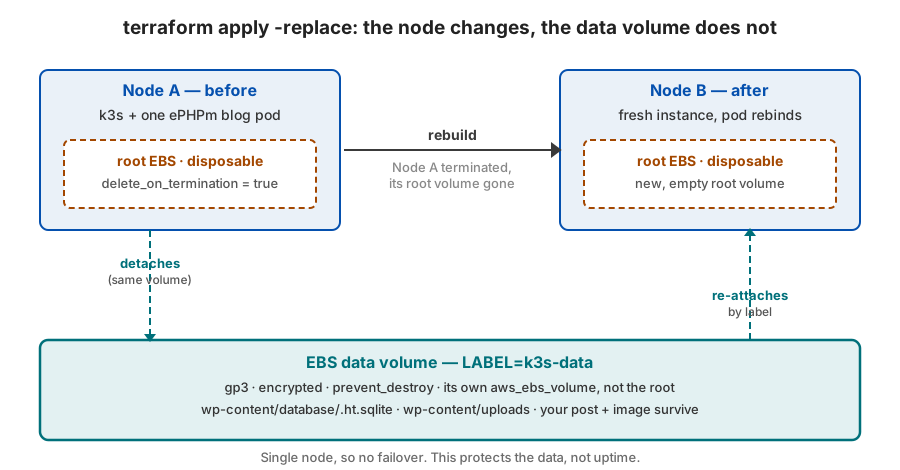
A couple of weeks ago I wrote up surviving a node rebuild on single-node k3s. Put the stateful bytes on a dedicated EBS volume, treat the node as cattle, and rebuild the machine without losing the data. It works.
Then I looked at what I was actually running on that node and felt a little silly.
The workload is three PHP sites (an admin app, self-hosted Sendy for email, a wholesale catalog) plus three crons. That’s it. To run it I had a k3s control plane, a kubelet, Traefik for ingress, Tailscale for access, a CSI driver, a litestream sidecar for backups, three k8s CronJobs, and a stack of Helm charts holding it together. Every piece of that is something I patch, monitor, and get paged for, and none of it is the app. It was a datacenter wrapped around three PHP sites and some crons.
So I migrated it. The whole thing now runs as a single process on one AWS VM: ePHPm. The one binary is the web server, the PHP runtime, the per-site SQLite engine, the KV store, the cron scheduler, and the backup agent: the whole stack above, collapsed into one. The only other thing on the machine is the app code.
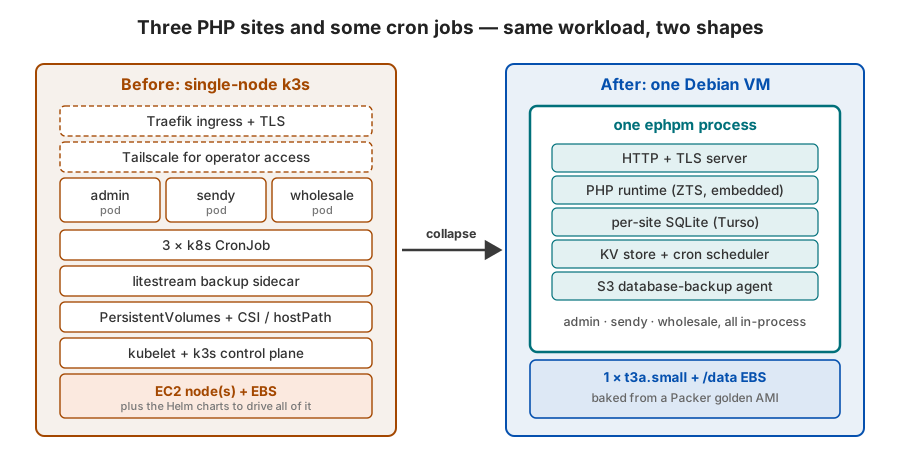
What ePHPm absorbs
The reason a single binary can replace that stack is that ePHPm already is most of the stack. It embeds PHP with the ZTS build, so it is the runtime directly, no php-fpm pool. It serves HTTP and terminates TLS itself, so there’s no reverse proxy. Each site gets its own SQLite database through the embedded Turso engine, so there’s no MySQL to run. And it carries a Redis-compatible KV store for sessions, a cron scheduler, and a backup agent that snapshots every database to S3.
I covered the clustered SQLite and the
KV store before; what matters here is the deployment shape. One ephpm.toml
describes all three sites. The apps connect to their databases with stock pdo_mysql over a loopback listener, and ePHPm
injects each site’s credentials, so no app file holds a password. Sendy’s scheduled send, its CSV import, and the wholesale
catalog refresh are three [[cron.jobs]] entries: the former k8s CronJobs, now config lines the scheduler runs exactly
once even when more than one node is up.
Sendy is the one that proves the isolation is real. It’s a classic .htaccess app (dozens of top-level PHP scripts and
pretty tracking URLs), so it needs a per-site [[rewrite]] block, plus a scoped capability grant that lifts mail and
fsockopen for that vhost alone. Admin and wholesale never get those; they stay hardened. One binary, three very different
apps, and the loose one can’t reach past its own vhost.
One structural fact matters below: the box is a baked, immutable image, and its state lives on a separate EBS volume. The instance is disposable; the data isn’t. How that image is built is part two. Here it just has to be true, because it’s what makes the cost math work.
What it costs
This is the part people get wrong about going from a cluster to a box. They assume you traded capability for thrift. You didn’t. You matched the bill to the size of the problem. Here’s the whole monthly bill, us-west-2, on-demand, nothing reserved.
| Line item | Spec | Monthly |
|---|---|---|
t3a.small on-demand |
2 vCPU / 2 GB, ~730 hrs | $13.72 |
| EBS gp3 | 20 GB root + 20 GB data @ $0.08/GB | $3.20 |
| Public IPv4 (Elastic IP, in use) | 1 address @ $0.005/hr | $3.65 |
| S3 backups | gzipped snapshots, retention-tuned | ~$2-3 |
| All-in | ~$23/mo |
The fixed floor (compute, disk, IP) is $20.57. Two line items are easy to miss. gp3 is cheaper than the old gp2 default and still gives you 3,000 IOPS baseline for free, so 40 GB is $3.20 and not a penny more. And since February 2024 AWS charges for every public IPv4 address, in use or idle: about $3.65/mo for the one Elastic IP, a line nobody budgeted for two years ago. A “free” static IP is a real part of this comparison.
I did shop around. Linode and DigitalOcean bundle the static IP, and Oracle’s always-free ARM tier is genuinely capable for nothing. Both are real options, and the ARM pricing is better. I stayed on AWS for two unglamorous reasons: the account, Terraform, and S3 bucket are already there, and the admin app’s imagick build is pinned to amd64 and glibc 2.36, so Oracle’s ARM (Ampere) tier means rebuilding that ABI story, not copying a config. A $3.65/mo static IP that just works beat a free one on a platform I’d have to re-learn.
None of this is about squeezing pennies. It’s about matching the infrastructure bill and the operational cost to the actual size of the problem. Three PHP sites and some crons is a small problem. It should run on a small thing.
The outage you can afford
Everything above is on-demand, the no-tricks number. But there’s a cheaper gear, and whether you can shift into it is a question about your apps, not your infrastructure.
First, right-size. I load-tested the box and it idles around 400 MB of RAM and a few percent of one CPU. Even under a
sustained flood (fifty concurrent connections on the heaviest catalog page), memory barely moved, because ePHPm caps PHP
concurrency to the core count (floored at two) and queues the rest; traffic can’t balloon the heap, it just waits. A 1 GB
t3a.micro has plenty of headroom. The 2 GB in the table was caution, not need.
Then spot. Spot is the same hardware at a fraction of the price (a t3a.micro runs about $2-3/mo on spot against $6.86
on-demand) with one string: AWS can take the box back on two minutes’ notice. For a lot of workloads that’s a dealbreaker;
for this one it isn’t, since the storefront is Shopify, never this box, and what’s here (the admin panel, the wholesale
catalog, Sendy) is internal tools and a mailer that can go dark for a couple of minutes without breaking a checkout or
losing a dollar, exactly the profile where spot stops being reckless and starts being obvious.
Right-sized and on spot, it’s the same box for less than half the bill:
| On-demand, as billed above | Right-sized on spot | |
|---|---|---|
| Instance | t3a.small, 2 GB |
t3a.micro, 1 GB |
| Compute | $13.72/mo | ~$2-3/mo |
| All-in | ~$23/mo | ~$10/mo |
| Interruptions | none | AWS can reclaim on two minutes’ notice |
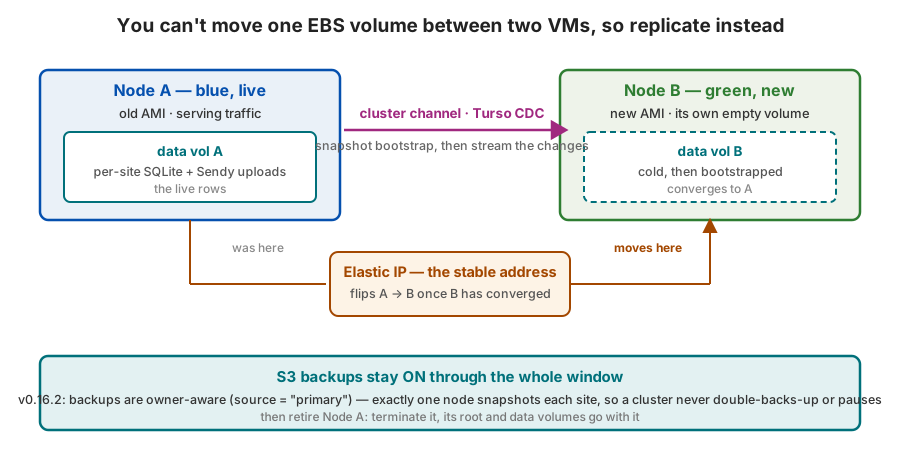
So the box runs in a single-node spot Auto Scaling Group. The data already lives on its own EBS volume, so when a spot node dies the disk outlives it. A replacement boots, re-attaches that same volume (seconds, not a copy; the 1.3 GB never moves), re-grabs the Elastic IP, and starts serving. A small watcher catches the two-minute interruption notice and stops ePHPm gracefully first, so it flushes its WAL and finishes the in-flight Sendy SES batch; the next cron tick resumes the send at the exact queue offset, because Sendy’s queue is the resume point.
I didn’t want to take that on faith, so I tested it the rude way and timed the gap, twice:
- Hard kill, no notice. I terminated the running spot node cold, the worst case. The ASG launched a replacement, it re-attached the volume and the IP, and the site answered again 81 seconds later. The databases came back byte-for-byte intact, because the replacement replayed Sendy’s uncheckpointed WAL on startup, which is the whole point of a write-ahead log.
- Real rebalance, minutes later. AWS sent a genuine rebalance recommendation and the ASG swapped the node again, and the data sailed through that one too.
Two unplanned replacements, zero data loss.
The second swap taught me one thing worth passing on: for a single node, leave capacity rebalancing off. It replaces an at-risk instance before it’s actually interrupted, which is what you want when a second node covers the swap and what you don’t want when there’s one node and every swap is 80 seconds dark for an interruption that might never come. One node rides until a real interruption; a fleet rebalances early.
Is it zero-downtime? No. One node on spot has a real, non-zero chance of a few minutes dark, and no arrangement of spot
drives that to zero. If I needed never-interrupted I’d keep one on-demand node as a floor (on_demand_base = 1) or run a
warm second node; both cost more, in dollars or moving parts. I need neither. Call it 99.98% on internal tools whose
outages self-heal and never reach a customer; not a number worth paying to improve. Match the availability to the problem:
some apps can trade a sliver of uptime for a chunk of cost, and these are those apps. Doing it drops the all-in nearer
$10/mo than $23.
Baking the image, backing it up, and shipping new code without downtime is the second half.