
Rolling Your Own KV Store Instead of Embedding Redis
Why ePHPm has its own Redis-compatible cache built in instead of running Redis. It also covers a bug that hid in it for four months and how it compares to real Redis on the same machine.
Every PHP deployment I’ve run eventually grew a Redis. Sessions, the WordPress object cache, Laravel’s cache and locks,
rate limiting. ePHPm is supposed to be one binary that replaces nginx + php-fpm +
Redis, so it needed a cache in the box. I didn’t want to write one. This post covers why I did anyway and how it’s
built. It also covers the bug that sat in its eviction code from March until last month. Then I compare it against a
stock Redis on the same machine with redis-benchmark doing the talking.
What I tried to embed first
The goal was a library. I wanted something I could link into the same process, call from Rust and expose to PHP. Here are the usual suspects and why each one didn’t work:
- Redis is a server, not a library. It owns its process, runs its own
aeevent loop and expects to be the only thing inmain(). There is nolibredis.a. Carving one out of the codebase would be a fork I’d maintain forever. Its license also moved to RSALv2/SSPL with 7.4 in 2024. AGPL was added as an option with 8.0. That’s a lot of legal surface for something I’d be redistributing inside another product. - Dragonfly is the most interesting one technically and the clearest no. It’s a standalone C++ server built on
io_uringand its own fiber runtime, which would fight tokio for the same cores. And its BSL 1.1 license permits use “only as part of your own product or service, provided it is not an in-memory data store product or service.” One headline feature of this PHP server is a clustered in-memory cache. That’s close enough to the line that I’m not going near it. - Dragonfly’s threading model is also wrong for this. It’s shared-nothing. Each thread owns a slice of the keyspace and requests get routed to the owning thread. In ePHPm any PHP worker thread needs to read any key synchronously from inside a request.
- KeyDB, Garnet, Valkey have different licenses but the same shape. Valkey is BSD, which is great. They’re all servers that want to own a process.
All of them are built for millions of ops per second across many gigabytes. They bring persistence, replication, Lua
and streams. What PHP apps use Redis for is much narrower: get/set with a TTL, counters, a few hashes, SETNX for locks.
What I built instead
crates/ephpm-kv is the whole thing. As of v0.5.2 it’s about 5,900 lines including its unit tests. It has four parts:
- a store
- a RESP2 parser and encoder
- a command dispatcher
- a TCP server
The core is two DashMaps, one for strings and one for hashes. That way WRONGTYPE falls out
naturally:
pub struct Store {
    /// The main data map (string values).
    data: DashMap<String, Entry>,
    /// Hash values stored separately to avoid Entry enum complexity.
    hashes: DashMap<String, HashEntry>,
    /// Approximate total memory used by all entries.
    mem_used: AtomicUsize,
    config: StoreConfig,
}
DashMap is a sharded concurrent hash map. It has a power-of-two number of shards, about 4 × CPU count by default. Each
shard is an RwLock around a hashbrown table. Reads on different shards never touch the same lock, and reads on the
same shard share a read lock. That’s the property Dragonfly’s model doesn’t give me: any thread, any key, no routing.
There are two ways in. PHP code can call native functions (ephpm_kv_get() and friends) that go straight from the Zend
engine into this store with no socket at all. There’s also a RESP2 listener, off by default. With it, existing clients
work unchanged against 127.0.0.1:6379. That includes phpredis, Predis, redis-cli and Laravel’s Redis driver.
The command set is deliberately the cache subset:
GET SET SETEX SETNX MGET MSET INCR/DECR[BY] APPEND STRLEN GETSET DEL EXISTS EXPIRE PEXPIRE TTL PTTL PERSIST TYPE RENAME KEYS DBSIZE FLUSHDB FLUSHALL- the
H*hash commands PING ECHO SELECT INFOSETwithEX/PX/NX/XX/GET
No lists, sets, sorted sets, streams, pub/sub, Lua or MULTI. If you need a queue, run a real Redis.
Expiry: lazy on read, swept in the background
Each entry carries an optional absolute expiry. A read that finds an expired entry deletes it and reports a miss. You never see stale data even if nothing else runs:
pub fn get(&self, key: &str) -> Option<Bytes> {
    let entry = self.data.get(key)?;
    if entry.is_expired() {
        drop(entry);
        self.remove_local(key);
        return None;
    }
    entry.touch(self.now_nanos());
    if entry.compressed {
        decompress_value(&entry.data, self.config.compression.algo)
    } else {
        Some(entry.data.clone()) // Bytes: a refcount bump, no memcpy
    }
}
Lazy expiry alone leaks memory for keys that are set and never read again. Every abandoned session is one of those. So a
background task runs expire_pass() periodically. Originally that walked every entry in the map to find expired ones.
In July (#173) it got a side index. That’s a DashSet of keys that have a
TTL at all. Now the sweep is proportional to the number of keys that can expire rather than all keys. The index is a
hint, not the truth. The authoritative check is still is_expired() on the entry. A stale hint just costs one lookup
and gets pruned.
Eviction, and the bug that hid in it
There’s a memory_limit (256MB by default) with Redis’s policies: noeviction, allkeys-lru, volatile-lru,
allkeys-random. Memory accounting is approximate on purpose. It counts key + value + struct + a fixed overhead per
entry. The total is kept in an atomic and checked on every write.
An exact LRU needs a linked list threaded through every entry and re-linked on every read. That means a second lock on the read path. Redis doesn’t do that either. It samples a handful of keys and evicts the one that was touched longest ago. ePHPm does the same: sample 16, evict the oldest, repeat until there’s room.
This is what that looked like from March until July:
// Sample keys and find the one with the oldest last_accessed.
for entry in &self.data {
    if volatile_only && entry.value().expires_at.is_none() {
        continue;
    }
    // ... keep the oldest ...
    count += 1;
    if count >= sample_size {
        break;
    }
}
That’s not a sample. &self.data iterates DashMap from shard 0 every time. The “random 16” were always the first 16
entries of the first shard or two. Keys in every other shard were never eviction candidates at all. The same handful of
keys got re-examined on every attempt. Under memory pressure it evicted whatever happened to hash into shard 0, hot or
not. The tests passed because they used small stores where the first 16 entries were the whole store.
The fix (#197, late July) uses DashMap’s raw-api. It starts at a
pseudo-random shard and walks shards from there, taking candidates until it has 16. It’s the one unsafe block in the
crate. It dereferences raw hashbrown buckets while holding that shard’s read lock. It’s also bounded. It visits at most
shard_count + 16 entries per victim regardless of store size.
Two other read-path changes in July are worth mentioning. They’re the kind of thing you only find with a profiler:
- Clone-on-read (#146).
getreturnedVec<u8>, a full copy of the value. The RESP encoder then boxed it again. Values are nowbytes::Bytes, so aGETis a refcount bump from the store to the socket. The RESP parser also slices bulk strings out of the read buffer withsplit_to().freeze(). ASETpayload goes from the network buffer into the store without a copy either. - The LRU touch (#146, #173).
last_accessedwas anInstant. EveryGETtook the shard’s write lock to update it, so concurrent reads of the same shard serialized. It’s now anAtomicU64of nanoseconds since a store-level anchor. It’s updated with a relaxed store under the read lock. Then it got coarser: the touch only writes if the stored time is more than 100ms old. Hot keys read thousands of times per second were bouncing that cache line between cores on every read. Now a read is a load, and the line stays shared.
And one fix wasn’t in the store at all. Every RESP connection was missing TCP_NODELAY
(#161), and so was the DB proxy. Nagle plus delayed ACK added a ~44ms stall
on certain round trips. The HTTP accept loop already set it on every accepted socket. That’s why nobody noticed on the
web side.
Against a real Redis
I wanted to know whether any of this was competitive or just “good enough for PHP.” So I pointed redis-benchmark at
three servers on the same box, each with the RESP listener enabled:
- Redis 7.4.11 in a container
- the v0.5.2 release of ePHPm, with all of the above
- the v0.2.0 release from the end of June, before the July read-path work
Each test used 50 clients, 256-byte values, 100,000 random keys and 1,000,000 requests. I ran it once without pipelining and once with 16 commands per pipeline, three runs each:
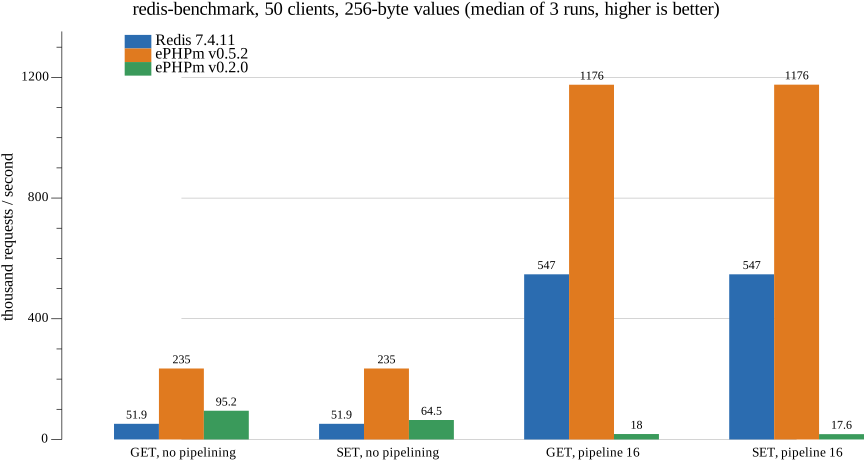
| ops/s (median of 3) | Redis 7.4.11 | ePHPm v0.5.2 | ePHPm v0.2.0 |
|---|---|---|---|
| GET, no pipelining | 51,929 | 235,238 | 95,211 |
| SET, no pipelining | 51,929 | 235,239 | 64,491 |
| GET, pipeline 16 | 547,345 | 1,175,641 | 17,975 |
| SET, pipeline 16 | 547,345 | 1,175,779 | 17,582 |
Before anyone screenshots that and posts “Rust cache 4x faster than Redis”: it isn’t, not in the way that headline
means. Redis executes commands on one thread. ePHPm handles RESP connections on a multi-threaded tokio runtime against a
sharded map. That runtime has 32 worker threads on this box. Give it 50 concurrent connections and a client that can
push hard enough (redis-benchmark --threads 4), and the multi-threaded server wins on throughput. That’s what you’d
expect from 32 threads against one. Two more runs make the shape clearer:
| Redis 7.4.11 | ePHPm v0.5.2 | |
|---|---|---|
| 1 client, GET, p50 latency | 0.079 ms (10,934 ops/s) | 0.079 ms (11,632 ops/s) |
| 50 clients, single-threaded benchmark client, GET | 71,628 ops/s | 67,096 ops/s |
One connection at a time, they’re the same speed. The round trip over loopback dominates and neither server is the bottleneck. With a single-threaded benchmark client, the client is the bottleneck and Redis is a little ahead. So here’s the honest summary. Per command, ePHPm’s store is in the same league as Redis. Under concurrent load it scales across cores where stock Redis doesn’t. Redis’s I/O threads would close some of that gap. I ran it with defaults. That’s plenty for a PHP cache.
The more interesting comparison is v0.2.0 to v0.5.2. Same server code path, a month apart. Unpipelined throughput went
up 2.5x to 3.6x. Pipelined throughput went from about 18,000 ops/s to 1.18 million. The old figure was slower than the
same version without pipelining. I haven’t bisected which of the July changes fixed the pipelining collapse. It predates
the copy removal, the atomic LRU touch, the coarse clock and TCP_NODELAY. Any of them could interact with batched
writes. It’s a good reminder that “works in the tests” and “works under a pipelining client” are different claims.
What it isn’t
It’s a cache. There’s no persistence, so a restart is an empty cache (that’s what a cache is). The memory accounting is an
estimate. There’s no MULTI, no Lua, and no data types beyond strings and hashes. Every one of those is a deliberate
“not yet.” The RESP listener means the exit is cheap. If an app outgrows it, point the Redis client at a real Redis and
nothing else changes.
What it is: no second daemon, no second config file, no extra port open between PHP and its cache. When PHP calls the native functions instead of RESP there’s no socket at all. That last path is a whole topic of its own.
How I measured
- AMD Ryzen 9 5950X (16C/32T), 128 GB (62 GiB visible to WSL2), Windows 11 with WSL2. ePHPm ran in the Ubuntu WSL
distro. Redis (
docker.io/library/redis:7-alpine, 7.4.11,--save '' --appendonly no) andredis-benchmarkran in Podman with host networking. On WSL2 that shares the network namespace with the Ubuntu distro, so everything is loopback. - ePHPm
v0.5.2+php8.4.23andv0.2.0+php8.4.22release binaries,[kv] memory_limit = "2GB", compression off,[kv.redis_compat] enabled = true. redis-benchmark -t set,get -n 1000000 -r 100000 -d 256 -c 50 -P 1 --threads 4 --csvand the same with-P 16 -n 10000000. v0.2.0 used-n 1000000because it would otherwise take ten minutes. Three runs per configuration, median reported. The two extra rows are-c 1 -t get -n 100000and-c 50without--threads, one run each.- Same machine for client and servers, so the client competes for CPU. Redis is single-threaded for command execution. ePHPm runs its RESP connections on a multi-threaded tokio runtime. That’s an honest description of how each runs by default, not a tuned comparison.
Links
- ePHPm, the store is
crates/ephpm-kv - #146 Bytes values and atomic LRU touch, #161 TCP_NODELAY, #173 coarse LRU clock and TTL index, #197 unbiased sampled eviction
- DashMap
- Redis key eviction (the sampled LRU this copies)
- Dragonfly license




