
Faking MySQL's Quirks Well Enough to Fool WordPress
Passing WordPress's install tests didn't mean litewire behaved like MySQL. This is the second round of fixes, for the small MySQL behaviors that WordPress and Laravel quietly depend on.
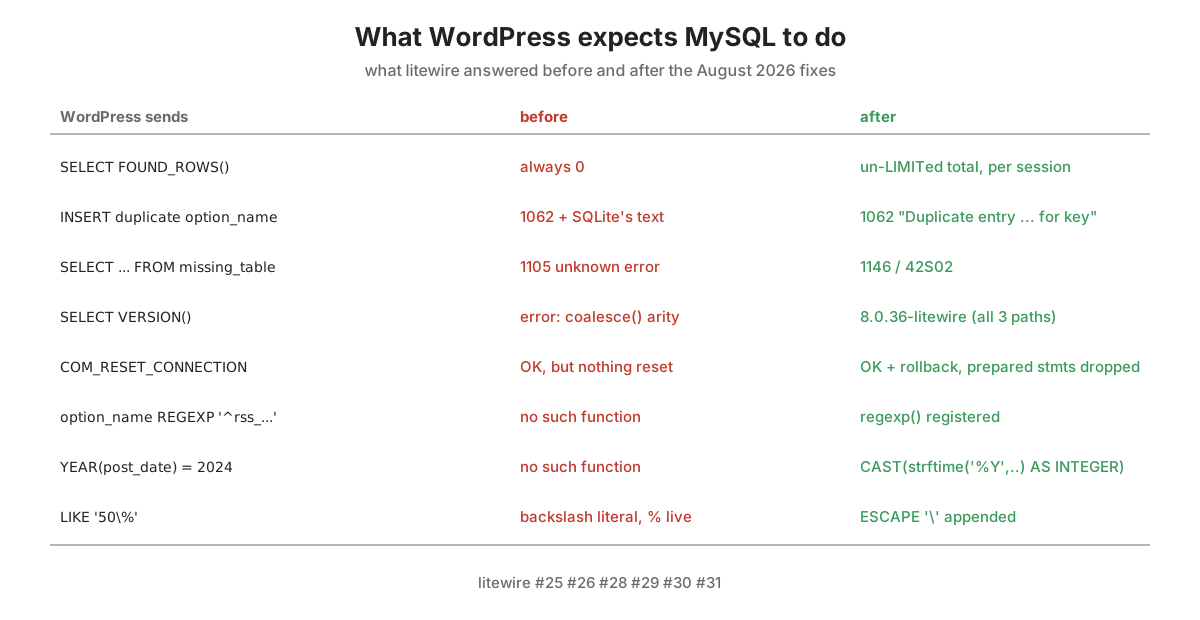
Last month I wrote about running SQLite behind a MySQL socket with litewire. I ended on “passing an install suite is not the same thing as behaving like MySQL”. That turned out to be accurate. On August 10th a few things happened at once:
- I put a real WordPress 7.0.3 site through a benchmark on ePHPm.
- I A/B tested the new in-process database bridge against the wire path.
- I started building ephpm/db-wordpress, a
wpdbdrop-in that talks to the database in-process instead of over a socket.
Between them they produced six litewire issues in about three hours. None of them broke the install. All of them made WordPress quietly do the wrong thing.
The common thread is that the client is code I don’t control. WordPress, Laravel, Doctrine and PDO all make decisions based on what MySQL says back. Some of those decisions are made by matching strings. If litewire answers in the wrong shape, the app doesn’t crash. It just takes the wrong branch.
FOUND_ROWS() was always zero
WP_Query paginates the old way:
SELECT SQL_CALC_FOUND_ROWS wp_posts.ID FROM wp_posts WHERE ... ORDER BY wp_posts.post_date DESC LIMIT 10, 10;
SELECT FOUND_ROWS();
MySQL 8 deprecates the hint, but WordPress still uses it unconditionally. The second statement is how found_posts
gets set. In July the translator stripped the hint, since sqlparser can’t parse it. It also rewrote FOUND_ROWS() into
something SQLite would accept, which got the install suite past it. Here’s what it did with that second statement:
IN : SELECT FOUND_ROWS()
OUT: SELECT abs(0)
So the benchmark probe ran a calc query that returned 56 rows and got 0 back from FOUND_ROWS(). That’s
found_posts = 0 on every WordPress running on ePHPm. Every REST list response said X-WP-Total: 0 and every archive
page had broken totals (litewire#23). The fix that made the install pass
was the one that hid the bug.
FOUND_ROWS() is per-connection state, so it can’t live in the stateless translator. It lives in
litewire-session’s Session, next to in_transaction. That means the wire path and ePHPm’s in-process bridge both
get it. After a statement carrying the hint succeeds, the session runs one extra COUNT(*). The count statement is
derived through the AST, not by string surgery. Take the fully translated statement, remove LIMIT, ORDER BY and
FETCH, and wrap it.
let stmt = crate::rewrite_statement(statements.pop()?, dialect).ok()?;
let Statement::Query(mut query) = stmt else {
    return None;
};

if limit_clause_has_placeholder(query.limit_clause.as_ref()) {
    return None;
}
query.limit_clause = None;
query.order_by = None;
query.fetch = None;

Some(format!("SELECT COUNT(*) FROM ({query})"))
For the WP_Query statement above, at litewire cb707ab, that produces:
SELECT COUNT(*) FROM (SELECT wp_posts.ID FROM wp_posts WHERE 1 = 1
  AND wp_posts.post_type = 'post' AND wp_posts.post_status = 'publish')
It’s bound with the same parameter list, so WHERE placeholders keep working. A bare SELECT FOUND_ROWS() is then
answered from session state without touching the backend. Statements without the hint pay one allocation-free ASCII
scan and zero extra round trips. A counting-backend test pins that down. Two cases fall back to the returned row count
instead:
- the hint inside multi-statement input
- a
LIMITbound as a placeholder, since stripping it would desynchronize the positional parameters
The end-to-end tests for this immediately found a worse bug. rewrite_limit_clause took the limit clause out of the
AST to check for MySQL’s LIMIT offset, count form. It only put it back if it matched:
fn rewrite_limit_clause(query: &mut sqlparser::ast::Query) {
    if let Some(LimitClause::OffsetCommaLimit { offset, limit }) = query.limit_clause.take() {
        query.limit_clause = Some(LimitClause::LimitOffset { /* LIMIT count OFFSET offset */ });
    }
}
Everything else was dropped on the floor. Running it at the July revision:
SELECT * FROM wp_posts LIMIT 5            => SELECT * FROM wp_posts
SELECT * FROM wp_posts LIMIT 5 OFFSET 10  => SELECT * FROM wp_posts
SELECT * FROM wp_posts LIMIT 10, 5        => SELECT * FROM wp_posts LIMIT 5 OFFSET 10
WordPress mostly emits the comma form, which is how this hid. An existing test even hedged with “sqlparser may or may
not preserve LIMIT”. The fix is one other => query.limit_clause = other arm. It rode along in
litewire#26 because FOUND_ROWS() is meaningless if LIMIT doesn’t apply.
Error codes are an API
SQLite’s no such table: wp_foo fell through to MySQL’s catch-all, 1105 / HY000. That carries no information, and
frameworks branch on the real code. Doctrine raises TableNotFoundException off 1146, and MySQL clients expect 42S02
to come with it. Mapping it was a substring match. It also catches the Turso engine’s wording, which prefixes the same
text with Parse error: .
Duplicate keys were already 1062 / 23000, but with SQLite’s message. That’s the more interesting failure. Frameworks
mostly key off the code, so 1062 / 23000 already got Laravel and Doctrine onto the right branch. But some code greps
the message for MySQL’s Duplicate entry '...' for key '...' shape. That never matched
UNIQUE constraint failed: users.email. Now the message gets a MySQL-shaped prefix and keeps SQLite’s words:
Duplicate entry '<unknown>' for key 'users.email' (UNIQUE constraint failed: users.email)
There are two honest gaps in that line. SQLite’s message doesn’t include the duplicated value. The statement’s
parameters aren’t available at this layer either. So the slot says <unknown> instead of inventing one. And MySQL
names the index where SQLite names the columns. For a single-column unique index, those are the same thing. The same
goes for the name-the-index-after-the-column convention WordPress and Laravel both follow.
The unit tests passed the first time and the real-backend tests didn’t:
got: Duplicate entry '<unknown>' for key 'UNIQUE constraint failed: users.email'
     (SQLite error: UNIQUE constraint failed: users.email)
rusqlite wraps the message in SQLite error: , so splitting on the first ": " grabbed the wrapper’s colon. The
column list is now found by the constraint failed: marker instead. The unit tests fed the classifier an idealized
string and could never have seen it (litewire#31).
Three versions, and one that never ran
A client can ask for the server version three ways, and each was answered by its own string literal:
| Path | Read by | Was |
|---|---|---|
| wire handshake | mysqli_get_server_info(), PDO::ATTR_SERVER_VERSION |
8.0.36-litewire |
SELECT VERSION() |
$wpdb->db_version() |
8.0.0-litewire |
@@version |
capability checks | 8.0.0-litewire |
They all read one constant now. Writing the end-to-end test for that showed SELECT VERSION() had never returned a
version at all. It returned an error:
SQLite error: wrong number of arguments to function coalesce()
in SELECT coalesce('8.0.0-litewire') at offset 7
The rewrite pass only sees the Function node, not its parent expression. So a MySQL built-in with no SQLite analogue
can’t become a bare literal. It has to stay a function call that returns a constant. The call chosen was coalesce(),
which SQLite rejects with fewer than two arguments. VERSION, DATABASE, SCHEMA, USER, CURRENT_USER,
SESSION_USER, SYSTEM_USER and CONNECTION_ID were all emitted that way.
The funny part is the FOUND_ROWS arm sitting between the broken ones. It had a comment explaining exactly this
(“coalesce and max need >= 2 args”) and used abs(0). The unit tests asserted on the emitted SQL string and never
executed it. Constant folding now goes through two helpers, constant_text (trim('...')) and constant_number
(abs(n)). The single-argument rule lives in one place (litewire#30):
IN : SELECT VERSION()
OUT: SELECT trim('8.0.36-litewire')
A stray OK packet
This one came from an A/B benchmark of the in-process bridge against the wire path. Under PHP persistent connections
(PDO::ATTR_PERSISTENT) the wire path desynced twice, with nothing in the server log:
Wrong COM_STMT_PREPARE response size. Received 7
Packets out of order. Expected 1 received 2
2006 MySQL server has gone away
opensrv-mysql 0.7.0 parses nine client commands. Every other command byte falls into one catch-all that writes a
default OK packet and logs nothing. OK is the right reply to some of those and the wrong shape for others. mysqlnd sends
housekeeping commands on persistent handles. A reply of the wrong shape leaves the client one packet behind. Every
response after that belongs to the previous command. Received 7 is exactly the size of that OK payload.
litewire can’t change opensrv’s command loop. So litewire#28 puts a
CommandFilter between the socket and opensrv’s reader. It looks at the first byte of every command packet:
- Commands opensrv handles go through byte for byte.
COM_STMT_RESET,COM_RESET_CONNECTIONandCOM_CHANGE_USERare rewritten into aCOM_PING. That’s opensrv’s own OK path, so the reply is encoded for whatever capability flags the connection negotiated. The reset ones also raise a flag the handler drains before the next statement. Draining it rolls back an open transaction and drops prepared statements. Before this, a reset was acknowledged and did nothing.- Anything else gets
ER_UNKNOWN_COM_ERROR(1047), which is what a real server sends, and awarnlog with the byte.
Command packets are told apart from handshake and continuation packets by sequence id, which resets to 0 at the start
of every command. COM_CHANGE_USER is only a no-op on the single-backend path. Sometimes litewire chooses a backend per
tenant during the handshake. There, answering OK would tell the client it’s someone else while the connection keeps
talking to the original tenant’s database. So in that case it’s refused.
I want to be straight about this one. The original desync was probabilistic and never reduced to a repro. So the PR doesn’t claim to fix that specific trace. What it does guarantee is that no command reaches the catch-all anymore.
REGEXP, YEAR() and LIKE
The last three were feature degradations WordPress logged and moved past.
populate_options() cleans up stale RSS transients at install time with
WHERE option_name REGEXP '^rss_[0-9a-f]{32}(_ts)?$'. SQLite parses REGEXP but ships nothing behind it. The operator
calls a regexp(pattern, subject) function the host has to register. I could have translated anchored patterns to
GLOB. But that covers only the patterns that happen to be expressible and silently mis-answers the rest. Registering a
real function is faithful for the whole pattern language. So every rusqlite session now gets one backed by the regex
crate. The compiled pattern is cached in SQLite’s aux-data slot, so a constant pattern compiles once per statement
instead of once per row. The Turso engine already registers an equivalent built-in on the same crate. The differences
from MySQL are documented. It uses regex syntax rather than ICU. It’s also case-sensitive, where MySQL usually isn’t
under utf8mb4_general_ci. I picked matching Turso over matching MySQL so one query can’t mean two things depending on
the backend.
YEAR(), MONTH() and DAYOFMONTH() are used by wp_old_slug_redirect and the 404 permalink guesser. The cast is
the part that matters:
IN : SELECT * FROM wp_posts WHERE YEAR(post_date) = 2024 AND MONTH(post_date) = 3
OUT: SELECT * FROM wp_posts WHERE CAST(strftime('%Y', post_date) AS INTEGER) = 2024
       AND CAST(strftime('%m', post_date) AS INTEGER) = 3
strftime returns text, and SQLite applies no affinity to a function result, so '2024' = 2024 is false. A bare
strftime translation would parse, run without error and match nothing. That’s worse than the error it replaced
(litewire#29).
And LIKE. MySQL’s LIKE uses backslash as its escape character by default. Only NO_BACKSLASH_ESCAPES turns it off.
SQLite has no default escape character at all. wpdb::esc_like('50%') produces 50\%, which on SQLite matched a
literal backslash followed by a live wildcard. Every MySQL-dialect LIKE without an explicit ESCAPE now gets one. It
goes through the AST visitor so it reaches subqueries and UPDATE/DELETE predicates too
(litewire#25):
IN : SELECT option_name FROM wp_options WHERE option_name LIKE '50\%'
OUT: SELECT option_name FROM wp_options WHERE option_name LIKE '50\%' ESCAPE '\'
What I took away from it
Every one of these had unit tests around it that passed. The translator tests asserted on the SQL string that came
out. The error map tests fed it the string SQLite was supposed to produce. What found the bugs was executing the
statement against a real backend, or driving a real mysql_async client over the wire, and asserting on what came back.
That’s now the rule in the repo: a wire-visible fix lands with a wire-level test reproducing what the client saw.
ePHPm picked these up in two pin bumps, ephpm#265 and ephpm#297. Next is the other half of the August work. That was less about WordPress and more about not shipping a use-after-free.




