
SQLite as a Production Database via Protocol Translation
litewire speaks the MySQL wire protocol on one side and SQLite on the other. That lets WordPress and Laravel run against a .db file without a code change.
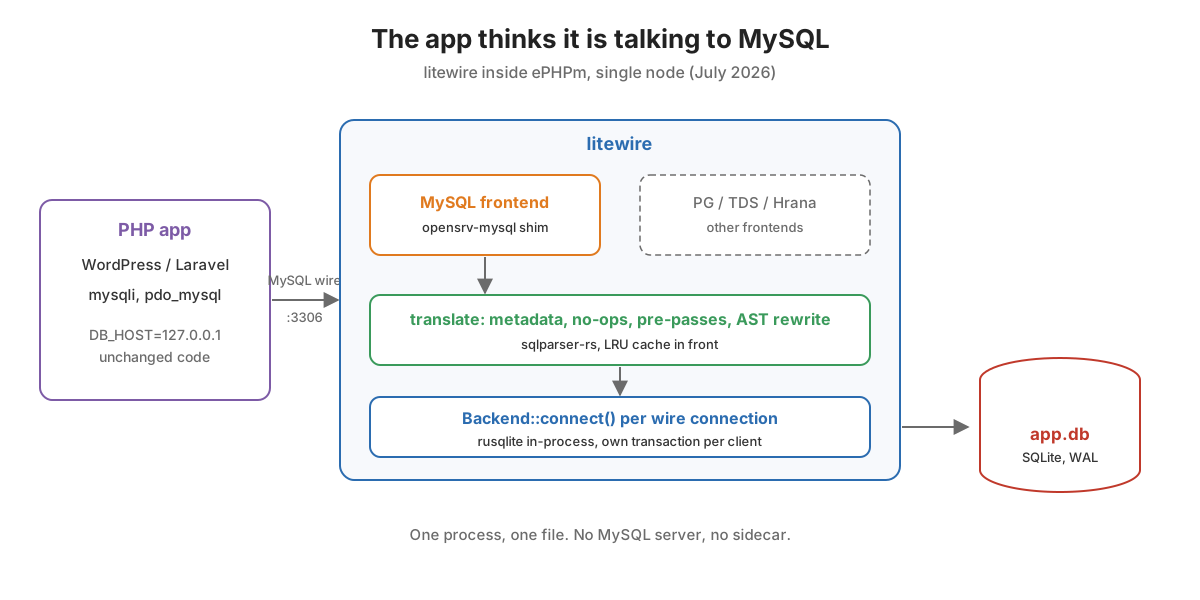
Most of the PHP sites I’d put on ePHPm don’t need a MySQL server. A brochure
WordPress, an internal Laravel tool, a preview environment that lives for an afternoon. What they do need is something
that looks like MySQL, because mysqli and pdo_mysql are the only database drivers their code has ever been
pointed at. I mentioned this in the ePHPm pragmatism post as a one-paragraph
“because”. This is the longer version, now that WordPress 7.0 and Laravel 13 both install and run end to end on it.
The piece doing the work is litewire, a standalone Rust project (MIT) that I started at the end of March. It accepts MySQL, PostgreSQL, SQL Server (TDS) and Hrana HTTP connections. It translates the dialect to SQLite on the fly and runs it against a pluggable backend. ePHPm embeds it as a library.
The challenge to “you need MySQL”
The usual objection is that SQLite isn’t a production database. For a lot of workloads that’s just habit. A single-node site with a few writes a second and mostly reads is squarely what SQLite in WAL mode is good at. The operational difference is large:
- there’s no server to patch
- there are no credentials to rotate
- there’s no connection limit to tune
- the backup is a file
What stops people is the application. WordPress doesn’t have a SQLite driver in core. It has a plugin that rewrites queries inside PHP. Laravel supports SQLite, but every plugin, package and raw query in a real app was written and tested against MySQL. Asking someone to port that is asking them not to use your thing. So the translation has to happen below the app, at the wire.
The shape of it
PHP (pdo_mysql, mysqli)
        |  MySQL wire protocol, 127.0.0.1:3306
        v
  litewire-mysql      opensrv-mysql shim: handshake, COM_QUERY, prepared statements
        |
  litewire-translate  metadata emulation, no-ops, text pre-passes, sqlparser AST rewrite
        |
  litewire-backend    Backend::connect() -> one BackendConn per wire connection
        |
     SQLite (rusqlite, WAL)
The MySQL frontend is built on opensrv-mysql. It handles the packet framing and the handshake and calls into a shim for each command. PostgreSQL uses pgwire. SQL Server has no Rust server-side TDS crate, since tiberius is client only. So that frontend is hand-rolled and experimental. The Hrana frontend skips translation entirely since the SQL is already SQLite.
The translator is where the real work is. It runs a fixed pipeline on every statement:
- Metadata detection before parsing, because some of the input isn’t valid SQL to begin with. Emulation queries
against
sqlite_masterandPRAGMAanswerSHOW FULL COLUMNS,DESCRIBE,INFORMATION_SCHEMA.*andSELECT @@vars. - Transaction rewrites:
START TRANSACTION,BEGIN WORKand friends becomeBEGIN. - No-ops:
SET NAMES,SET time_zone,SET sql_mode, isolation level changes. They return OK without touching SQLite. - Text pre-passes for MySQL syntax sqlparser-rs can’t
represent, like
bigint(20)display widths andKEY k (col(191))index prefix lengths. - Parse, rewrite the AST, emit with sqlparser’s
Display.
Rather than describe the rewrites, here’s what the translator does with real WordPress and Laravel statements. I ran
these through litewire_translate::translate(sql, Dialect::MySQL) at litewire 699e634:
IN : CREATE TABLE wp_usermeta (
       umeta_id bigint(20) unsigned NOT NULL auto_increment,
       user_id bigint(20) unsigned NOT NULL default '0',
       meta_key varchar(255) default NULL,
       meta_value longtext,
       PRIMARY KEY  (umeta_id),
       KEY user_id (user_id),
       KEY meta_key (meta_key(191))
     ) DEFAULT CHARACTER SET utf8mb4 COLLATE utf8mb4_unicode_520_ci
OUT: CREATE TABLE wp_usermeta (umeta_id INTEGER NOT NULL, user_id INTEGER NOT NULL DEFAULT '0',
       meta_key TEXT DEFAULT NULL, meta_value TEXT, PRIMARY KEY (umeta_id))

IN : INSERT INTO `wp_options` (`option_name`, `option_value`, `autoload`)
       VALUES ('siteurl', 'http://example.test', 'yes')
       ON DUPLICATE KEY UPDATE `option_name` = VALUES(`option_name`),
       `option_value` = VALUES(`option_value`), `autoload` = VALUES(`autoload`)
OUT: INSERT INTO `wp_options` (`option_name`, `option_value`, `autoload`)
       VALUES ('siteurl', 'http://example.test', 'yes')
       ON CONFLICT DO UPDATE SET `option_name` = excluded.`option_name`,
       `option_value` = excluded.`option_value`, `autoload` = excluded.`autoload`

IN : SELECT ... FROM wp_posts WHERE ... ORDER BY wp_posts.post_date DESC LIMIT 10, 10
OUT: SELECT ... FROM wp_posts WHERE ... ORDER BY wp_posts.post_date DESC LIMIT 10 OFFSET 10

IN : alter table `users` add unique `users_email_unique`(`email`)
OUT: CREATE UNIQUE INDEX `users_email_unique` ON `users`(`email`)

IN : START TRANSACTION          OUT: BEGIN
IN : SET NAMES utf8mb4          OUT: <noop>
IN : SELECT LAST_INSERT_ID()    OUT: SELECT last_insert_rowid()
IN : SHOW FULL COLUMNS FROM `wp_options`
OUT: <metadata ShowColumns { table: "wp_options" }>
Two of those are worth a closer look. The wp_usermeta table keeps PRIMARY KEY (umeta_id) on an INTEGER column.
SQLite treats that as a rowid alias, so auto_increment behaves the way WordPress expects without the keyword. And
the two inline KEY lines are gone. SQLite has no inline secondary index syntax, and the translator drops them rather
than failing the whole CREATE TABLE. That’s a deliberate trade. The source calls it “a performance concern, not a
correctness one”. I’d like to revisit it by emitting real CREATE INDEX statements, the way the ALTER TABLE ... ADD UNIQUE path already does.
The upsert one is load-bearing. add_option() uses that exact shape, and update_option() falls back to it for a new
option. If VALUES(col) doesn’t become excluded.col, WordPress can’t save a setting.
All of that sits behind a bounded LRU cache keyed on the SQL text. The PR that added the cache (litewire#5) measured a WordPress-shaped join in release mode. It took 39 µs per translation cold and 277 ns warm. PHP apps send the same few hundred statement shapes over and over, so the parser runs rarely after warmup.
Wiring it into ePHPm
On the ePHPm side the config is a file path. The MySQL listener defaults to 127.0.0.1:3306. You only need the proxy
block if you want to move it or add the Hrana listener for external tools:
[db.sqlite]
path = "/var/lib/ephpm/myapp.db"

[db.sqlite.proxy]
mysql_listen = "127.0.0.1:3306"
hrana_listen = "127.0.0.1:8080"  # optional
The app’s config stays the MySQL config it already had. For Laravel that’s the stock .env:
DB_CONNECTION=mysql
DB_HOST=127.0.0.1
DB_PORT=3306
DB_DATABASE=laravel
DB_USERNAME=ephpm
DB_PASSWORD=
In single-node mode litewire runs in-process with the rusqlite backend. There’s no child process and nothing else
listening. Clustered mode swaps the backend for a client to a replicated SQLite server, which is a separate story.
There’s also an experimental engine = "turso" knob. It runs the same frontends over the Turso engine instead of
SQLite’s C library. And if you do want a real MySQL, [db.mysql] turns the same listener into a pooling proxy. SQLite
drops out of the picture entirely.
What it took to make WordPress actually install
For most of litewire’s life, “WordPress works” was a claim in the README that nothing tested. I took it out in July
(litewire#4). I replaced it with what the end-to-end tests actually cover.
Then I put full installs through it. ePHPm’s Turso evaluation needed a WordPress and Laravel suite run against both
engines anyway. So I ran a WordPress 7.0.1 wp core install and a Laravel 13 php artisan migrate through the MySQL
frontend. The then-default SQLite engine was the control. Neither got past installation:
Error: Error: WordPress 7.0.1 requires MySQL 5.5.5 or higher
opensrv-mysql’s default handshake banner is 5.1.10-alpha-msql-proxy. WordPress 6.5 and later refuse to talk to a
server that old. Dropping back to WordPress 6.4.3 got further and then died in dbDelta:
wp_usermeta -> SQL translation error: SQL parse error: sql parser error: Expected: ), found: ( at Line: 9, Column: 24
That’s the meta_key(191) index prefix length, and it hit 7 of the 12 core tables. Laravel failed on the very first
statement of migrate. The table options went straight through to SQLite:
SQLSTATE[HY000]: General error: 1105 SQLite error: near "DEFAULT": syntax error in
CREATE TABLE `migrations` (...) DEFAULT CHARACTER SET = utf8mb4 COLLATE = 'utf8mb4_unicode_ci' at offset 115
The five WordPress tables that did parse were never actually created. Their inline KEY constraints were emitted
verbatim.
The full list came to nine gaps:
- the handshake version
- index prefix lengths
- table options
- inline
KEY/INDEX ON DUPLICATE KEY UPDATE ... VALUES(col)- a mis-shaped
SHOW FULL COLUMNS(WordPress read every core option back as an empty string) SQL_CALC_FOUND_ROWSinformation_schemaexistence probes that Laravel uses before migrating- qualified
UPDATE t SET t.col = ...references
The important thing about the list is that both engines failed it identically. That made it obvious every one of them lived in the wire and translate layer, not the database.
They landed together in litewire#11 with 13 regression tests. After it, both suites went 20/20 green on both engines. The WordPress suite covers install, theme render, posts, comments, a hundred options, generated content, search-replace and plugin DDL. The Laravel suite covers migrate, seed, CRUD, transaction commit and rollback, migrate rollback and re-migrate. ePHPm picked up the pin in ephpm#190.
Two bugs a test suite wouldn’t have found
Getting the install green was the visible part. Putting real PHP traffic through it in the same couple of weeks turned up two problems that would have hurt in production.
Transactions weren’t per client. The rusqlite backend held one Arc<Mutex<Connection>> shared by every wire
connection. The MySQL handler tracked in_transaction per client in Rust, but the actual BEGIN ran on the shared
handle. Client A’s BEGIN meant client B’s next INSERT landed inside A’s transaction. Either one’s COMMIT
finalized both. The mutex also serialized every query. That threw away WAL’s concurrent readers before they ever
reached SQLite. The fix in litewire#6 turned Backend into a factory:
#[async_trait]
pub trait Backend: Send + Sync + 'static {
    /// Open a new session. Each BackendConn has its own transaction state.
    async fn connect(&self) -> Result<Box<dyn BackendConn>, BackendError>;
    // stateless query/execute/describe_columns kept as defaults
}
Every accepted connection calls connect() once and holds its own rusqlite connection to the same file. SQLite’s file
locking coordinates writers. busy_timeout (5 s default) handles SQLITE_BUSY. litewire defaults each session to
synchronous=NORMAL, the usual setting for WAL mode. One wrinkle: open_in_memory() gives each connection a
different database. The shared-cache URI workaround defeats WAL. So Rusqlite::memory() now quietly backs itself
with a temp file.
Every SELECT took 44 ms. This was measured from ePHPm with PHP PDO on loopback. A point SELECT was 44.01 ms p50
and an INSERT was 1.36 ms. The asymmetry is the clue. An INSERT reply is one OK packet. A result set is a column
count, column definitions, an EOF, rows and another EOF. opensrv-mysql wrote each of those as its own TCP segment.
Something on the loopback path sat on those small segments for about 40 ms. That’s the classic Nagle/delayed-ACK
stall. I never got a packet capture inside the test host to prove which side was holding. Setting TCP_NODELAY on the
server side (litewire#3) was the right thing to do, but it didn’t cure it
on its own. What did was wrapping the write half in a 64 KiB BufWriter, so the whole result set goes out as one
write (litewire#7):
| op | before | after |
|---|---|---|
point SELECT p50 |
44.01 ms | 0.23 ms |
INSERT p50 |
1.36 ms | 0.30 ms |
Those numbers are from the PR, measured on a rebuilt ePHPm image. It only ever reproduced through PHP. mysql_async
and the mysql CLI against the same server never showed it. I don’t have a satisfying explanation for the difference
yet. mysqlnd sets TCP_NODELAY on its sockets too, so it isn’t that.
Where it doesn’t make sense
I’d rather be specific about this than have someone find out the hard way:
- One writer at a time. WAL gives you concurrent readers and a single writer. If the app does heavy concurrent writes, run MySQL or Postgres and use ePHPm’s proxy mode instead.
- One process owns the file. Don’t point a second server or a cron job’s own SQLite client at the live database.
- Not every MySQL behavior is emulated.
SET autocommit = 0is a no-op with a warning. Half-emulating MySQL’s implicit transactions with a hiddenBEGINwould be worse than saying so.LOCK TABLESis also a no-op with a warning, since SQLite only has file-level locking. Inline secondary indexes are dropped, as above. - PostgreSQL and TDS are CRUD-level. The MySQL frontend is the one that gets tested against real applications.
Inside those lines it’s a good fit for CI and preview environments, a single VPS, edge boxes and small production
sites. The same .db file runs under ephpm dev on a laptop and on the server. The app never knows.
Next up is the long tail. Passing an install suite is not the same thing as behaving like MySQL on every query a plugin might send. I expect real traffic to find the next round.




