
The Pragmatism of ePHPm - Every Decision Has a "Because" Behind It
ePHPm hit v0.1.0 this week. It isn't a rewrite-it-in-Rust project. Here's what I built, what I borrowed, what I sent upstream, and what I deliberately haven't built.
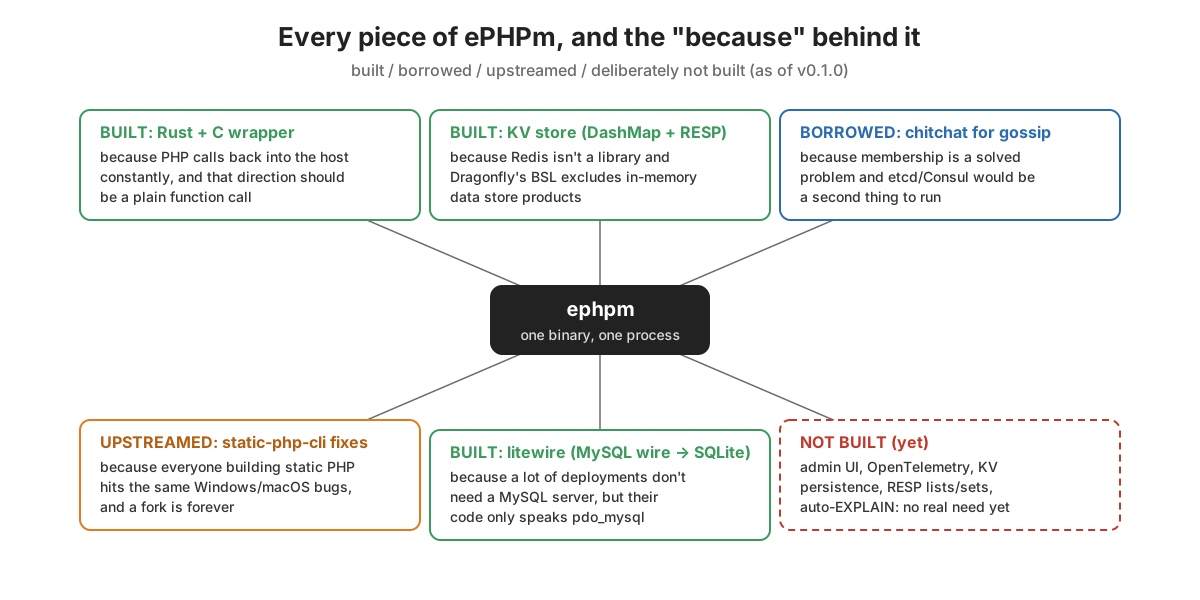
ePHPm tagged v0.1.0 this week, three months after the first commit. Before the feature list grows any further I want to write down how decisions get made on it. This is mostly for myself. The easiest way to ruin a project like this is to let it turn into a checklist of things other projects have.
The pitch is simple. One binary that runs a PHP app with fewer moving parts than nginx + php-fpm + Redis + MySQL. Every feature has to trace back to that. If I can’t finish the sentence “this exists because…” with a real problem from running PHP in production, it doesn’t go in.
Rust, because I measured cgo
This isn’t a “rewrite it in Rust” project. I write Go for a living and I’d have been faster in Go. I picked Rust
because PHP calls back into its host constantly. Every echo, every header, every cache read once the KV functions
exist. I wanted that direction to be a plain function call. When I
actually measured it the cgo tax turned out to be a lot smaller than my
own design doc claimed. It was about 24ns per call on Go 1.26, not 200, and I said so. The decision survived the
correction because the reasons were never only that one number:
- One runtime in the process.
- No GC next to Zend.
- No second project to upstream into before I can change how a request is dispatched.
The part I didn’t get to pick is the C wrapper. PHP’s error handling is setjmp/longjmp, and that has to live in C
regardless of what language is on the other side. So the answer to “is it Rust?” is “it’s Rust plus about 1,900 lines of
C that I’d rather not have.”
A KV store, because there was nothing to embed
I did not want to write a KV store. Building databases isn’t the fun part of this for me. But a PHP app server without a cache just means the user runs Redis next to it. Then the single binary pitch is gone.
So I went looking for something to embed:
- Redis isn’t a library. It’s a server that wants to own a process and its event loop. There’s no
libredis.a. (Its licensing also changed in 2024, which made me even less interested in building a product on top of it.) - Dragonfly is also a standalone server. Its BSL 1.1 license explicitly excludes use in an “in-memory data store product or service.” A PHP server with a built-in clustered cache is close enough to that line that I’m not going near it.
- KeyDB, Garnet, Valkey: different licenses, same shape. Servers, not libraries. Dragonfly’s shared-nothing model (each thread owns a slice of the keyspace) is also the opposite of what ePHPm needs. Any PHP thread has to be able to read any key.
What PHP apps use Redis for is caching, sessions and counters. Strings, a few hashes, TTLs. That’s a DashMap and a
RESP2 parser so existing clients work. Add lazy expiry plus a sweeper and an eviction policy. A few thousand lines of
Rust instead of a second daemon. It’s not Redis and it doesn’t pretend to be. No lists, no sets, no pub/sub, no
persistence. If you need a queue, run a real Redis.
Gossip, because etcd would be a second thing to run
Multi-node is where it’d be easiest to reach for etcd or Consul. Both are excellent. Both are also another cluster you have to operate, which defeats the point. I also didn’t write a membership protocol, because that’s a solved problem. Quickwit’s chitchat crate does scuttlebutt gossip with a phi-accrual failure detector. It’s a library and it’s MIT licensed. It runs on tokio, which ePHPm already has. Nodes find each other from a seed list and that’s the entire control plane.
That’s the general rule for what gets borrowed. If a well-maintained crate does the job and fits the runtime and the license, use it. hyper, rustls, tokio and chitchat are all in that bucket.
SQLite behind a MySQL socket, because the code only speaks pdo_mysql
A lot of the sites I’d want to run on this don’t need a MySQL server. A brochure WordPress, an internal Laravel tool,
something on an edge box. They do need MySQL as far as their code knows. That’s what pdo_mysql and mysqli talk
to. litewire speaks the MySQL wire protocol on one side and SQLite on the other.
The app’s config says DB_HOST=127.0.0.1 and nothing else changes. It exists because the alternative is asking people
to port their database layer, and they won’t. It’s not there because SQLite is fashionable. It’s also optional. Point
the proxy at a real MySQL and it pools connections instead.
Upstream, because a fork is forever
ePHPm needs a static libphp for every OS and architecture it ships on.
static-php-cli is the project that builds those. When it broke for
me, the fix went upstream rather than into a private fork:
- Test fixes for Windows path separators.
- A
vswherefix for Windows static builds. - Dropping
-fno-pltfrom macOS static CFLAGS. - A GNU mirror change.
- A log filter so GitHub tokens don’t end up in CI logs.
- A mongodb build fix.
Two more Windows build fixes are still open. The Windows embed SAPI work itself moved to php-src, where it’s still under review. Everyone building static PHP hits the same bugs. Every patch I carry privately is a patch I have to rebase forever.
The other half of that is not rebuilding PHP on every CI run. Compiling PHP and its libraries from source on each build was the slowest thing in the pipeline. So the builds moved into a separate repo, ephpm/php-sdk, that publishes prebuilt SDKs per OS/arch/PHP version. ePHPm’s build downloads one and links against it.
So the three-way split I keep coming back to:
- Contribute upstream when the thing is shared infrastructure that others are already maintaining (SPC).
- Use what exists when a library does the job as-is (chitchat, hyper, rustls).
- Build my own only when nothing can be embedded or the license won’t allow it (the KV store, the C wrapper).
What isn’t built
The list of things that don’t exist matters as much as the list of things that do. As of v0.1.0:
- No admin UI. Early docs listed an embedded dashboard as an advantage over FrankenPHP and RoadRunner. In May I pulled those rows out of the comparison pages. Claiming something you haven’t shipped as a feature is how docs turn into marketing. It’s on the roadmap. It’ll get built when there’s something worth looking at that Prometheus and Grafana don’t already show.
- No OpenTelemetry. Prometheus metrics exist because I use them. Tracing will come when I need a trace to debug something real.
- No KV persistence, no lists or sets. It’s a cache.
- Some knobs are parsed and not implemented, and the config reference says so in bold. That covers
auto_explain, thelag-awareread/write split strategy,max_replica_lag, and the Unix socket for the Redis-compatible KV listener. Read/write splitting itself is the one feature I’ll admit went in early on a hunch rather than a need. The half-built strategy options next to it are what that looks like. I’d rather label those honestly than either delete the parsing or pretend they work.
That’s the contrast I’m trying to avoid. Some projects chase a competitor’s feature matrix or build the thing that makes a good conference demo. The feature matrix in ePHPm’s docs is there to be honest about status, not to win rows.
Real apps, not hello world
The proving ground is my home lab and real applications. WordPress, Laravel, the stuff people deploy. They get installed and clicked through on boxes I can break. That’s on top of the e2e suite that covers the server itself. Synthetic “hello world” benchmarks are good for exactly one thing, which is measuring dispatch overhead. Every interesting bug I’ve hit so far showed up in a real app or under real load, never in a 200-byte PHP file. The SIGPROF crash is the best example.
What’s next
The next stretch is about correctness under real apps rather than new boxes on the diagram:
- Request isolation.
- WordPress end to end.
- Making the KV store fast enough that nobody misses Redis.
If something new shows up, it’ll come with its “because.”
Links
- ePHPm and the v0.1.0 release
- litewire
- ephpm/php-sdk
- chitchat
- static-php-cli, e.g. #1149 and #1150
- Dragonfly’s license




