
Why Rust for PHP Embedding (Not Go)
I'm a Go developer building a PHP application server in Rust. Here's the FFI reasoning, the C wrapper it forced on me, and what cgo actually costs when you measure it.
Go is my primary language and has been for a long time. When I started building ePHPm
a few weeks ago the obvious move was to write it in Go. ePHPm is a PHP application server. It’s one binary that embeds
the real PHP interpreter (libphp, the Zend engine) and puts an HTTP server, TLS, a KV cache and a database proxy
around it. A PHP app doesn’t need nginx + php-fpm + Redis to run. FrankenPHP already proved
the “PHP inside a Go web server” idea works, and it works well. I wrote it in Rust anyway. This post covers the
reasoning, and the part of the design that Rust made easier and the part it didn’t. It also has some numbers I should
have measured before I wrote the design doc instead of after.
What embedding PHP actually means
PHP is a C library if you build it with --enable-embed=static. Plain --enable-embed gives you a shared
libphp.so. You get libphp.a, a header set, and the embed SAPI (php_embed_init() / php_embed_shutdown()).
Everything else is your problem. Where output goes, where the POST body comes from, how $_SERVER gets filled. PHP
asks for all of that through the SAPI. That’s a struct of function pointers that the host fills in
(ub_write, read_post, send_headers, register_server_variables and friends). php-fpm, Apache’s mod_php and the
CLI are all just different implementations of that struct.
So the host language talks to PHP in two directions:
- Host calls PHP: start a request, execute a script, read back results.
- PHP calls host: every
echois aub_writecallback, readingphp://inputisread_post, building$_SERVERisregister_server_variables.
The second direction is the one that matters for this comparison. It happens many times per request, and it’s where the language boundary gets crossed from the “wrong” side.
What my design doc said
When I sat down to compare runtimes I wrote up FrankenPHP in some detail. I covered its Caddy module, its worker loop,
and how it parks a PHP thread on a Go channel. The headline in my own project notes was this line. It’s in AGENTS.md
and the architecture doc:
Go’s CGO incurs ~200ns overhead per call. FrankenPHP crosses the CGO boundary 11+ times per request (~2.2μs+ overhead). Rust FFI to libphp is zero overhead.
The 11 crossings came from walking a request through FrankenPHP:
- Dispatch to the PHP thread.
- The SAPI callbacks for superglobals, headers, cookies, body reads and output writes.
- The trip back to finish the request.
The 200ns was a number I’d carried around in my head for years from older Go releases. I didn’t measure it. That’s fine in a design doc and not fine in a blog post, so I measured it.
Measuring the boundary
The benchmark is about as small as it gets. Three C functions, compiled with gcc -O2 and marked noinline. They’re
linked into both a Go test binary and a Rust binary. Each side gets its own copy of the file, and this is the Go one:
#include <stddef.h>
__attribute__((noinline)) void noop(void) {}
__attribute__((noinline)) size_t write_buf(char *p, size_t n) { return n + (p != 0); }
extern size_t goUbWrite(char *p, size_t n);   /* rust_ub_write on the Rust side */
__attribute__((noinline)) size_t c_calls_host(char *p, size_t n) { return goUbWrite(p, n); }
write_buf is the shape of ub_write, a pointer and a length. c_calls_host is C calling back into the host
language. That’s what every SAPI callback does if the host owns the output buffer. On the Go side it’s a cgo package
with an //export’d goUbWrite and a normal testing.B loop. On the Rust side it’s an unsafe extern "C" block and
a #[unsafe(no_mangle)] pub extern "C" fn rust_ub_write. A loop of 200 million calls is timed with Instant, with
black_box on the arguments so nothing gets folded away. Each case ran five times and I took the median.
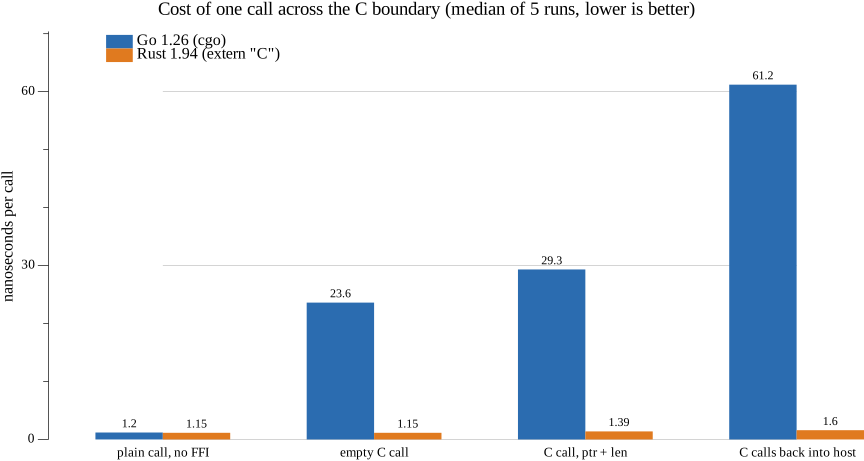
| Case | Go 1.26 cgo | Rust 1.94 |
|---|---|---|
| Plain function call, no FFI (baseline) | 1.20 ns | 1.15 ns |
| Empty C call | 23.6 ns | 1.15 ns |
| C call with pointer + length | 29.3 ns | 1.39 ns |
| C calls back into the host | 61.2 ns | 1.60 ns |
So my doc was wrong, and wrong in Go’s favor. A cgo call on Go 1.26 is about 24ns on this box, not 200. Going the other
way, C calling into an exported Go function, is about 61ns. Rust calling C is indistinguishable from Rust calling Rust.
It is the same thing. Same calling convention, same stack, a call instruction.
If I redo the napkin math with real numbers, 11 crossings cost somewhere between roughly 0.25µs (all cheap calls) and 0.7µs (all callbacks) per request. That is real and it’s measurable. It is still small next to running a WordPress page. Anyone who tells you cgo overhead alone is what makes Go the wrong choice here is doing what I did in the design doc.
So why Rust anyway
The per-call number isn’t the whole cost of putting a Go runtime and the Zend engine in the same process. These are the things that pushed me over.
There’s no second runtime in the way. A cgo call isn’t just a jump. The goroutine has to move onto the system stack
and tell the scheduler it’s leaving Go. A callback from C into Go has to get back onto a goroutine. A C thread that Go
didn’t create has to be adopted by the runtime first. FrankenPHP creates each PHP thread in C with pthread_create and
calls back into Go from it. It parks the thread on a channel select waiting for the next request, so the goroutine
scheduler never gets to move it. All of that is well-engineered. All of it is also machinery that exists because there
are two runtimes in the process with different ideas about threads and stacks. In Rust a PHP thread is an OS thread. I
call ts_resource(0) on it once to register it with PHP’s thread-safe resource manager and that’s the whole story.
No GC sharing the process with Zend. PHP has its own allocator and its own refcounting/GC. Go’s GC doesn’t scan C memory, so it’s not a correctness problem. But it is a second source of pauses in the same process as your PHP requests. Tail latency is one of the numbers I care about for this project.
The scope is bigger than an HTTP front end. ePHPm isn’t only going to serve PHP. The plan includes an in-process KV store that PHP can call into directly, a pooling MySQL/Postgres proxy, and gossip clustering. Most of those are hot paths where PHP calls out of the Zend engine into host code. That is exactly the 61ns-vs-1.6ns row in the table. I’d rather that direction be free from day one than try to batch around it later.
I want to own the binary. FrankenPHP is a Caddy build. That’s a feature for them. For ePHPm I wanted the HTTP stack (hyper), the TLS/ACME stack, and the PHP lifecycle all under my control. Nothing should have to be upstreamed into a second project before I can change how a request is dispatched.
None of that makes Go bad at this. FrankenPHP exists and people run real traffic on it. It’s a trade I’m comfortable with because I’m the one paying the Rust learning tax.
The part Rust doesn’t solve: setjmp/longjmp
Here’s the catch that every embedder hits regardless of language. PHP’s error handling is setjmp/longjmp. A fatal
error, an exit() in older paths, a memory limit or a timeout all end the same way. The Zend engine calls
zend_bailout(), which longjmps back to the nearest zend_try. The zend_try/zend_catch macros expand to a
SETJMP on a jump buffer stored in executor globals.
You can’t do that from Rust. setjmp “returns twice,” which Rust’s compiler doesn’t model. A longjmp across Rust
frames skips their destructors and is undefined behavior. If PHP longjmps through a Rust frame that holds a
MutexGuard or a Vec, you’ve leaked or corrupted something. You won’t find out until later.
The fix is boring and mandatory. Rust never calls into the Zend engine directly for anything that can bail out. It
calls a C function, and the C function owns the jump buffer. This is the core of ephpm_execute_request() in
crates/ephpm-php/ephpm_wrapper.c (trimmed):
int ephpm_execute_request(const char *filename)
{
    /* ... reset buffers, fill SG(request_info), rebuild superglobals ... */

    int result = 0;
    JMP_BUF *__orig_bailout = EG(bailout);
    JMP_BUF __bailout;

    EG(bailout) = &__bailout;
    if (SETJMP(__bailout) == 0) {
        zend_file_handle file_handle;
        zend_stream_init_filename(&file_handle, filename);
        php_execute_script(&file_handle);

        /* PHP 8.x: exit()/die() throws an unwind exit exception instead
         * of calling zend_bailout(). Treat it like the old bailout path. */
        if (EG(exception) && zend_is_unwind_exit(EG(exception))) {
            zend_clear_exception();
            result = -2;
        }
    } else {
        /* PHP bailed out (fatal error) */
        result = -2;
    }
    EG(bailout) = __orig_bailout;

    capture_response_headers();
    response_status_code = SG(sapi_headers).http_response_code;
    return result;
}
The longjmp lands in a C frame and the C function returns an int. Rust only ever sees a normal return. The rules
the rest of the code follows fall out of that:
- Every Rust → PHP entry point goes through a C function that sets up the bailout.
- SAPI callbacks are C, and they write into thread-local C buffers (
output_buf,headers_buf). They don’t call into Rust while PHP might still bail out above them. - Rust reads the buffers back after the C function returns.
On the Rust side, the call is a handful of CStrings that have to outlive the call. Then it’s a plain function call:
unsafe extern "C" {
    pub fn ephpm_request_set_info(
        method: *const c_char, uri: *const c_char, query_string: *const c_char,
        content_type: *const c_char, cookie: *const c_char,
        post_data: *const c_char, post_data_len: usize, path_translated: *const c_char,
    );
    pub fn ephpm_execute_request(filename: *const c_char) -> c_int;
    pub fn ephpm_get_output_buf(out_len: *mut usize) -> *const c_char;
}

// method, uri, script_filename... are CStrings owned by this stack frame,
// so the pointers C holds stay valid until ephpm_execute_request returns.
let ret = unsafe { ffi::ephpm_execute_request(script_filename.as_ptr()) };

let body = {
    let mut len: usize = 0;
    let ptr = unsafe { ffi::ephpm_get_output_buf(&mut len) };
    if ptr.is_null() || len == 0 { Vec::new() }
    else { unsafe { std::slice::from_raw_parts(ptr.cast::<u8>(), len) }.to_vec() }
};
The C wrapper is just under 1,400 lines at this point. Most of it is SAPI plumbing I’ll write up separately. The Rust
side is mostly CString conversions and // SAFETY: comments. The split has held up so far. Rust handles everything
that’s async or long-lived. C handles anything that touches Zend’s control flow.
Threads
The other thing the diagram at the top hides is threading. PHP comes in two flavors:
- NTS (non-thread-safe) runs one request at a time per process, which is why php-fpm forks.
- ZTS (Zend Thread Safety) keeps every global in a per-thread slot managed by TSRM.
For the first couple of weeks ePHPm ran NTS PHP behind a mutex. That’s a fine way to get correct output and a terrible way to serve concurrent requests.
As of this week it’s ZTS. hyper and tokio handle connections asynchronously, and each PHP request runs on a tokio
spawn_blocking thread. The first time a given thread runs PHP it calls into C to register with TSRM and start a
request context. After that it’s a thread-local bool check. All the per-request C state in the wrapper is
__thread. Rust’s threads are OS threads, so there’s no question about which thread a piece of code runs on.
One thing is not free, and I learned it the hard way the same week I wrote the code above. PHP’s init installs
process-wide signal handlers, including the SIGPROF handler behind max_execution_time. Those do not care that your
process has 32 tokio threads in it. That bug gets its own post.
What I’d tell a Go developer considering this
If you want PHP inside a Go web server, use FrankenPHP. It’s mature and it’s under the PHP Foundation now. 24ns per crossing is not what’s going to hurt you. Rust fits a different shape of project:
- PHP calls back into host code constantly.
- You want one runtime in the process.
- You’re willing to write a C shim for Zend’s control flow either way.
There, Rust gets out of the way in a way cgo structurally can’t.
And measure your own numbers before you put them in a design doc.
How I measured
- AMD Ryzen 9 5950X (16 cores / 32 threads), Ubuntu under WSL2, kernel 6.18, gcc 15.2
- Go 1.26.0 (
go test -bench, five runs of about 2 seconds each), Rust 1.94.0 (cargo build --release, opt-level 3) - The same three C functions are linked into both binaries (two copies differing only in
constand the callback name). They arenoinlineand live in a separate object, so neither compiler can inline across the boundary (no cross-language LTO) - Numbers are the median of five runs per case
Links
- ePHPm
- FrankenPHP and its source
- cgo documentation
- The Rustonomicon on FFI, whose section on FFI and unwinding is the reason you don’t let anything unwind or
longjmpthrough a Rust frame - PHP embed SAPI source




