
Proxmox JSON, Part 2: null PIDs, 1.12589990684262e+15 and net10
The Proxmox VE API found three more ways for its JSON not to fit Go's encoding/json. There's a null I fixed and then broke, petabyte storage in scientific notation, and devices past index 9 that were silently dropped.
In 2023 I wrote about why go-proxmox has StringOrInt and friends.
Proxmox sends the same number quoted in one place and bare in another, so the client has types that accept both. That
post ended on a pretty confident note. Since then three more shapes of “the JSON is valid and Go still won’t take it”
have come in. One of them is a bug I’d already fixed once and then reintroduced myself.
null, twice
#198, June 2025: listing VMs on a node fails with
failed to match ^[0-9.]*$: null
if any of the VMs is a template. Templates never run, so /nodes/{node}/qemu sends "pid": null for them. A running
VM on the same list gets "pid": "14558", a quoted string. PID is a StringOrUint64. Its unmarshaller strips quotes
and requires what’s left to match ^[0-9.]*$. null doesn’t.
The embarrassing part is that this worked in May 2023. A contributor had sent a fix for stopped VMs returning null. It had the
unmarshaller treat anything without a digit in it as zero:
numeric := numericRegex.MatchString(str) // `\d`
if !numeric {
	*d = StringOrUint64(0)
	return nil
}
Three months later I rewrote all the StringOr types to parse floats and truncate. That’s the version in the 2023 post.
“Non-numeric means zero” became “non-numeric is an error, except the empty string”. I wanted garbage to fail loudly.
null is not garbage. It’s Proxmox saying the field doesn’t apply. No test fixture had a null in it, so nothing
noticed for two years. The fix in #265 is one condition on each
of the three types:
str := strings.ReplaceAll(string(b), "\"", "")
// Empty string and JSON null both yield the zero value. Proxmox returns
// null for fields that are simply absent on the resource (e.g. PID on a
// stopped VM template — see issue #198).
if str == "" || str == "null" {
	*d = StringOrInt(0)
	return nil
}
Note that encoding/json calls UnmarshalJSON with the literal bytes null for a custom type rather than skipping it.
That’s why this has to be handled in the type at all.
A petabyte in scientific notation
#191: a directory storage backed by a MinIO bucket over a FUSE
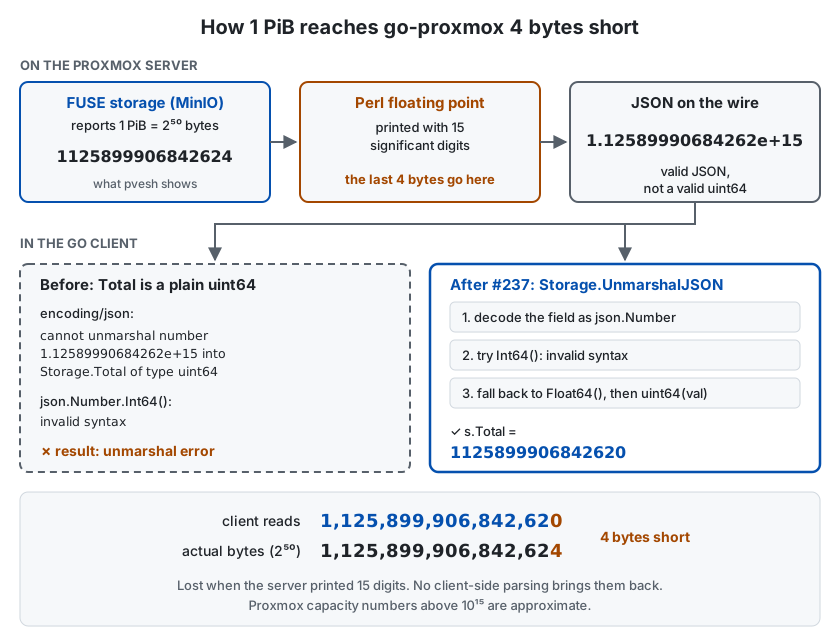
mount. The FUSE driver can’t tell how big the bucket is, so it reports 1 PiB. pvesh shows exactly that:
content   storage        type active avail           enabled shared total           used
backup    minio_backup   dir  1      1125899906842624 1       0      1125899906842624 0
The API sends something else:
json: cannot unmarshal number 1.12589990684262e+15 into Go struct field Storage.Total of type uint64
Somewhere in Proxmox’s storage code that value became a Perl floating point number. A float that big gets printed with
15 significant digits in exponent form. It’s valid JSON. It’s not a valid uint64, and json.Number.Int64() won’t
parse it either:
uint64: json: cannot unmarshal number 1.12589990684262e+15 into Go struct field .total of type uint64
json.Number Int64 err: strconv.ParseInt: parsing "1.12589990684262e+15": invalid syntax
json.Number Float64 -> uint64: 1125899906842620
actual bytes (2^50):           1125899906842624
The fix (#237, from a contributor’s earlier attempt in #195) is
a custom UnmarshalJSON on Storage. It decodes the numeric fields as json.Number. It tries Int64 first and falls
back to Float64:
if aux.Total != "" {
	// Try int64 first, then fall back to float64 for scientific notation
	if val, err := aux.Total.Int64(); err == nil {
		s.Total = uint64(val)
	} else if val, err := aux.Total.Float64(); err == nil {
		s.Total = uint64(val)
	}
}
Look at the last two lines of that output though. The client now reads 1,125,899,906,842,620 for a storage that is 1,125,899,906,842,624 bytes. Those four bytes were gone before the response left the server. They went when the number was printed with 15 digits. No amount of client-side parsing brings them back. For a fake petabyte nobody cares. It’s worth knowing that Proxmox capacity numbers above 10^15 are approximate.
That fix then broke something else in a way I would not have guessed.
#241 came from running the
cluster-api-provider-proxmox test suite against main.
Marshal a Storage, unmarshal it again, and Name comes back empty. The struct had two fields that map to the same key.
That’s easy to miss until you remember encoding/json matches keys case-insensitively:
Name    string `json:"storage"` // marshals as "storage"
Storage string                  // marshals as "Storage"
Marshal writes both "storage":"local" and "Storage":"". On the way back in, the new unmarshaller’s aux struct has a
single json:"storage" field. Both keys match it and the later one wins. It’s the empty one. The old Storage field was
a leftover from before Name existed. #243 tagged it json:"-"
and marked it deprecated. The round trip works again.
net10 and the fields that weren’t there
#211: a VM with eleven or more network interfaces only shows the
first ten. VirtualMachineConfig had explicit fields for indexed devices. Those were Net0 through Net9, SCSI0
through SCSI30, Unused0 through Unused9 and so on. It also had helper maps (Nets, SCSIs, …) that a custom
UnmarshalJSON filled in by reflecting over those fields. Proxmox allows net0 to net31, unused0 to unused255,
and so on. encoding/json throws away any key that doesn’t match a struct field before your code ever gets a look at
it. So net10 was dropped on the floor, silently.
The fix in #260 unmarshals the body a second time into
map[string]json.RawMessage. Then it routes every <prefix><digits> key into the matching map:
routes := vmc.indexedDeviceMaps() // "net" -> &vmc.Nets, "scsi" -> &vmc.SCSIs, ...
for k, v := range raw {
	prefix, ok := indexedDeviceKey(k)
	if !ok {
		continue
	}
	target, ok := routes[prefix]
	if !ok {
		continue
	}
	var s string
	if err := json.Unmarshal(v, &s); err != nil {
		// non-string indexed value — skip rather than fail the whole config
		continue
	}
	if *target == nil {
		*target = make(map[string]string)
	}
	(*target)[k] = s
}
The obvious version of this is strings.HasPrefix(k, "scsi"). An earlier PR for the same issue did exactly that. It’s
wrong, because scsihw (the SCSI controller type) starts with scsi. The VM config also has a plain numa flag next
to numa0..numa9. So the key parser requires the prefix to be followed by digits and only digits:
// indexedDeviceKey returns ("net", true) for "net10" and ("", false) for keys
// like "scsihw" or "numa" that share a prefix but lack a pure-digit suffix.
func indexedDeviceKey(k string) (prefix string, ok bool) {
	for i := 0; i < len(k); i++ {
		c := k[i]
		if c >= '0' && c <= '9' {
			if i == 0 {
				return "", false
			}
			// rest of the string must be all digits
			for j := i + 1; j < len(k); j++ {
				if k[j] < '0' || k[j] > '9' {
					return "", false
				}
			}
			return k[:i], true
		}
	}
	return "", false
}
There are unit tests for exactly those two collisions. #260 kept the explicit Net0..Net9 fields populated for
compatibility. v0.7.0 (#261) removed them. The maps are now the
only shape: cfg.Nets["net10"]. It’s one of the bigger sections of the v0.7.0 migration guide because a lot of code
reads cfg.Net0.
The pattern
All three of these are the same bug as the 2023 post wearing a different hat. The JSON is fine. The Go type was written
from the docs or from one sample response. The real API sends a shape nobody put in a test fixture: a null, a float,
an eleventh NIC. Each fix is small. Finding them is the hard part. That’s why I’m now more interested in testing against
recorded responses from a real cluster than in typing more fixtures by hand.




