
Proxmox Doesn't Know What Type a Number Is
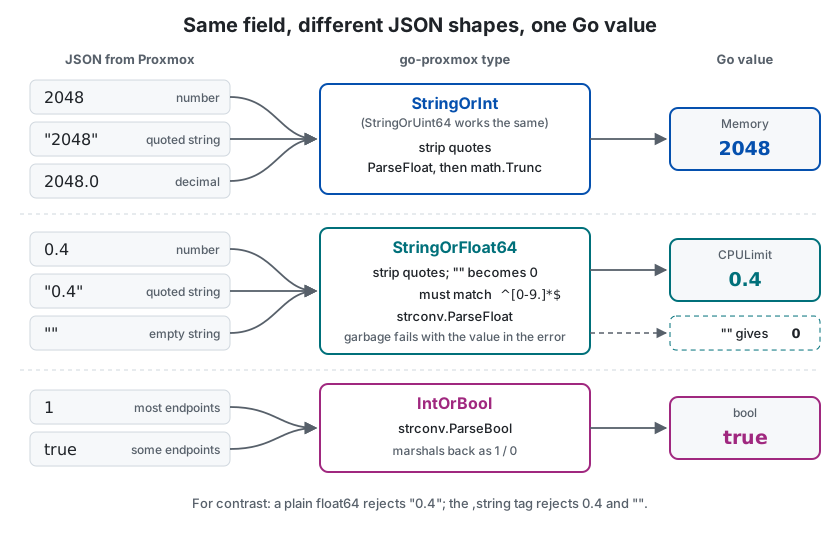
The Proxmox VE API returns the same field as 1234 in one place and "1234" in another. This is why go-proxmox has StringOrInt, StringOrUint64, StringOrFloat64 and IntOrBool instead of plain Go types.
Every couple of months somebody opens an issue on go-proxmox with a
title that starts with json: cannot unmarshal string into Go struct field. The most recent one was fixed last week.
It’s the same root cause every time. The Proxmox VE API is backed by Perl, and Perl doesn’t really care whether a
scalar is a number or a string. The JSON encoder on the other end writes whatever the scalar happens to be at the time.
So a field that is documented as an integer comes back as 2048 from one endpoint and "2048" from another.
Sometimes it changes on the same endpoint depending on how the value got into the config.
Go’s encoding/json does care, a lot. Here’s how the client deals with it.
The cpulimit report
The cleanest example is #66 and its follow up
#69. CPULimit was an int in VirtualMachineConfig. That’s
wrong on its face because the Proxmox docs describe it as a float (1.0 is 100% of a core, 0.4 is 40%). So it
became a float32. Then the reporter came back with the actual response from /nodes/{node}/qemu/{vmid}/config:
{
  "data": {
    "cores": 2,
    "memory": 2048,
    "cpulimit": "0.4",
    "scsihw": "virtio-scsi-pci"
  }
}
That’s trimmed. The real payload has the rest of the VM config in it. cores and memory are numbers. cpulimit is
a string. Same object, same endpoint.
Why not ,string
The reporter’s first suggestion was the ,string struct tag option. It tells encoding/json the value is a number
wrapped in quotes. That handles exactly one shape. I tried it and it was a mess. Here is the comparison as a little
program you can run. It feeds three inputs to a plain float64, a float64 with ,string, and the type we ended up
with:
type plain struct {
	CPULimit float64 `json:"cpulimit"`
}
type withTag struct {
	CPULimit float64 `json:"cpulimit,string"`
}
type withOr struct {
	CPULimit StringOrFloat64 `json:"cpulimit"`
}
{"cpulimit":"0.4"}   float64: 0      err=json: cannot unmarshal string into Go struct field plain.cpulimit of type float64
                     ,string: 0.4    err=<nil>
                     StringOrFloat64: 0.4    err=<nil>
{"cpulimit":0.4}     float64: 0.4    err=<nil>
                     ,string: 0      err=json: invalid use of ,string struct tag, trying to unmarshal unquoted value into float64
                     StringOrFloat64: 0.4    err=<nil>
{"cpulimit":""}      float64: 0      err=json: cannot unmarshal string into Go struct field plain.cpulimit of type float64
                     ,string: 0      err=json: invalid use of ,string struct tag, trying to unmarshal "" into float64
                     StringOrFloat64: 0      err=<nil>
(Go 1.21.4.) ,string fixes the quoted case and breaks the unquoted one. It also can’t cope with an empty string,
which Proxmox also sends. In this client a lot of structs are used for two endpoints that disagree. A tag can’t help
you there. You need a type that accepts both.
The StringOr types
The idea goes back to the first version of the client. It’s a named numeric type with its own UnmarshalJSON that
strips any quotes and parses what’s left. There’s one type per Go numeric kind we need. Here’s the float version I
wrote for #69:
var (
	isFloat = regexp.MustCompile(`^[0-9.]*$`)
)

type StringOrFloat64 float64

func (d *StringOrFloat64) UnmarshalJSON(b []byte) error {
	str := strings.Replace(string(b), "\"", "", -1)
	if str == "" {
		*d = StringOrFloat64(0)
		return nil
	}

	if !isFloat.MatchString(str) {
		return fmt.Errorf("failed to match %s: %s", isFloat.String(), str)
	}

	parsed, err := strconv.ParseFloat(str, 64)
	if err != nil {
		return err
	}
	*d = StringOrFloat64(parsed)
	return nil
}
StringOrInt and StringOrUint64 are the same thing with a math.Trunc before the conversion. So "2048", 2048
and 2048.0 all land as 2048. Before that change the integer versions used strconv.ParseUint, which chokes on a
decimal point. Moving everything to ParseFloat and truncating fixed a second class of report for free. The regex is
there so garbage fails loudly with the offending value in the error instead of quietly becoming zero.
#59 asked the obvious question back in May. Wouldn’t it be
easier to always convert to uint64? My answer then is still my answer now. The API was returning 1234 and "1234"
and interchanging them a lot. One unmarshaller on a StringOrUint64 means you don’t write a custom UnmarshalJSON for
every struct that has a numeric field which might show up quoted. The cost is that you have to convert at the edges
(uint64(vm.VMID)), which I’ll take.
Going the other way is a non-issue. None of these types have a MarshalJSON, so they serialize as plain numbers.
Proxmox is perfectly happy to accept a number for a field it would hand back to you as a string.
When upstream changes the type under you
#105, merged last week, is the other way this bites. Reading a
VM config started failing on memory after a Proxmox update. Johann tracked it down to
qemu-server 8.0.8.
That release gave memory its own property-string parser ([current=]<integer>) “in preparation to add more
properties to the memory configuration”. From then on the API returns it quoted. The fix was one line:
Memory StringOrInt `json:"memory,omitempty"` // See commit 7f8c808772979f274cdfac1dc7264771a3b7a7ae on qemu-server
That’s the real argument for the StringOr types over hand-picking int vs string per field. A field can flip
between Proxmox point releases. When it does, you want a type that already accepts both rather than a broken release
for everyone who upgraded their cluster.
Booleans have the same problem
Booleans are their own flavor. Some endpoints return true/false and most return 1/0. The config files on disk
are all 1/0. IntOrBool leans on the fact that strconv.ParseBool already accepts 1, 0, true and false:
type IntOrBool bool

func (b *IntOrBool) UnmarshalJSON(i []byte) error {
	parsed, err := strconv.ParseBool(string(i))
	if err != nil {
		return err
	}
	*b = IntOrBool(parsed)
	return nil
}

func (b *IntOrBool) MarshalJSON() ([]byte, error) {
	if *b {
		return []byte("1"), nil
	}
	return []byte("0"), nil
}
This one does marshal, and always as 1/0, because that’s the form every write endpoint accepts.
I follow one rule now when adding a field. If Proxmox documents it as a number, use the matching StringOr type. The
exception is when I’ve seen it come back unquoted from every endpoint that shares the struct. It’s a little uglier in
the struct definitions and it means far fewer cannot unmarshal string issues.




