
Five Ways to URL-Encode an SSH Key (and Why Proxmox Rejects Them)
Proxmox's sshkeys parameter wants Python-style percent encoding that no single Go function produces. This covers a two-year-old issue, its one-line fix, and a related double-encoding bug in guest file writes.
Issue #144 on go-proxmox was opened in April 2024 with the title “Weird sshkeys SSH public key validation error”. It is one of my less proud threads. It’s thirteen comments of people, including me, trying to get a public key into a cloud-init VM through the API. The working answer took more than a year to show up. The fix that finally landed in May is one line. Here’s why it took so long.
What the API wants
Setting sshkeys on a VM is how you get a key into cloud-init’s authorized_keys. With qm on the node you can point
it at a file (--sshkeys ~/.ssh/id_rsa.pub). That’s where the thread started. The reporter passed a path through the
API and got 500 SSH public key validation error. Over the API you have to send the key text itself. That part is
fair. The confusing part is the next error, once you send the key:
400 Parameter verification failed. - {"sshkeys":"invalid format - invalid urlencoded string: ssh-rsa%20AAAAB ...
The schema declares the parameter with format => 'urlencoded'. The format check lives in
pve-common’s JSONSchema.pm:
sub pve_verify_urlencoded {
    my ($text, $noerr) = @_;
    if ($text !~ /^[-%a-zA-Z0-9_.!~*'()]*\z/) {
        return undef if $noerr;
        die "invalid urlencoded string: $text\n";
    }
    return $text;
}
That’s the entire allowed character set: letters, digits, - _ . ! ~ * ' ( ) and %. Everything else has to be
percent-encoded, including +, /, =, @ and space. Those are exactly the characters that show up in an OpenSSH
public key. There’s the base64 body, the user@host comment, and spaces between the fields. Multiple keys are
separated by newlines, so %0A too.
Trying them all
The thread worked through url.PathEscape, url.QueryEscape and three flavors of base64. My own contribution was
“try url.QueryEscape”, which the reporter had already said didn’t work. A couple of hours later I linked the regex
above. That was the right thing to look at, and then nobody, me included, followed it through. So here it is followed
through. This program generates a throwaway ed25519 key whose base64 contains both + and /. It runs each candidate
through the same regex. Then it checks whether URI-unescaping the result gives the original key back. That’s what
Proxmox does with it before handing it to cloud-init:
var pveURLEncoded = regexp.MustCompile(`^[-%a-zA-Z0-9_.!~*'()]*$`)

cands := []struct{ name, val string }{
	{"raw", key},
	{"url.PathEscape", url.PathEscape(key)},
	{"url.QueryEscape", url.QueryEscape(key)},
	{"base64.StdEncoding", base64.StdEncoding.EncodeToString([]byte(key))},
	{"base64.URLEncoding", base64.URLEncoding.EncodeToString([]byte(key))},
	{"base64.RawURLEncoding", base64.RawURLEncoding.EncodeToString([]byte(key))},
	{"EncodeSSHKeys", strings.ReplaceAll(url.QueryEscape(key), "+", "%20")},
}
key: ssh-ed25519 AAAAC3NzaC1lZDI1NTE5AAAAIJvjKHeVkHgJQH4UQ5/xmNW/x9zm+bx0PLNpFG9hC0gB luther@example
raw                    validator=false roundtrip=true  rejected=" /+@" ssh-ed25519 AAAAC3NzaC1lZDI1NTE5AAAAIJvjKHeVkHgJ...
url.PathEscape         validator=false roundtrip=true  rejected="+@"   ssh-ed25519%20AAAAC3NzaC1lZDI1NTE5AAAAIJvjKHeVkH...
url.QueryEscape        validator=false roundtrip=false rejected="+"    ssh-ed25519+AAAAC3NzaC1lZDI1NTE5AAAAIJvjKHeVkHgJ...
base64.StdEncoding     validator=false roundtrip=false rejected="="    c3NoLWVkMjU1MTkgQUFBQUMzTnphQzFsWkRJMU5URTVBQUFB...
base64.URLEncoding     validator=false roundtrip=false rejected="="    c3NoLWVkMjU1MTkgQUFBQUMzTnphQzFsWkRJMU5URTVBQUFB...
base64.RawURLEncoding  validator=true  roundtrip=false rejected=""     c3NoLWVkMjU1MTkgQUFBQUMzTnphQzFsWkRJMU5URTVBQUFB...
EncodeSSHKeys          validator=true  roundtrip=true  rejected=""     ssh-ed25519%20AAAAC3NzaC1lZDI1NTE5AAAAIJvjKHeVkH...
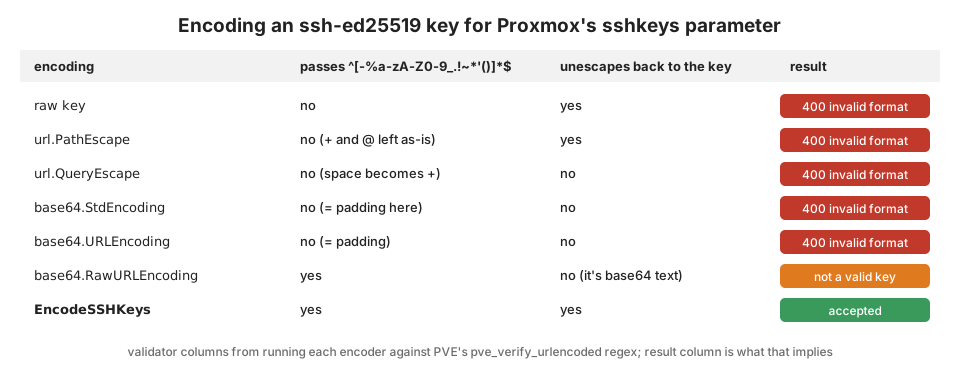
Going through the failures:
PathEscapeis for a single path segment. It encodes the space and the/but leaves+and@alone because they’re legal in a path. Proxmox doesn’t want them.QueryEscapedoes HTML form encoding, where a space is+. The validator rejects+outright. Even if it didn’t, a URI unescape that isn’t form-aware turns it back into a literal+. You’d get a corrupted key.- Standard and URL-safe base64 end in
=padding here, which fails the regex. It doesn’t matter much, because… RawURLEncodingsails through the validator, and it’s the worst one of the bunch. The alphabet is entirely legal characters, so the format check passes and Proxmox stores the base64 text as the key. Then the key check, or cloud-init, gets a string that isn’t an OpenSSH key.
What works is RFC 3986 percent encoding with nothing marked safe. That’s what Python’s
urllib.parse.quote(key, safe='') does. It’s also what a Proxmox staff member recommended on the forum years ago. Go
doesn’t have that as a single function, but QueryEscape is one substitution away from it. It percent-encodes
everything except unreserved characters. The only thing it does differently is spaces as +.
The fix
@abbaszai posted a working Go version in August 2025. It had
some extra trimming and decoding logic around the core idea. #273
reduced it to the core and put it in the library next to MakeTag:
// EncodeSSHKeys returns the given SSH public keys encoded the way Proxmox's
// sshkeys parameter requires. Multiple keys are joined with newlines (PVE's
// documented separator) before encoding.
func EncodeSSHKeys(keys ...string) string {
	return strings.ReplaceAll(url.QueryEscape(strings.Join(keys, "\n")), "+", "%20")
}
opts := []proxmox.VirtualMachineOption{
	{Name: "sshkeys", Value: proxmox.EncodeSSHKeys(pubKey1, pubKey2)},
}
The + to %20 swap is safe because QueryEscape already turned every literal + in the input into %2B. The only
+ characters left in its output are spaces. The test table includes a key with a literal + to prove that.
It would be easy to do this automatically inside the VM config call, and I deliberately didn’t. Everyone who hit #144
has a workaround in their code that already encodes the key one way or another. Auto-encoding would encode their
already-encoded value a second time. %20 becomes %2520 and the validator is perfectly happy with that. The key that
lands in the guest is garbage with no error anywhere. An opt-in helper and a doc comment on the SSHKeys field is the
version that can’t silently break anyone.
The same mistake, in the other direction
Encoding flags bit again this month. The QEMU guest agent wrapper has AgentFileWrite, for writing a file into a
running VM. The guest agent wants base64 content. The Proxmox endpoint has an encode parameter that the API docs
describe like this:
If set, the content will be encoded as base64 (required by QEMU). Otherwise the content needs to be encoded beforehand - defaults to true.
The original wrapper base64-encoded the content itself and also sent encode: 1. It had a confident comment saying
that encode=1 “tells PVE the content is already base64”. It means the opposite. Proxmox encoded it again and the
guest agent decoded it once. Every file written through that method landed in the guest as base64 text. Someone was
writing a TOML config and a PEM file into a guest. They found it when the service inside crash-looped on
expected value but found '='. #343 keeps the client-side
encoding (binary safe) and sends encode: 0:
body := map[string]interface{}{
	"file":    file,
	"content": base64.StdEncoding.EncodeToString(content),
	"encode":  0,
}
Both bugs are the same lesson. When two layers each might encode something, decide which one does it. Write the decision down where the next person will see it. When there’s a flag for it, read the description of the flag on the side that receives it rather than guessing from the name.




