Luther Monson, Staff Software Engineer at SUSE

Luther Monson

Go by way of PHP · Containers · VMs · Windows · Kubernetes

Building k9s for Linode With Bubble Tea

A k9s-style terminal app for managing Linode. Search for any resource, browse it, and jump straight into k9s, a database shell or SSH.
8-Minute Read

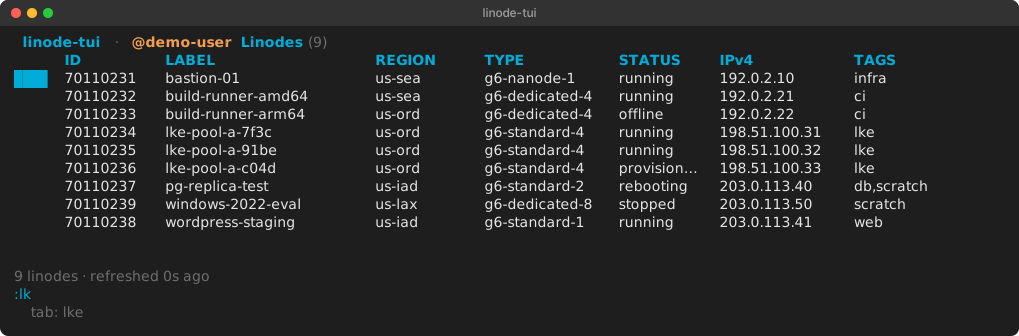
linode-tui showing the Linodes view with the command bar open and tab completion suggesting lke

A lot of my day is spent in k9s. Sometimes I need something from the Linode side of the house. Maybe it’s a node that won’t boot, a volume nobody cleaned up or the kubeconfig for a cluster I just made. Then I’m back in a browser tab or typing linode-cli incantations. I wanted the k9s workflow for the Linode API itself:
Finding a Data Race in rancher/remotedialer, Then Pinning Only Two-Thirds of the Fix

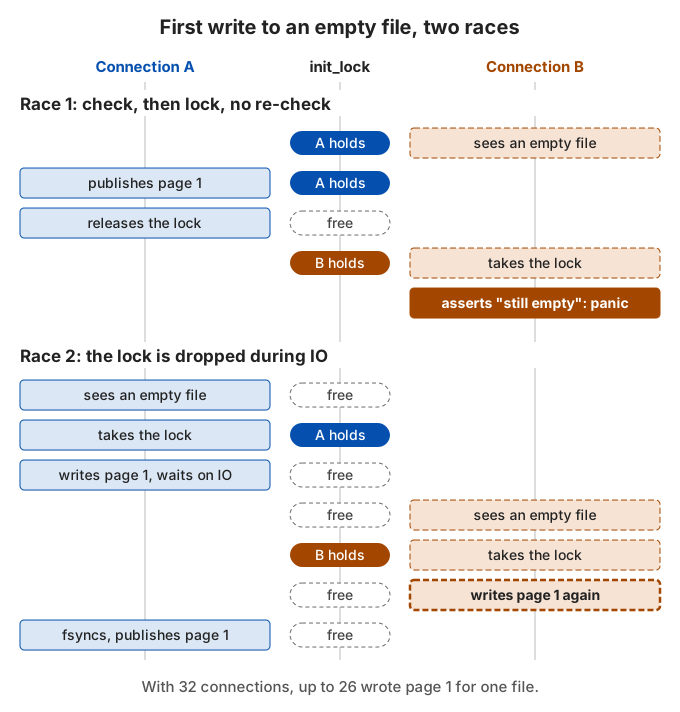
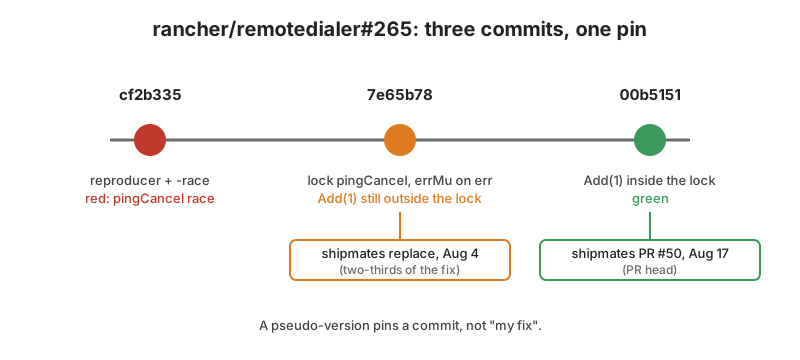
Two data races in remotedialer v0.6.1 that upstream's tests never ran with -race, and how my replace directive ended up pinned to the middle commit of my own fix.

7-Minute Read

Three commits of remotedialer PR 265 and which one the replace directive pointed at

shipmates ships connect to Fleet Command over outbound websocket tunnels. That way nothing on the ship side has to be exposed to the internet. I didn’t write that tunnel layer. I used rancher/remotedialer, the same library Rancher uses to reach downstream cluster agents. I spent years around that code at Rancher, so it was the obvious pick. What I didn’t expect was for my CI’s race job to find two data races in it in the first week.

What an Overloaded PHP Server Actually Returns

Closed-loop benchmarks can't show you overload. An open-loop load generator with an error taxonomy showed ePHPm returned nothing at all, and then verified the fix.

11-Minute Read

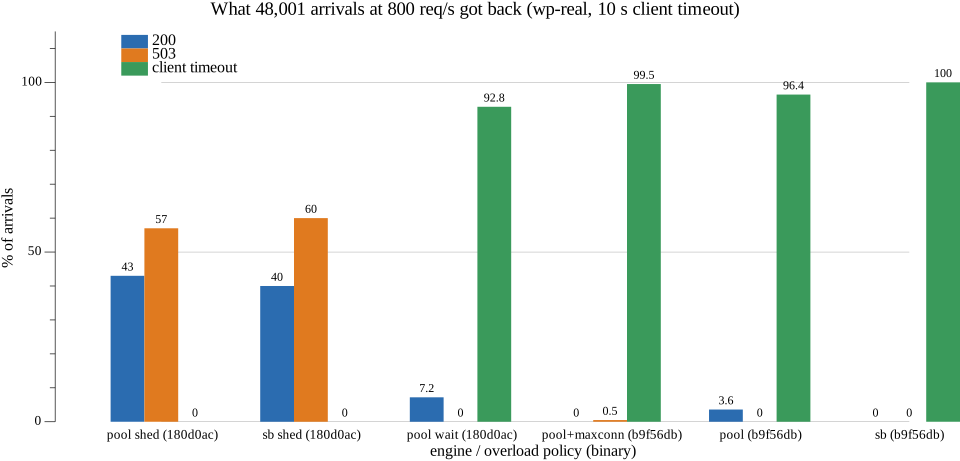
Bar chart of what 48,001 arrivals at 800 req/s got back: before the fixes almost everything was a client timeout, after them every arrival got a 200 or a fast 503

Ask most people what their PHP server does when it’s overloaded and you’ll hear “it returns 503s.” Ask them how they know and it usually comes down to a config setting they read about. I was in that camp for ePHPm. We had a [server.limits] max_connections knob, and the docs said it returned 503 at the cap. Every benchmark we had ever run reported zero errors under heavy load. Then I wrote a load generator that could produce overload. The honest answer was that an…

shipmates: Persona-Based AI Coding Crews That Remember

shipmates is a Go CLI and daemon that runs crews of AI coding agents across machines. It adds per-project memory, a shared task graph, voice control and a real permission model.

7-Minute Read

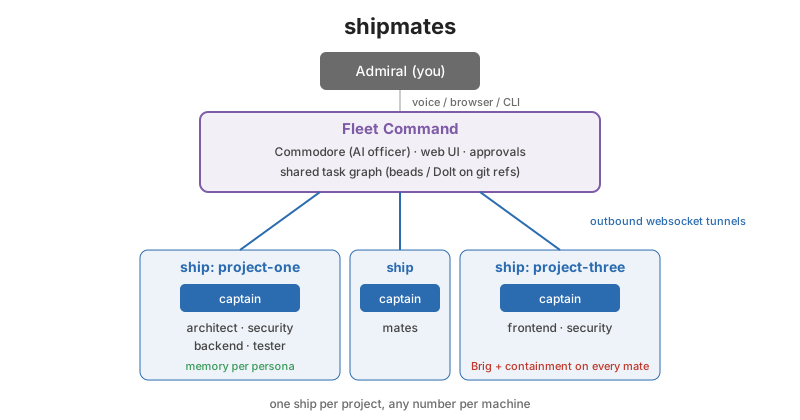
shipmates hierarchy: Admiral, Fleet Command, ships, captains and mates

Since June most of my evenings have gone into shipmates, a Go CLI and daemon for running crews of AI coding agents. I tagged v0.5.0 on August 17th. That was two months and about 240 commits after the first architecture doc. So it’s a good time to write down what it is and why it exists.

ephemerd: One Daemon, a Fresh Runner Per Job, Every OS

A single Go binary that runs self-hosted GitHub Actions runners on Linux, Windows and macOS, with a new container or VM for every job.

6-Minute Read

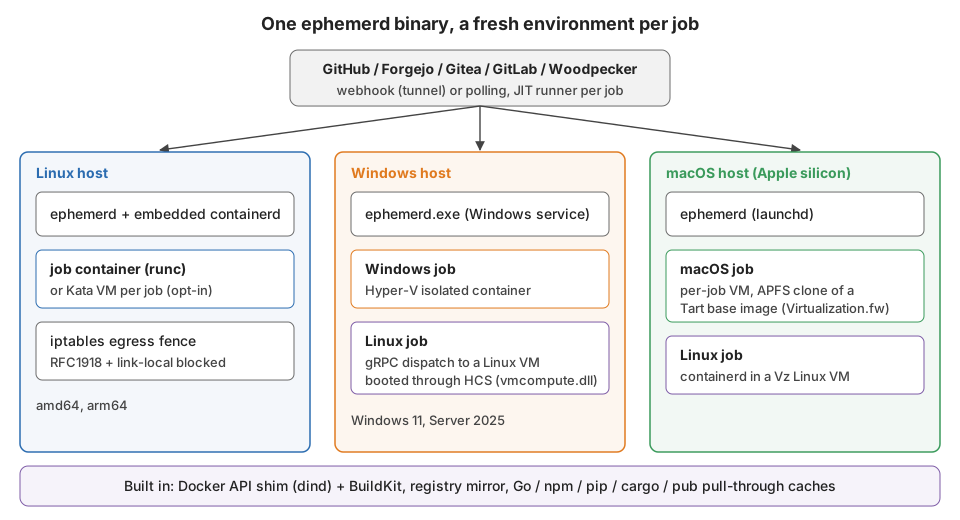
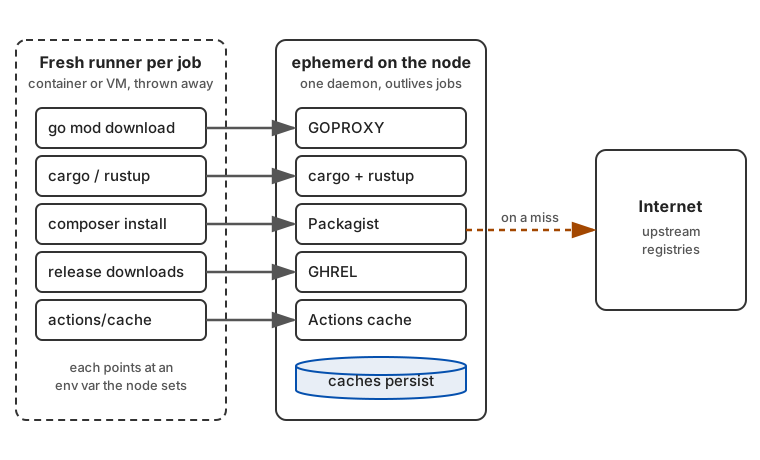
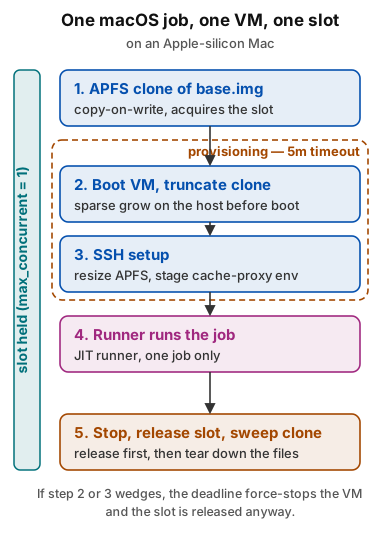
ephemerd architecture across Linux, Windows and macOS hosts

I have CI that needs Linux amd64, Linux arm64, Windows and macOS. GitHub-hosted runners for all four get expensive fast, especially the arm64 and Mac minutes. Self-hosted runners fix the bill and create a different problem. A stock actions/runner on a box you own runs whatever the workflow says. It keeps whatever the last job left behind. And it’s one fork PR away from somebody running code on your LAN.

Atomic File Replacement on NTFS Is Not rename + fsync

The Unix recipe for durable atomic file replacement doesn't translate to Windows. This is what shipmates uses instead, plus the delete-pending window that made an 8-way test fail only when the whole suite ran.

7-Minute Read

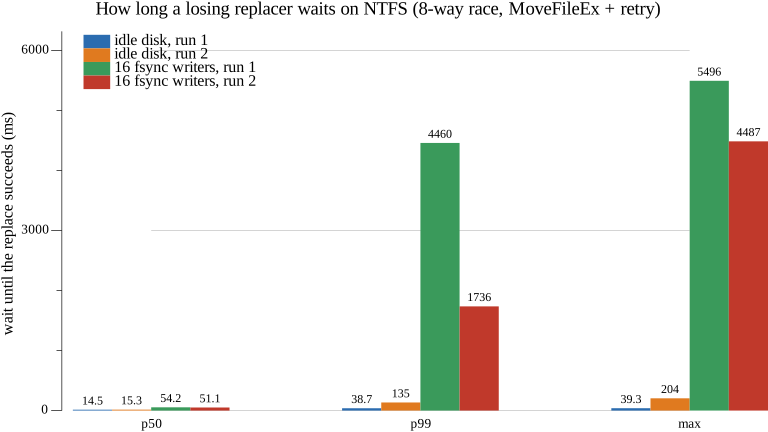
How long a losing concurrent replacer waits on NTFS, idle disk vs a disk under fsync load

shipmates writes a lot of small state files that other processes read. Voyage plans and state, tracker files. Each of them has to be replaced atomically, so a reader sees the old file or the new one and never half of each. Each also has to be replaced durably. When the function returns success, a power cut doesn’t take it back. Every Unix programmer knows the recipe for that. It doesn’t work on Windows, and the reasons are more interesting than “Windows is different”.

Five Ways to URL-Encode an SSH Key (and Why Proxmox Rejects Them)

Proxmox's sshkeys parameter wants Python-style percent encoding that no single Go function produces. This covers a two-year-old issue, its one-line fix, and a related double-encoding bug in guest file writes.

6-Minute Read

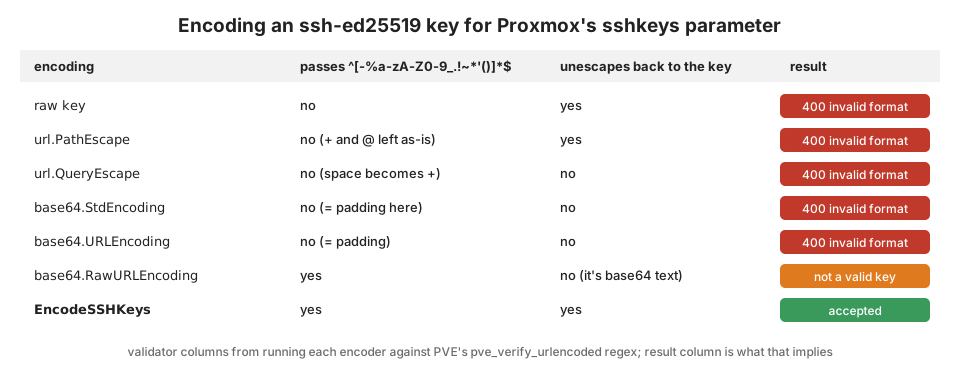
Table of seven ways to encode an SSH public key and whether each passes Proxmox's urlencoded validator

Issue #144 on go-proxmox was opened in April 2024 with the title “Weird sshkeys SSH public key validation error”. It is one of my less proud threads. It’s thirteen comments of people, including me, trying to get a public key into a cloud-init VM through the API. The working answer took more than a year to show up. The fix that finally landed in May is one line. Here’s why it took so long.

Two Small go-proxmox Fixes: A Watch Channel That Never Closed, and WithRetry

go-proxmox had a task log channel that only closed on the happy path. It also gained a composable RoundTripper that retries the 502s and 503s Proxmox throws during cluster transitions.

6-Minute Read

Proxmox VE Logo

Here are two changes from the v0.5 to v0.7 stretch of go-proxmox. They’re too small for a post each. They’re worth knowing about if you write long-running tooling against Proxmox. One is a bug in code I wrote about in 2022. The other is a feature that replaces a retry loop everybody was writing for themselves.

Maintaining an Open-Source Library With AI Agents: AGENTS.md and the Rule They Kept Breaking

Six weeks of go-proxmox with coding agents doing most of the typing taught me what belongs in AGENTS.md. Five parallel agents got the same API shape wrong, and a coverage metric bent the code around it.

7-Minute Read

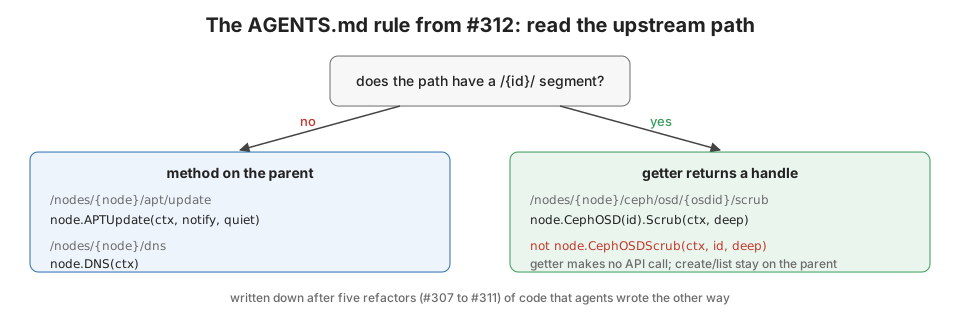
Decision diagram: endpoints without an id in the path become methods on the parent, endpoints with an id get a handle type

On May 9th I merged #264. It added an AGENTS.md to go-proxmox and a stub CLAUDE.md that just points at it. The next six weeks ran through the v0.8.0 migration guide on June 15th. In that time main took 77 commits and +31,794 / -1,144 lines. The repo went from 84 to 186 .go files. Endpoint coverage went from 30% to 100% of the Proxmox API. Most of that code was typed by coding agents, a lot of it by several at once. This is what that looked like from the maintainer’s chair. It’s…

Proxmox JSON, Part 2: Three More Surprises

The Proxmox API found three more ways to trip up Go's JSON decoding. Here's what broke and how I fixed it.

7-Minute Read

Proxmox VE Logo

In 2023 I wrote about why go-proxmox has StringOrInt and friends. Proxmox sends the same number quoted in one place and bare in another, so the client has types that accept both. That post ended on a pretty confident note. Since then three more shapes of “the JSON is valid and Go still won’t take it” have come in. One of them is a bug I’d already fixed once and then reintroduced myself.

Recent Posts

Categories

About

Luther is a 20+ year software veteran specializing in backend APIs and architecting products. Employed at SUSE as the Team Lead for the Containers on Windows Team working on Rancher + Kubernetes