
Two Small go-proxmox Fixes: A Watch Channel That Never Closed, and WithRetry
go-proxmox had a task log channel that only closed on the happy path. It also gained a composable RoundTripper that retries the 502s and 503s Proxmox throws during cluster transitions.
Here are two changes from the v0.5 to v0.7 stretch of go-proxmox. They’re too small for a post each. They’re worth knowing about if you write long-running tooling against Proxmox. One is a bug in code I wrote about in 2022. The other is a feature that replaces a retry loop everybody was writing for themselves.
The channel that only closed when things went well
In 2022 I wrote up how tasks and Watch work. Watch returns a channel of
log lines. A goroutine tails the task log until the task stops. Then it closes the channel so you can range over it.
Here is the tail loop from that post:
func tasktail(start int, watch chan string, task *Task) error {
	for {
		if err := task.Ping(); err != nil {
			return err
		}

		if task.Status != TaskRunning {
			close(watch)
			return nil
		}

		logs, err := task.Log(start, 50)
		if err != nil {
			return err
		}
		// ...
	}
}
The channel is closed in exactly one place: when the task is no longer running. Every return err leaves it open. Since
context support was added in 2023 there’s a new way to hit those error paths. You cancel the context.
@aisbergg reported precisely that in #254:
logChan, err := task.Watch(ctx, 0)
if err != nil {
	return err
}

for line := range logChan {
	logLine(line)
}
Here’s what happens when you cancel ctx:
- the next
Pingfails andtasktailreturns the error - the goroutine logs it and exits
- the
rangewaits forever on a channel nobody will ever write to or close
A network blip did the same thing. It was just rarer.
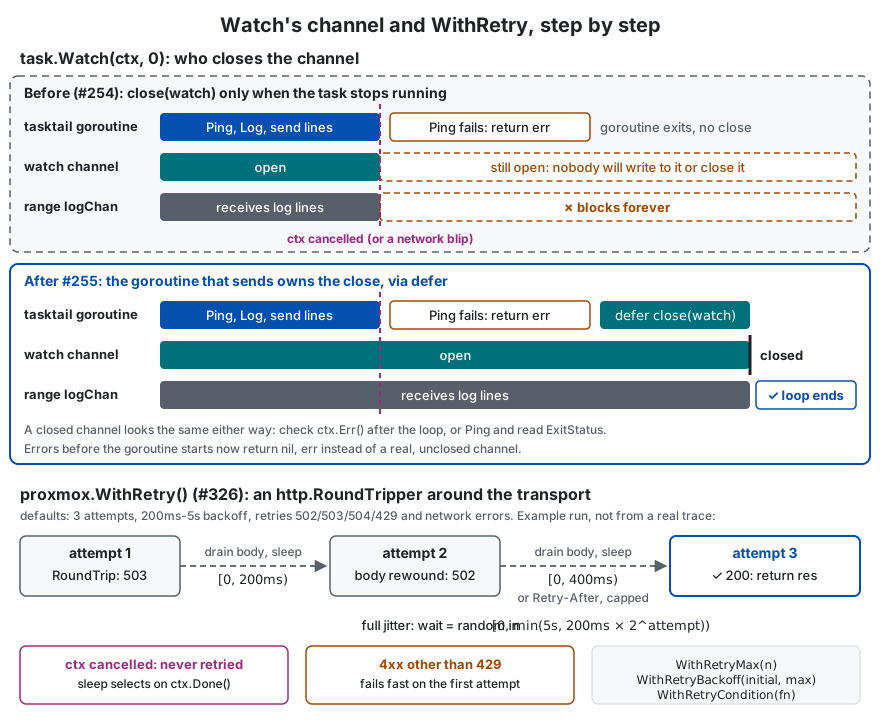
The fix, #255, also came from @aisbergg. It’s the rule I should
have followed in the first place. The goroutine that owns the sends owns the close. It does it with defer so every
exit path is covered.
-	watch := make(chan string)
-
 	log, err := t.Log(ctx, start, 50)
 	if err != nil {
-		return watch, err
+		return nil, err
 	}
 ...
+	watch := make(chan string)
+
 	go func() {
+		defer close(watch)
 		t.client.log.Debugf("logs found for task %s", t.UPID)
 		for _, ln := range log {
 			watch <- ln
 ...
 		if task.Status != TaskRunning {
 			task.client.log.Debugf("task %s is no longer running, closing down watcher", task.UPID)
-			close(watch)
 			return nil
 		}
The other half of the diff is quieter but matters too. The error returns before the goroutine starts used to hand back a
real, unclosed channel alongside the error. Anyone who ranged over it without checking err first would block forever.
Now they get nil, and the channel is only created once there’s a goroutine that will close it.
Both halves are @aisbergg’s work: the diagnosis, the diff and the PR. My part was reviewing it and merging it. I tagged v0.5.0 that evening so it shipped. The bug itself is mine, from 2022.
What the caller loses is the reason the stream ended. A closed channel looks the same whether the task finished or the
context was cancelled. Check ctx.Err() after the loop, or Ping the task and look at ExitStatus.
WithRetry
Proxmox returns 502 and 503 while a cluster is doing something to itself. That could be pveproxy restarting after an
update, a node rejoining, or a quorum change. Every tool I’ve seen built on the client wraps its calls in the same
three-line retry loop. #326 moves that into the client as an
option:
client := proxmox.NewClient(url,
	proxmox.WithAPIToken(tokenID, secret),
	proxmox.WithRetry(), // 3 attempts, 200ms-5s backoff, retries 502/503/504/429 and network errors
)
It’s an http.RoundTripper wrapped around whatever transport the client ends up with, rather than logic inside
Client.Req. That’s what lets it compose with the other transport options in any order. Those are
WithInsecureSkipVerify, WithRootCAs, WithProxy and WithRequestInterceptor. It’s installed in a finalize step
after all the options have run. So WithRetry() before or after WithHTTPClient(custom) both end up wrapping the
custom client’s transport.
The loop itself is the standard shape with a few details I care about:
for attempt := 0; attempt < r.policy.maxAttempts; attempt++ {
	// Reset the body before every attempt after the first.
	if attempt > 0 && rewind != nil {
		req.Body = rewind()
	}

	res, err := r.base.RoundTrip(req)

	// Honor user-initiated cancellation immediately — never retry it.
	if err != nil && ctxErr(ctx) != nil {
		return nil, ctx.Err()
	}

	lastRes, lastErr = res, err

	if !r.policy.condition(res, err) {
		return res, err
	}
	// ... non-idempotent check, last-attempt check ...

	delay := r.computeBackoff(attempt, res)

	// Drain and close the body so the underlying connection can be
	// reused on the next attempt.
	drainResponse(res)

	if err := r.policy.sleep(ctx, delay); err != nil {
		return nil, err
	}
}
- Full jitter. The wait is a random duration in
[0, min(5s, 200ms * 2^attempt)). A dozen workers that all got a 503 at the same moment don’t all come back at the same moment. Retry-Afterwins whenever the server sends one, in both the seconds and HTTP-date forms. It’s capped at the configured max so a misconfigured proxy can’t park the client for an hour.- Cancellation is final. A cancelled context is never retried. The sleep between attempts is a
selectonctx.Done(), so cancelling during a backoff returns immediately. - The body is replayable. The request body is buffered once and a fresh reader is handed to each attempt. In this
client every body is already a
[]byte, so that costs nothing. - 4xx other than 429 fails fast. A 400 isn’t going to get better on attempt two.
The knobs are WithRetryMax(n), WithRetryBackoff(initial, max) and WithRetryCondition(func(*http.Response, error) bool).
One thing to think about before turning it on. Because the body is replayable, POST is retried along with the
idempotent verbs. That’s the right call for a 503 from pveproxy itself. That means the request never reached the API
handler. A 502 from a reverse proxy in front of Proxmox is less clear-cut. The proxy may have given up after the backend
already accepted the request. A retried POST /nodes/{node}/qemu could then try to create the VM twice. With a fixed
VMID the second attempt fails because the ID is already taken. That’s noisy but safe. If you create things without
pinning IDs, pass a WithRetryCondition that leaves 502 alone. Or only enable retry on read-heavy clients.




