
Per-Tenant Network Policy in One Process: ePHPm's eBPF Thread Tags
Every site on an ePHPm server runs inside the same process, so a normal firewall can't tell them apart. A small eBPF program tags each thread with its site. It keeps sites from reaching each other's local ports for under a microsecond per connection.
In multi-tenant mode ePHPm serves every site in sites_dir from one process. Every
tenant’s PHP runs as the same OS user on the same pool of ZTS threads. A thread that just served blog.example will
serve shop.example a few milliseconds later. That’s the density win. It also means the kernel has no idea which
tenant is behind a given connect(). As far as Linux is concerned it’s all ephpm-web.
Most of the isolation work in ePHPm happens above the kernel. That covers open_basedir, the function denylist,
per-site databases and KV keyspaces. Network is the one place where that isn’t enough. This week we brought eBPF in
to give the kernel a per-tenant identity. It went from a roadmap doc on Wednesday morning to merged that evening
(#413, aimed at v0.8.1). v0.8.1 never got a release because its Linux
legs failed to link. v0.8.2 shipped with the BPF object silently stubbed out. v0.8.3 was the first release that
carried it. This post covers what it enforces and what it costs. It also covers what broke on the way out the door
and what it doesn’t do.
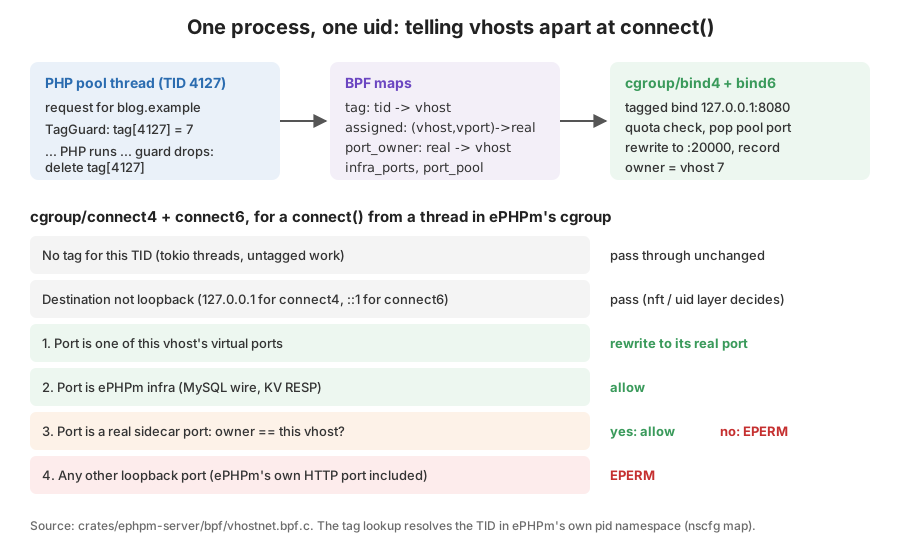
Why uid rules can’t see tenants
The hardened preview host already had an nftables table scoped to meta skuid ephpm-web. It seals loopback, drops
cloud metadata and RFC1918, and pins DNS. That’s a good floor. It also treats every tenant the same, because a uid
match is all it has to go on. Two things fall out of that:
- No sidecars. Say tenant A wants to run something on
127.0.0.1:8080for its own PHP to talk to. You either seal loopback for everyone (A can’t reach its own sidecar) or open it for everyone (B can reach A’s sidecar too). - No per-tenant ports. Two tenants that both hardcode
127.0.0.1:8080collide on bind.
Network namespaces are the textbook answer, but they’re built for one process per context. For ePHPm that means a
setns() per request plus CAP_SYS_ADMIN. It also means a veth, route, NAT and DNS setup per tenant. That doesn’t
fit a model where a 1 GB node is supposed to hold a lot of sites.
What we needed was a way to attach an identity to a thread for the duration of one request. Then the kernel could
read it at bind()/connect() time.
A tag per thread
The whole design hangs off one BPF hash map called tag. It’s keyed by thread ID with a numeric vhost ID as the
value. Before a request’s PHP runs, the router writes tag[tid] = vhost. It deletes the entry when the request is
done. From crates/ephpm-server/src/tenant_ebpf.rs:
pub fn tag_current_thread(self: &Arc<Self>, site_key: &str) -> TagGuard {
    let vhost = self.site_ids.id_for(site_key);
    let tid = current_tid();
    if let Ok(mut tag) = self.tag.lock()
        && let Err(e) = tag.insert(tid, vhost, 0)
    {
        tracing::warn!(tid, vhost, error = %e, "tenant_ebpf: failed to write tag");
    }
    TagGuard { owner: Arc::clone(self), tid }
}

impl Drop for TagGuard {
    fn drop(&mut self) {
        if let Ok(mut tag) = self.owner.tag.lock() {
            let _ = tag.remove(&self.tid);
        }
    }
}
The router creates the guard at the top of run_php. That’s the per-request closure both fpm engines run. The guard
is dropped on the same pool thread when that closure returns:
// crates/ephpm-server/src/router.rs
let run_php = move || -> Result<ephpm_php::response::PhpResponse, ephpm_php::PhpError> {
    let _ebpf_tag_guard = ebpf_tag.as_ref().map(|(e, key)| e.tag_current_thread(key));
    // ... per-site KV, DB, open_basedir, then PhpRuntime::execute ...
The one invariant that matters here is that a stale tag must never survive onto the next request. If it did, tenant B
would inherit tenant A’s network identity on a reused thread. That’s the exact cross-tenant leak this is supposed to
prevent. The Drop is a bpf_map_delete_elem syscall, not a PHP call. It doesn’t cross PHP’s setjmp/longjmp
boundary. PhpRuntime::execute catches its own bailout and returns a Result, so the closure always unwinds
normally. The shed, 503 and hung-thread paths return before run_php runs at all. They never write a tag in the
first place.
A failed tag write logs and lets the request run untagged. Keep that in mind for the limits section.
Which thread is this, really?
On the kernel side the obvious helper is bpf_get_current_pid_tgid(). Its low 32 bits are the TID. The catch is that
it returns the global TID. That turned up in the proof of concept before any of this was merged. If ePHPm runs
inside a PID namespace (a container, Kubernetes, or WSL2), the gettid() ePHPm sees is a different number. The
lookup misses and every thread looks untagged. So the loader writes the {dev, ino} of /proc/self/ns/pid into a
one-slot nscfg map at startup. The programs then resolve the TID in that namespace:
// crates/ephpm-server/bpf/vhostnet.bpf.c
static __always_inline __u32 resolve_tid(void)
{
    __u32 zero = 0;
    struct nscfg_t *c = bpf_map_lookup_elem(&nscfg, &zero);
    if (c && c->dev) {
        struct bpf_pidns_info ns = {};
        if (bpf_get_ns_current_pid_tgid(c->dev, c->ino, &ns, sizeof(ns)) == 0)
            return ns.pid; // .pid == TID in that namespace
    }
    return (__u32)bpf_get_current_pid_tgid(); // global TID (low 32 bits)
}
I got to re-learn this one personally while benchmarking for this post. I loaded the object with bpftool instead of
ePHPm’s loader and forgot to fill nscfg. Inside WSL2 the tagged bind came back on the port I asked for. A tagged
connect to a port nobody owned got Connection refused from the network stack instead of EPERM from the hook. The
hooks were attached and doing nothing. Filling nscfg the way the loader does fixed it immediately:
## nscfg left empty
tagged -> unowned 127.0.0.1:3307    r=-1 errno=Connection refused
tagged bind 127.0.0.1:8080 -> real port 8080

## nscfg = {dev, ino} of /proc/self/ns/pid
tagged -> unowned 127.0.0.1:3307    r=-1 errno=Operation not permitted
tagged bind 127.0.0.1:8080 -> real port 20000
That’s the failure mode in a nutshell. A mismatch doesn’t error out. It looks like a working box with no policy.
What connect4 decides
Four programs attach to ePHPm’s own cgroup: cgroup/bind4, bind6, connect4 and connect6. They only touch the
UAPI fields of struct bpf_sock_addr (user_ip4, user_ip6, user_port). That means no CO-RE relocation and no
vmlinux.h. connect4 calls it loopback when the destination is 127.0.0.1, and connect6 when it’s ::1. Both
then hand off to the same function. It’s short enough to show whole:
static __always_inline int do_connect(struct bpf_sock_addr *ctx, int is_loopback)
{
    __u32 *vhostp = current_vhost();
    if (!vhostp)
        return 1; // untagged: connect unchanged
    __u32 vhost = *vhostp;

    if (!is_loopback)
        return 1; // non-loopback egress handled by the per-vhost allowlist layer

    __u32 dport = bpf_ntohs(ctx->user_port);

    // 1) Virtual port for this vhost -> rewrite to its private real port.
    __u64 key = ((__u64)vhost << 32) | dport;
    __u32 *rport = bpf_map_lookup_elem(&assigned, &key);
    if (rport) {
        ctx->user_port = bpf_htons((__u16)*rport);
        return 1;
    }

    // 2) Shared ePHPm infra port (MySQL wire, KV RESP) -> always allow.
    if (bpf_map_lookup_elem(&infra_ports, &dport))
        return 1;

    // 3) Direct connect to a real port -> authorize by ownership.
    struct owner_t *o = bpf_map_lookup_elem(&port_owner, &dport);
    if (o)
        return (o->vhost == vhost) ? 1 : 0; // own sidecar allow; cross-vhost DENY

    // 4) Unowned loopback port: DENY for managed vhosts. This is the loopback
    //    floor that REPLACES the static nft loopback-drop for tagged traffic.
    return 0;
}
Returning 0 from a cgroup sockaddr program fails the syscall with EPERM. Step 4 is the important one. It’s the
loopback floor. A tagged tenant can’t reach a loopback port that it doesn’t own and that isn’t infra. That includes
ePHPm’s own HTTP listener and whatever else the box runs on localhost.
Read that comment on the non-loopback branch carefully, though. It says public egress is “handled by the per-vhost allowlist layer”. There is no per-vhost allowlist layer. The roadmap’s phase 1 described one. What shipped passes every non-loopback connect straight through to whatever the operator’s nftables table does. That table is per-uid. So the eBPF policy is a per-tenant loopback policy. More on that below.
The tag is also only written in fpm mode with sites_dir set. validate() rejects ebpf_policy = true off Linux,
without sites_dir, and in worker mode. Worker mode’s persistent loop would need per-event tagging inside the PSR-7
envelope. That isn’t built.
Every tenant gets its own :8080
The bind side is what makes sidecars usable. When a tagged thread binds, bind4 does three things:
- pops a free port from a pool ePHPm owns
- rewrites the bind to it
- records who owns it
The app asked for 127.0.0.1:8080 and the socket really lands on :20000. When the same tenant later connects to
:8080, step 1 above rewrites the destination to :20000. Another tenant binding :8080 gets :20001. Neither app
knows anything happened.
// Idempotent rebind: same (vhost, vport) reuses its real port.
__u32 *ex = bpf_map_lookup_elem(&assigned, &key);
if (ex) {
    ctx->user_port = bpf_htons((__u16)*ex);
    return 1;
}

// Per-vhost quota (anti port-bomb), enforced in-kernel on the tag.
__u32 *cntp = bpf_map_lookup_elem(&sidecar_count, &vhost);
__u32 cnt = cntp ? *cntp : 0;
if (cnt >= quota_max())
    return 0; // DENY: this vhost is at its sidecar cap

__u32 rport = 0;
if (bpf_map_pop_elem(&port_pool, &rport) != 0)
    return 0; // DENY: pool exhausted (box-wide sidecar cap reached)
The pool is a BPF_MAP_TYPE_QUEUE. The loader fills it from sidecar_port_range (default 20000-32767) at startup.
Allocating is an O(1) pop with no scan. Before filling it, the loader reads net.ipv4.ip_local_port_range and
refuses to start if the ranges overlap. Otherwise an outbound connect could get an ephemeral source port that ePHPm
also wants to hand out as a sidecar port.
The part that didn’t make it is giving ports back. Returning a port to the pool when a listener closes needs one of two things:
- a
cgroup/sock_releaseprogram that reads the socket’s source port (the verifier rejects that read on 6.18) - a
BPF_MAP_TYPE_SK_STORAGEmap to hang ownership on the socket (aya 0.13 can’t load that map type)
So ports and per-vhost counts come back only when the process exits. The assigned map keeps a rebind of the same
virtual port idempotent. A sidecar that restarts on :8080 doesn’t burn a second slot. A tenant that cycles through
many different ports will hit its max_sidecar_ports_per_vhost cap (default 8) until ePHPm restarts. The code
comments and the guide say that’s coming in v0.8.2. v0.8.5 is out and it still isn’t there, because neither blocker
has moved.
Watching it work
There’s no automated test in the repo yet that loads these programs. They need root and a writable cgroup v2 hierarchy. Nothing in CI has either. So I did it by hand:
- compiled the v0.8.5
vhostnet.bpf.cwithbuild.rs’s flags - attached it to a scratch cgroup with
bpftool - ran a small C program as three tenants
Alice and Bob each bind 127.0.0.1:8080 from a tagged thread. The main thread then re-tags itself as one tenant or
the other and connects:
alice bind 127.0.0.1:8080 -> real port 20000
bob   bind 127.0.0.1:8080 -> real port 20001
bob      -> 127.0.0.1:8080  (own virtual port)     connected, read "hello from bob"
bob      -> 127.0.0.1:20001 (own real port)        connected, read "hello from bob"
bob      -> 127.0.0.1:20000 (alice's real port)    Operation not permitted
bob      -> 127.0.0.1:3306  (infra port)           connected, read "hello from infra"
bob      -> 127.0.0.1:9999  (unowned port)         Operation not permitted
alice    -> 127.0.0.1:8080  (own virtual port)     connected, read "hello from alice"
alice    -> 127.0.0.1:20001 (bob's real port)      Operation not permitted
untagged -> 127.0.0.1:20000 (alice's real port)    connected, read "hello from alice"
carol    bind 127.0.0.1:9001 -> real port 20002
carol    bind 127.0.0.1:9008 -> real port 20009
carol    bind 127.0.0.1:9009 -> Operation not permitted
Both tenants hardcoded :8080 and each one reached its own listener. A cross-tenant connect to the other’s real port
is a kernel EPERM, not a Connection refused. Carol’s ninth distinct port hits the quota of 8. The untagged line
is the one to remember for later. A thread with no tag isn’t a tenant, so the policy doesn’t apply to it.
The other half of verifying this is cleanup. The loader attaches with fd-based bpf_links and pins nothing to bpffs.
A graceful shutdown drops the aya::Ebpf and the kernel detaches. A kill -9 closes the fds and the kernel
refcounts everything to zero on its own. The loader commit (0cb5ec7)
records bpftool showing 0 programs, 0 maps and 0 cgroup attachments after a kill -9. I didn’t repeat that with
aya myself, since my harness used bpftool to load. A cold restart never has stale BPF state to reconcile.
What it costs
The hook runs once per bind() or connect(), not per packet. It’s a handful of hash lookups. The other cost is the
two map syscalls per PHP request. I measured both with the same harness (test setup below):
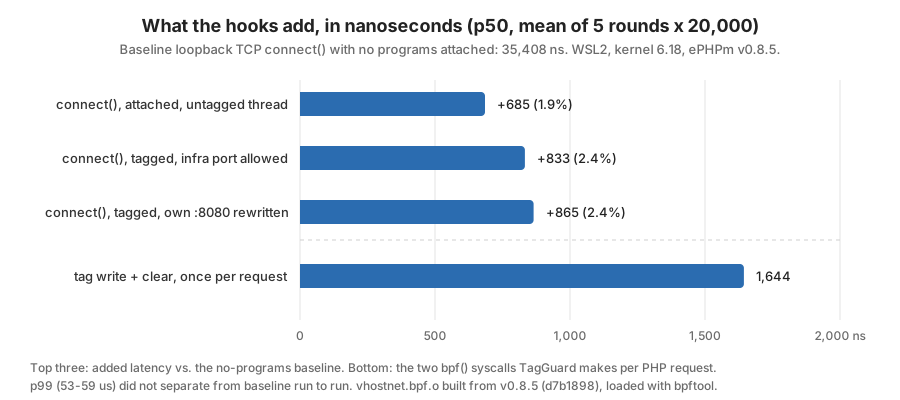
A loopback TCP connect() took about 35.4 µs at p50 with nothing attached. With the four programs attached it took
0.7 to 0.9 µs longer. That’s about 2 to 2.5%. The tagged paths (lookup plus rewrite or infra allow) cost a little
more than the untagged one. The p99 sat at 53 to 59 µs in every configuration and didn’t separate from the noise.
Every request also pays a tag write plus delete. That came out at 1.64 µs p50, about 800 ns per bpf() syscall.
It’s several times the roadmap’s “tens to low-hundreds of nanoseconds” estimate. Next to running a PHP request it’s
still noise.
Shipping it was the hard part
The kernel code was the quick part. The hard part was getting a C BPF object into a Rust binary that builds on four CI shapes. That took five follow-up commits over Wednesday and Thursday, with v0.8.2 through v0.8.4 cut along the way.
clang isn’t always there. The BPF program is C. build.rs compiles it with clang -target bpf and it’s embedded
with aya::include_bytes_aligned!. (Plain include_bytes! puts the blob at 1-byte alignment and aya’s ELF parser
fails with “error parsing ELF data”.) The reasoning was that clang is already a build dependency for bindgen. It
isn’t. Stub-mode CI installs libclang-dev for bindgen but not the clang binary. The first version of build.rs
panicked and broke every job that compiled ephpm-server. Now build.rs never panics:
// crates/ephpm-server/build.rs
if !matches!(&run, Ok(status) if status.success()) {
    std::fs::write(&out, [])
        .expect("write placeholder eBPF object so include_bytes_aligned! compiles");
    // ... loud cargo:warning naming why ebpf_policy is unavailable ...
    return;
}
An empty object fails closed at load time. The feature is off by default. The release is smoke-tested to make sure the
real object shipped. (The module doc comment at the top of build.rs still says it fails the build when clang is
missing. It doesn’t.)
gettid() isn’t in old glibc. The release links against an older glibc to keep the binary’s floor low. The glibc
gettid() wrapper only exists from 2.30. The v0.8.1 release legs failed with undefined symbol: gettid while CI on
newer runners was green. The fix is the raw syscall, which has always existed:
let tid = unsafe { libc::syscall(libc::SYS_gettid) };
AlmaLinux 8 has no libbpf headers. Even with clang installed on the release legs, v0.8.2 shipped with the eBPF
object stubbed. The release builds in an almalinux8 image and libbpf-devel isn’t packaged there. So
bpf/bpf_helpers.h wasn’t found, and the never-panic path dutifully wrote the empty placeholder. The fix was to
vendor the five program-side libbpf headers under bpf/include and pass -I bpf/include. That’s the downside of a
build that degrades. It degrades quietly, which is why the release smoke test exists.
LimitMEMLOCK=infinity in the unit. The loader calls setrlimit(RLIMIT_MEMLOCK, infinity) itself. The hardened
unit sets NoNewPrivileges and doesn’t grant CAP_SYS_RESOURCE, so the raise is refused. Per
bd2dd03, map creation then failed with Operation not permitted
even with CAP_BPF and CAP_NET_ADMIN present. That error sends you looking at the capabilities, which are fine. I
didn’t reproduce that one. The loader’s own comment says the rlimit only matters before 5.11, when BPF memory moved
to cgroup accounting. I’d treat the setting as cheap insurance and keep it. The drop-in:
# /etc/systemd/system/ephpm.service.d/ebpf.conf
[Service]
AmbientCapabilities=CAP_NET_BIND_SERVICE CAP_BPF CAP_NET_ADMIN
CapabilityBoundingSet=CAP_NET_BIND_SERVICE CAP_BPF CAP_NET_ADMIN
LimitMEMLOCK=infinity
The firewall has to step aside. The cgroup connect hook runs before the packet ever reaches nftables. Say your nft
table still drops loopback for the ePHPm uid. The hook authorizes a sidecar connect and nft kills it one step later.
The app just sees a refused connection. With ebpf_policy on, the loopback drop has to come out of the nft table so
connect4 is the only thing deciding loopback. The metadata, LAN and DNS rules stay put. ePHPm can’t see your
firewall. All it can do is name the handoff in the startup error when the load fails. (The guide says it also logs a
warning on a successful start. I couldn’t find one in the code.)
Related: 6df4cdc landed alongside the loader. With egress enforced
below PHP, blocking fsockopen is just friction while curl and stream_socket_client reach the same places. So
network_egress_externally_managed = true drops it from the denylist. pfsockopen stays blocked. That one is about
persistent sockets outliving a request on a shared thread. The network layer does nothing about that.
What this doesn’t do
- Public egress isn’t per tenant. The eBPF layer governs loopback and sidecar ownership. Every non-loopback connect passes through to the operator’s nft table. ePHPm doesn’t ship that table and it’s per-uid. With the hardened table in place a hostile tenant still reaches public addresses.
- It covers
bind()andconnect(), nothing else. Unix domain sockets aren’t covered by these hooks. Neither is anything that doesn’t go through a cgroup sockaddr bind or connect. - Untagged means unrestricted. Threads with no tag pass through by design. That includes ePHPm’s own async runtime and any request for a Host that matched no vhost. A failed tag write also leaves the request untagged. The loader’s comment says that fails closed. From the code it looks to me like an untagged request is let through, not denied.
- Only request threads are tagged. A process started from PHP has its own TIDs and none of them are in the map.
The config doc for
cgroup_pathsays the policy covers “any sidecars it spawns”. The hooks fire for that process because it’s in the cgroup, but they treat it as untagged. - Linux only, with privileges. You need kernel 5.10 or newer with
CONFIG_CGROUP_BPF, cgroup v2,CAP_BPF+CAP_NET_ADMIN, and the memlock limit above. That’s two more capabilities than the hardened unit had. That’s the trade. On Windows and macOS, settingebpf_policy = trueis a config error. - Ports leak until restart, as covered above.
- No test loads it. Nothing in the test suite attaches the BPF programs. The e2e hardening suite covers the
function denylist and cross-tenant
ATTACH, not eBPF. (The litewire side of that is in the database proxy hardening post.) Getting a privileged runner that can exercise it is on the list. - It’s still one process. A tenant that crashes the process takes everyone down. This is a confidentiality boundary, not an availability one.
It’s off by default and labeled experimental. It also fails closed at startup. If the programs can’t load or attach,
or the port range overlaps the ephemeral range, ePHPm refuses to start rather than run without the policy. Next up is
a privileged test that runs the real loader. After that comes close-time port reclaim. That’s waiting on either a
loader that can do SK_STORAGE or another close signal the verifier will accept.
Test setup
- WSL2 on Windows 11, kernel 6.18, cgroup v2, BTF present.
- ePHPm v0.8.5
(
d7b1898). I compiled itsvhostnet.bpf.cwith the clang flags from itsbuild.rs(-O2 -g -Wall -Werror -target bpf -I bpf/include), thenllvm-strip -g. - I loaded it with
bpftool prog loadalland attached the four programs to a scratch cgroup. I filledport_poolwith 101 ports and set the quota to 8. I added3306toinfra_portsand wrotenscfgthe way the loader does. Same kernel object, different loader. - The harness is a C program running in that cgroup. It times only the
connect()syscall to a loopback listener. It setsSO_LINGER0 so closes don’t pile upTIME_WAIT. Each case is 20,000 connects, with five rounds with programs attached and five without. The tag cost is aBPF_MAP_UPDATE_ELEMplusBPF_MAP_DELETE_ELEMon thetagmap, 20,000 times per round. The chart shows the mean of the per-round p50s. - All of this is loopback on one machine inside a VM. Treat the absolute numbers as this box’s numbers. The deltas are the useful part. I didn’t measure end-to-end request throughput through a PHP-linked ePHPm with the policy on.
Links
- Design: roadmap doc,
#412,
4df45eb - Feature PR: #413
- Config and loader:
56ea958,0cb5ec7 fsockopenlifted when egress is managed below PHP:6df4cdc- Build and release fixes:
557d96canddda1e1d(clang,build.rsnever panics),e9ff5fe(SYS_gettid),84efd26(vendored libbpf headers),bd2dd03(LimitMEMLOCK=infinity) - Source at v0.8.5:
vhostnet.bpf.c,tenant_ebpf.rs,build.rs - Guides at v0.8.5: per-vhost network policy (eBPF), multi-tenant hardening
- Related on luth.io: what one more WordPress site costs, hardening a Rust database proxy
- aya




