
Escaping WSL: Booting My Own Linux VM Through Hyper-V's HCS API
WSL2 refuses to run under LocalSystem, so ephemerd boots an Alpine kernel directly through vmcompute.dll instead.
I’ve been building ephemerd, a daemon that runs self-hosted GitHub Actions runners with a fresh environment per job. On a Windows host, Windows jobs run in Hyper-V isolated containers. Linux jobs still need a Linux kernel from somewhere. The obvious answer on Windows in 2026 is WSL2, and that’s what I used first. It worked great from my terminal and fell over the moment ephemerd became a real Windows service.
WSL2 doesn’t do LocalSystem
A Windows service that wants to create containers and Hyper-V VMs runs as LocalSystem. WSL2 doesn’t support that context
at all. You get WSL_E_LOCAL_SYSTEM_NOT_SUPPORTED and that’s the end of the conversation. There’s no flag for it. WSL is a
per-user feature and a service account isn’t a user.
So there were two options. I could run the service as a real user account and inherit every weird profile-loading problem
that comes with it. Or I could skip WSL and talk to Hyper-V directly. I went with Hyper-V. The commit that did it is
fa41077, “replace WSL with Hyper-V for Linux VM on Windows”. The rest
of this post is what that took.
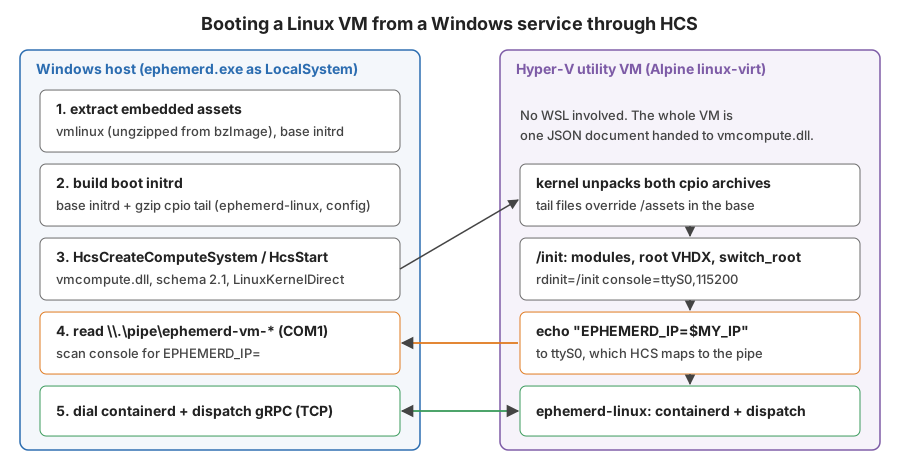
HCS is the API under all of it
Docker, containerd’s Windows shim and WSL itself all end up in the Host Compute Service, exposed through vmcompute.dll.
Microsoft’s Go library for it is hcsshim, and hcsshim already knows how to boot a
Linux VM. That’s what LCOW (Linux Containers on Windows) does. internal/uvm.makeLCOWDoc builds a JSON document describing
a “utility VM” with a kernel, an initrd and some devices, and hands it to HCS.
The catch is the word internal. Go won’t let you import another module’s internal packages, so the code I wanted to reuse
was off limits. What I could do is call vmcompute.dll directly, which is exactly what hcsshim does under the covers. Then
I defined my own copies of the schema structs:
var (
	modvmcompute = windows.NewLazySystemDLL("vmcompute.dll")

	procHcsCreateComputeSystem     = modvmcompute.NewProc("HcsCreateComputeSystem")
	procHcsStartComputeSystem      = modvmcompute.NewProc("HcsStartComputeSystem")
	procHcsTerminateComputeSystem  = modvmcompute.NewProc("HcsTerminateComputeSystem")
	procHcsEnumerateComputeSystems = modvmcompute.NewProc("HcsEnumerateComputeSystems")
	// ...
)

type hcsLinuxKernelDirect struct {
	KernelFilePath string `json:"KernelFilePath,omitempty"`
	InitRdPath     string `json:"InitRdPath,omitempty"`
	KernelCmdLine  string `json:"KernelCmdLine,omitempty"`
}
The whole VM is one document. It uses schema 2.1 and contains:
- A
LinuxKernelDirectchipset, so there’s no firmware or bootloader. - A SCSI controller with the root disk.
- A network adapter bound to an HCN endpoint on the Default Switch.
- A COM port mapped to a named pipe.
Trimmed down from pkg/vm/linuxvm_windows.go:
doc := &hcsComputeSystem{
	Owner:                             "ephemerd",
	SchemaVersion:                     &hcsVersion{Major: 2, Minor: 1},
	ShouldTerminateOnLastHandleClosed: true,
	VirtualMachine: &hcsVM{
		StopOnReset: true,
		Chipset: &hcsChipset{
			LinuxKernelDirect: &hcsLinuxKernelDirect{
				KernelFilePath: kernelPath,
				InitRdPath:     initrdPath,
				KernelCmdLine:  cmdline,
			},
		},
		ComputeTopology: &hcsTopology{
			Memory:    &hcsMemory{SizeInMB: l.cfg.MemoryMB, AllowOvercommit: true},
			Processor: &hcsProcessor{Count: uint32(l.cfg.CPUs)},
		},
		Devices: &hcsDevices{
			Scsi: map[string]hcsScsi{
				scsiControllerGUIDs[0]: {Attachments: map[string]hcsAttachment{
					"0": {Type_: "VirtualDisk", Path: l.rootVHDXPath()},
				}},
			},
			NetworkAdapters: map[string]hcsNetworkAdapter{"default": {EndpointId: endpointID}},
			ComPorts:        map[string]hcsComPort{"0": {NamedPipe: consolePipe}},
		},
	},
}
The SCSI controller GUID isn’t arbitrary either. hcsshim derives its controller IDs as v5 UUIDs from a fixed namespace. I
copied the first one (df6d0690-79e5-55b6-a5ec-c1e2f77f580a) rather than inventing one and finding out what HCS thought
of it.
Calling it is a plain syscall.SyscallN with UTF-16 strings. The one thing that tripped me up is that create and start are
asynchronous. A return of HCS_E_OPERATION_PENDING (0xC0370103) isn’t an error. It means the handle is good and HCS is
still working:
r0, _, _ := syscall.SyscallN(
	procHcsCreateComputeSystem.Addr(),
	uintptr(unsafe.Pointer(idPtr)),
	uintptr(unsafe.Pointer(configPtr)),
	0, // identity
	uintptr(unsafe.Pointer(&handle)),
	uintptr(unsafe.Pointer(&resultPtr)),
)
if uint32(r0) == hcsOperationPending {
	hcsResultString(resultPtr) // free result
	time.Sleep(3 * time.Second)
	return handle, nil
}
The kernel has to be an uncompressed ELF
LinuxKernelDirect loads the kernel itself, so it wants a raw vmlinux, not the bzImage every distro ships. I use
Alpine’s linux-virt package (6.12 series at the time). The build step pulls the gzip payload out of the bzImage by
scanning for gzip magic bytes. It keeps the first stream that decompresses to something starting with \x7fELF:
magic := []byte{0x1f, 0x8b, 0x08}
for i := 0; i <= len(data)-3; i++ {
	if data[i] != magic[0] || data[i+1] != magic[1] || data[i+2] != magic[2] {
		continue
	}
	gr, gzErr := gzip.NewReader(bytes.NewReader(data[i:]))
	if gzErr != nil {
		continue
	}
	gr.Multistream(false)
	raw, readErr := io.ReadAll(gr)
	_ = gr.Close()
	if readErr != nil || len(raw) < 64 {
		continue
	}
	if raw[0] == 0x7f && raw[1] == 'E' && raw[2] == 'L' && raw[3] == 'F' {
		return os.WriteFile(dest, raw, 0o644)
	}
}
It’s the same trick as the kernel’s own extract-vmlinux script, just without needing a Linux box at build time.
The kernel command line had one trap worth writing down. My first attempt said root=/dev/sda init=/init. That tells the
kernel to mount the (still unformatted) disk and look for init there. What I wanted is rdinit=/init. That runs init from
the initrd and lets the init script format and mount the disk itself:
cmdline := fmt.Sprintf(
	"rdinit=/init ephemerd.containerd_port=%d ephemerd.root_disk=/dev/sda%s "+
		"pci=off brd.rd_nr=0 pmtmr=0 nr_cpus=%d "+
		"8250_core.nr_uarts=1 8250_core.skip_txen_test=1 console=ttyS0,115200",
	l.cfg.ContainerdPort, dindFlag, l.cfg.CPUs,
)
Finding the VM’s IP through the serial console
Once the VM is up I need its IP address to dial containerd inside it. There’s no guest agent. Asking the Default Switch for DHCP leases from a service isn’t something I wanted to depend on. The VM already has a serial port wired to a named pipe, though, so the init script just prints its address:
echo "EPHEMERD_IP=$MY_IP"
echo "ephemerd-init: gateway=$GW"
The host reads the pipe, writes every line to a console.log, and watches for the marker:
scanner := bufio.NewScanner(pipe)
for scanner.Scan() {
	line := scanner.Text()
	fmt.Fprintf(logFile, "%s\n", line)
	if strings.HasPrefix(line, "EPHEMERD_IP=") {
		if ip := strings.TrimSpace(strings.TrimPrefix(line, "EPHEMERD_IP=")); ip != "" {
			select {
			case l.ipCh <- ip:
			default:
			}
		}
	}
}
Crude, but it has a nice side effect. Every kernel panic and init failure lands in console.log. That’s the first place I
look when the VM doesn’t come up. From there it’s a TCP poll until containerd and the dispatch gRPC server answer. The
first working version booted in about 20 seconds from service start to containerd ready.
The things HCS didn’t tell me
A handful of failures cost me real time. Here they are in case you go down this road too:
- The compute system ID has to be a GUID. HCS uses the ID as the identity for
GrantVmAccess, and a human-readable name gets rejected. ephemerd generates a v4 UUID for the ID and keeps a friendly name for logs. - File ACLs. The VM worker process opens the VHDX as a virtual account. Without an explicit grant on the file, create
succeeds and start fails with
HCS_E_SYSTEM_ALREADY_STOPPED. That reads like a lifecycle bug and is really a permissions bug (98d786c). ephemerd runsicaclson the VHDX before every boot. - Clock drift. Without the
hv_utilsmodule the guest has no Hyper-V TimeSync. The clock wanders, and the GitHub runner’s JWTs start getting rejected as expired. That one didn’t look like a VM problem at all (317b92a). - Stale VMs. If the service dies hard the VM can outlive it. On startup ephemerd enumerates compute systems owned by
ephemerdand terminates them before booting a new one.
Stop baking the binary into the initrd
The first design was a “fat initrd”. Busybox, the rootfs and the cross-compiled Linux build of ephemerd all went into one
cpio at build time. It was about 190 MB, and it had a nasty failure mode. A plain go build of ephemerd.exe didn’t
regenerate the initrd. I shipped several rounds of fixes that were running yesterday’s Linux code inside the VM before I
noticed.
The fix leans on a kernel feature I’d forgotten about. You can concatenate cpio archives and the kernel unpacks them in
order into one initramfs, with later entries overriding earlier ones. So the Linux binary moved into its own go:embed.
On every boot ephemerd appends a tiny gzipped cpio tail to the base initrd
(fb96345). The build-time initrd dropped from ~190 MB to ~7.6 MB.
The VM always runs the binary that’s actually on disk.
That same tail turned out to be the right way to get config into the VM. Every new setting the VM needed used to cost four things:
- A struct field.
- A kernel command line flag.
- A parser in the init script.
- A rebuild.
#89 puts the host’s config.toml into the tail with mode 0600:
if err := writeCPIOEntry(gw, "assets/ephemerd-linux", 0o100755, binData, ""); err != nil {
	return fmt.Errorf("cpio: ephemerd-linux: %w", err)
}
if cfgData != nil {
	if err := writeCPIOEntry(gw, "assets/config.toml", 0o100600, cfgData, ""); err != nil {
		return fmt.Errorf("cpio: config.toml: %w", err)
	}
}
The first draft of that feature used a Hyper-V Plan9 share instead, and it failed twice. Starting the VM failed with
HRESULT 0xc0370110, HCS_E_SYSTEM_ALREADY_STOPPED again. HCS couldn’t start the Plan9 device document I built. That
took Linux CI on my dev rig down for about 100 minutes. And even with the device accepted, Hyper-V serves Plan9 over
hvsock, not virtio. Mainline mount -t 9p has no hvsock transport. LCOW gets around that with its own guest agent passing
an AF_VSOCK fd to trans=fd. That’s a lot of machinery for one file read once at boot. The details are in
docs/arch/host-config-initrd.md.
Running KIND inside it
The real test of a homemade VM is whether someone else’s software runs in it. One of my repos runs KIND clusters in CI.
That means kube-proxy inside a kindest/node container inside a job container inside this VM. It didn’t work until two
kernel modules went into the initrd:
br_netfilter, plusbridge-nf-call-iptables=1. Without it, pod traffic crossing the CNI bridge skips iptables. CoreDNS can’t reach10.96.0.1:443, and everything downstream times out (fbc1e68).ipt_REJECT(withnf_reject_ipv4under it). kube-proxy’s first rule is a REJECT for services with no endpoints. Without the moduleiptables-restorefails on that line and aborts the whole batch.KUBE-SERVICESstays empty (88ebc24).
Neither error mentions a missing module unless you go and read kube-proxy’s own logs from inside the node container.
What’s next
The boot is still three handoffs: initrd, then a pivot into an Alpine rootfs, then ephemerd. There’s a proposal in the
repo (docs/arch/quickboot-image.md) to
collapse that into a custom kernel plus an initramfs where ephemerd itself is PID 1. It’s a proposal and nothing more yet.
But after this round I’m a lot less scared of owning the whole boot path.




