
Your Zero Value Just Turned Off My TLS Verification: omitempty, Go Defaults and Proxmox
A plain Go field can't tell unset from false. In go-proxmox the fix for one omitempty bug created the opposite bug, until an audit against the Proxmox schema found 75 fields and v0.7.0 moved them to pointers.
Every Go developer knows omitempty drops zero values. What takes longer to sink in is that a plain bool only has
two states. A caller filling in an options struct means one of three:
- “set it true”
- “set it false”
- “I didn’t touch this, do whatever the server does by default”
With omitempty you lose “false”. Without it you lose “didn’t touch it”. In
go-proxmox we managed to ship both bugs, in that order. The second one
quietly turned off TLS certificate verification for anyone downloading ISOs through the API.
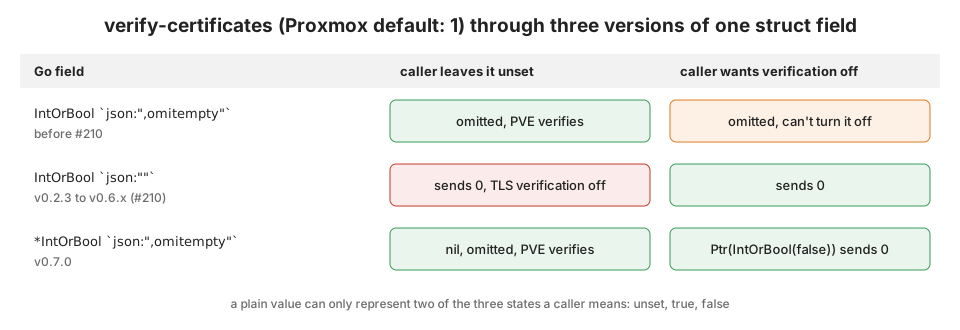
Bug one: you can’t say no
#209 from @kernel-sanders was a clean report. Create an API
token with Privsep: false because you want it to carry the user’s permissions. Proxmox creates a token with
privilege separation:
type Token struct {
	TokenID string    `json:"tokenid,omitempty"`
	Comment string    `json:"comment,omitempty"`
	Expire  int       `json:"expire,omitempty"`
	Privsep IntOrBool `json:"privsep,omitempty"`
}
false is the zero value, so omitempty drops it. Proxmox never sees the field and applies its default, which is
1. It’s the same story for disabling a user, creating an ACL that doesn’t propagate and a handful of others. The
issue listed them all.
Bug two: the fix
#210 was also from @kernel-sanders. It took option one from the
issue and removed omitempty from the affected booleans. I merged it in August 2025, and it went out in v0.2.3:
 type StorageDownloadURLOptions struct {
 	...
-	VerifyCertificates IntOrBool `json:"verify-certificates,omitempty"`
+	VerifyCertificates IntOrBool `json:"verify-certificates"`
 }
 ...
 type VirtualMachineBackupOptions struct {
 	...
-	Remove             bool                                   `json:"remove,omitempty"`
+	Remove             bool                                   `json:"remove"`
 	...
-	StdExcludes        bool                                   `json:"stdexcludes,omitempty"`
+	StdExcludes        bool                                   `json:"stdexcludes"`
Now false can be sent. It’s also sent when you didn’t set anything. Every one of those fields defaults to 1 in
Proxmox. Here’s what goes over the wire, from a small program using the same type and tags:
pre-#210 Token{Privsep: false}                   {"tokenid":"ci"}
v0.2.3 StorageDownloadURLOptions{} (unset)       {"url":"https://example.com/x.iso","verify-certificates":0}
v0.7.0 StorageDownloadURLOptions{} (unset)       {"url":"https://example.com/x.iso"}
v0.7.0 VerifyCertificates: Ptr(false)            {"url":"https://example.com/x.iso","verify-certificates":0}
So from v0.2.3 until v0.7.0, node.StorageDownloadURL with a struct that didn’t mention VerifyCertificates told
Proxmox to download the file without checking the server’s certificate. Every node.Vzdump with default options sent
remove: false and stdexcludes: false. Proxmox reads those as 0. So backups stopped pruning old archives per the
retention policy and started including /tmp and log files. Nobody filed an issue for either one, which is the scary
part. These don’t fail. They just do the wrong thing.
(One more trap while I’m here. IntOrBool’s MarshalJSON has a pointer receiver. Marshal a struct holding one by
value and the method isn’t in the method set. You get "verify-certificates":false instead of 0. The client always
marshals through a pointer, so it doesn’t bite there. It still surprised me when I wrote the test program.)
The general case
The underlying issue was already open. #199 came from @xortim
in June 2025. ContainerConfig.Console is an IntOrBool with omitempty, and Proxmox defaults it to 1. The more
general problem is any field where Go’s zero value differs from Proxmox’s default. And
#178 pointed out that VirtualMachineConfig.OnBoot is an
int when the schema says boolean. That’s two classes of bug, both of the form “the Go type doesn’t match what the
schema says”. Both had been getting fixed one report at a time.
So instead of waiting for reports I wrote an audit (#266). It
loads the Proxmox API schema and walks types.go with go/parser. For each config or options struct, it joins every
field’s JSON tag against the parameters of the endpoint that struct is sent to. It prefers the create (POST)
endpoint because that’s where Proxmox documents defaults. Indexed parameters like net[n] get matched to net0 and
friends. For each match it compares the Go zero value to the schema default and the Go type to the schema type. Then
it writes a table:
| Field | json tag | Go type | PVE type | Go zero | PVE default | Recommended fix |
|---|---|---|---|---|---|---|
Console |
console |
IntOrBool |
boolean |
0 |
1 |
*IntOrBool |
Memory |
memory |
int |
integer |
0 |
512 |
*int |
KVM |
kvm |
int |
boolean |
0 |
1 |
*IntOrBool |
VerifyCertificates |
verify-certificates |
IntOrBool |
boolean |
0 |
1 |
*IntOrBool |
Remove |
remove |
bool |
boolean |
false |
1 |
*IntOrBool |
It flagged 75 fields:
- 38 where the default differs on a non-boolean (needs
*T) - 9 where the default differs and the schema says boolean (
*IntOrBool) - 28 that are only the wrong type (
IntOrBool, no pointer needed because0is the default anyway)
That PR only added the tool, the report and a FIXME on each field. That way the breaking change could land as one
migration instead of a trickle.
One finding is worth being precise about. The audit’s note on FirewallNodeOption.Enable said an unset value would
silently disable the node firewall. That field was still a bool with omitempty on a PUT. Unset is omitted and
the firewall stays as it is, so it couldn’t disable it. What it couldn’t do was let you turn the firewall off, which
is bug one again. Both are fixed by the same change. But a tool’s description of the failure is a hypothesis until
you’ve traced the code path.
The fix: pointers, and a helper so pointers aren’t miserable
v0.7.0 changed about 30 fields from T to *T and about 25 from bool/int to IntOrBool. nil means “let
Proxmox decide”. Non-nil means “send this”. The cost is that you can’t write Cores: 4 in a struct literal anymore.
So there’s a one-line generic helper:
// Ptr returns a pointer to v. It exists so callers can construct optional
// fields on config/options structs inline without a temporary local variable.
func Ptr[T any](v T) *T { return &v }
cfg := &proxmox.VirtualMachineConfig{
	Memory:   proxmox.Ptr(proxmox.StringOrInt(4096)),
	Cores:    proxmox.Ptr(4),
	OSType:   proxmox.Ptr("l26"),
	CPUUnits: proxmox.Ptr(1024),
}
And the regression tests check both directions, because only checking one is how we got here. Unset must be absent. Explicit false or zero must be present:
func TestContainerConfig_DefaultsOmittedWhenUnset(t *testing.T) {
	// Bare struct — none of the pointer-typed fields should appear.
	m := marshalToMap(t, ContainerConfig{})
	for _, k := range []string{"arch", "cmode", "console", "cpuunits", "memory", "swap", "tty"} {
		_, present := m[k]
		assert.Falsef(t, present, "%q should be omitted when unset so PVE applies its default", k)
	}
}

func TestContainerConfig_ExplicitValuesAppearOnTheWire(t *testing.T) {
	cfg := ContainerConfig{
		Arch:     Ptr("amd64"),
		CMode:    Ptr("tty"),
		Console:  Ptr(IntOrBool(false)), // explicit disable — must reach PVE as 0, not be silently swallowed
		CPUUnits: Ptr(1024),
		Memory:   Ptr(512),
		Swap:     Ptr(0), // explicit no-swap — must reach PVE as 0, not be omitted
		TTY:      Ptr(2),
	}
	m := marshalToMap(t, cfg)
	assert.Equal(t, float64(0), m["console"]) // IntOrBool false marshals to 0
	assert.Equal(t, float64(0), m["swap"])
	// ...
}
Swap is a nice example of why “just use omitempty” doesn’t work even for integers. The Proxmox default is 512. 0
is a perfectly reasonable value meaning “no swap”, and you need to be able to send it.
Making it stick
A one-time sweep doesn’t help if the next endpoint wrapper reintroduces it. In v0.7 a lot of new wrappers were being
written. So the rule went into AGENTS.md (#271) as a decision
procedure:
- look up the field’s default in the API viewer
- use a pointer if it differs from Go’s zero
- leave it unboxed if it matches
- add a test that marshals the struct with the field unset
The one-line version is the question at the end of that section: if the user never touches this field, will an unintended value reach Proxmox?
There was one more lesson. The sweep that converted the fields stripped the FIXME comments and left nothing in their
place. Six months from now someone would see CPUUnits *int and “simplify” it back.
#268 put a comment on every pointerized field saying which
default it protects:
// Remove — PVE default 1 (remove old backups per retention policy).
// Schema is boolean; unset on the wire keeps pruning enabled. See #178 + #199.
Remove *IntOrBool `json:"remove,omitempty"`
Script string     `json:"script,omitempty"`
// StdExcludes — PVE default 1 (skip /tmp, /var/log, etc.). Unset on
// the wire keeps those default exclusions. See #178 + #199.
StdExcludes *IntOrBool `json:"stdexcludes,omitempty"`
If you’re on v0.2.3 through v0.6.x and you call StorageDownloadURL or Vzdump, set those fields explicitly or
upgrade. The full list of changed fields is in
migration/v0.7.0.md.




