
Clustered ACME in Production: Three Bugs That Took TLS Down
Moving wildcard TLS onto a live 3-node ePHPm cluster found a leader election that wasn't, a certificate only two nodes could see, and an HTTP port speaking TLS.
ePHPm gets its own certificates from Let’s Encrypt. In a cluster only one node should be talking to the CA. The nodes elect an ACME leader over the shared KV store. The leader orders the cert, and everybody else installs it from KV. That all had unit tests and had worked on single nodes for months. Then I tried to move wildcard TLS termination for our preview environment off a separate proxy and onto the 3-node cluster itself. In about two days it found three separate bugs that each took TLS down. None of them showed up in a unit test. All of them are the kind of thing you only learn by putting the feature on real machines.
The setup
Preview deployments get a subdomain each, something like pr-123.preview.example.com. Issuing a cert per subdomain
would burn through Let’s Encrypt’s 50 certificates per registered domain per week in no time. So the plan was one
wildcard, *.preview.example.com. TLS-ALPN-01 can’t validate a wildcard, because there’s no single hostname for the CA
to connect to. That meant DNS-01:
- publish a
_acme-challengeTXT record - wait for it to propagate
- tell the CA you’re ready
That lane landed first (#411), built on instant-acme. It reused the
existing clustered pieces from the TLS-ALPN-01 lane: the acme:leader election and the KV cert distribution. Reusing
the hard, correctness-critical parts instead of writing them twice is the right call. It also means you inherit their
bugs.
Three nodes, a Linode NodeBalancer in front, Let’s Encrypt staging first to protect the production rate limit.
Bug 1: leader election by start time
All three nodes logged that they’d acquired ACME leadership. Then they took it back from each other, over and over:
node-1  acquired ACME leadership node_id="1787985979173-..."
node-2  acquired ACME leadership node_id="1787986064600-..."
node-3  acquired ACME leadership node_id="1787986130867-..."
node-1  taking over ACME leadership (lower node id wins the tie-break) ...
node-2  taking over ACME leadership (lower node id wins the tie-break) ...
The election’s tie-break is “lowest node id wins”, which is fine. The problem was the id. The ACME code minted its own per-process identity:
1787985979173-22749-173895959
└─ epoch millis ─┘ └pid┘ └random┘
With an epoch-millis prefix, “lowest id wins” really means “whichever process started earliest”. That reshuffles on every restart. While nodes are rolling, leadership bounces around. The cycle on the cluster was roughly 70 seconds. A DNS-01 order spends about 60 seconds just waiting on TXT propagation. So no node held leadership long enough to finish an order, and two of three nodes never got a certificate. The third only had one because it loaded an old cert from its disk cache.
It also finally explained something I’d poked at before and left unexplained: “~7 minute leader flapping” in the logs. The cadence came from restart timing, not from any timer. That’s exactly why looking for a timer never found it.
The fix (#418) uses the configured [cluster] node_id. That’s the same
stable identity gossip already advertises. The generated form stays only as a fallback for a node without a configured
id. That’s a single-node deployment where there’s nothing to elect against. One subtle bit: a blank or whitespace-only
node_id also falls back to the generated form. Otherwise every node would collapse onto the same empty identity, and
every node would believe it holds the same claim.
Bug 2: the certificate only two nodes could see
With a stable leader, node-1 issued a valid certificate and served it. Nodes 2 and 3 never installed it. Ten minutes
later they were still failing handshakes with tlsv1 alert access denied, because they had no certificate at all.
The cert was written with Store::set, which in clustered mode routes by value size. Small values ride the gossip layer
to every node. Large values go to a sharded tier and land on replication_factor nodes, which defaults to 2. The issued
chain was 5140 bytes and small_key_threshold is 4096. So the certificate got sharded like a cache entry. The
read side used the plain, local-only Store::get, which has no “fetch it from the owner” path. On a 3-node cluster with
a replication factor of 2, one node could never see the certificate.
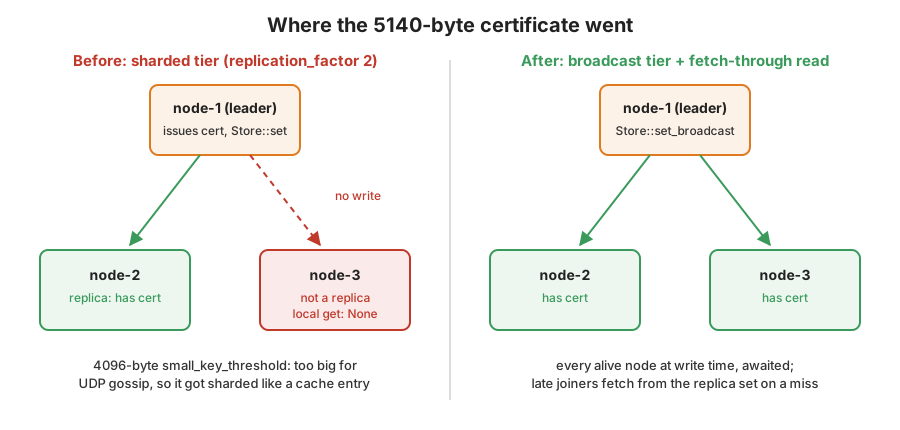
The obvious knob is raising small_key_threshold, and it’s the wrong one. The small tier is
chitchat gossip over UDP, so a multi-kilobyte payload can’t ride it.
That’s the whole reason the threshold exists. The bug wasn’t the threshold. It was the assumption that “too big for
gossip” means “shard it”. Sharding is a capacity optimization. It’s the wrong routing for state every node needs
locally, and every node terminates TLS with this certificate.
So #417 added two things, and both are load-bearing:
- A broadcast write tier (
Store::set_broadcast) that writes to every alive node regardless of size. Peer writes are awaited rather than fire-and-forget. A certificate gets written a few times a year, so cluster-wide read-your-writes matters a lot more than write latency. A partial delivery logs a warning instead of failing silently. - A fetch-through read (
Store::get_cluster). On a local miss, it falls back to the key’s replica set over the data plane. Broadcast only reaches nodes that are alive at write time. Without the read fallback, a node that joined after issuance would wait up to 60 days for the next renewal to get a certificate.
The TLS-ALPN-01 lane had the identical defect on its own cert and account cache, so it got the same fix. ACME account material moved to the broadcast tier too. Every node needs the same ACME identity. Otherwise a promoted follower registers a second account with its own rate-limit budget.
The test for this is the one I like best in the batch. It spins up three real gossip nodes on 127.0.0.x with a real
TCP data plane. It writes a 5140-byte payload (the size from the incident) through the same Store calls the ACME code
uses. Then it asserts the value is in the raw local store of the node the sharded tier would skip. Reverting
set_broadcast to the old routing makes it fail with left: None on that node. That’s the live outage reproduced in a
test.
The same bug from another direction
A follow-up showed up the moment the cluster was restarted as a whole. Lowest node id wins. The leader comes up holding
a still-valid cert in its disk cache, seeds from disk, and never orders anything. Broadcasts only happened at
issuance, so it never published. Followers found KV empty, and two of three nodes served nothing on :443 again.
#420 republishes the cached cert to KV on the leadership-acquisition
transition. It’s a no-op when KV already has it. After the redeploy, node-1 logged re-published cached certificate to the cluster on leadership acquisition and all three nodes served the staging wildcard.
That same PR fixed the next landmine before it went off. The DNS-01 cert cache keys in KV and the files on disk were
keyed only by domain set, never by ACME directory. Flip staging = false and the staging cert is sitting under the
exact key the production reader looks up. The cache is read first and nobody checks the issuer. The nodes would have
kept serving an untrusted staging cert forever and never ordered a production one. Every cache entry is now namespaced
by a hash of the directory URL.
It wasn’t quite the whole story. When I flipped to production, the cluster still came back with staging certs. The
account credentials on disk were a single account.json. After the flip the production KV key missed, so the code
fell back to disk and loaded the staging account. instant-acme then reconnected to the directory URL embedded in those
credentials. That was #421: account-<directory_hash>.json. It was the third
facet of the same bug. The order went to staging, so no production rate limit was spent finding it.
Bug 3: the HTTP port that spoke TLS
This one had already been misdiagnosed once. The config was [server] listen = "0.0.0.0:8080" plus
[server.tls] listen = "0.0.0.0:443". The NodeBalancer health-checks plain HTTP on 8080, and the health check failed.
That pulled nodes out of rotation and sent 503s to users. The earlier write-up called it “port 8080 connection refused”.
It wasn’t refused. Sending a plaintext GET with nc got this back:
15 03 03 00 02 02 32
That’s a TLS alert record. 0x15 is the alert content type and 03 03 is TLS 1.2, then a fatal decode_error. The
port was listening and accepting the whole time. It was speaking TLS. Clients reported a connection-level failure, so
the port looked dead.
The cause was in dispatch_main_connection. Plain HTTP on the main listener was gated on
has_tls_listener && redirect_http, and redirect_http defaults to false. So a separate TLS listener without a
redirect fell straight through to the TLS-mode match. That wrapped the main listener in TLS too. The code contradicted
its own documented contract (“when set, server.listen serves HTTP and this address serves HTTPS”). That contract was
already correct in two places. Now whenever a separate TLS listener is bound, the main listener serves plain HTTP.
redirect_http only decides whether that’s a 301 or a normal response. There’s no TLS-mode arm on that path anymore,
so manual and ACME modes can’t diverge again.
The tests drive the real dispatch_main_connection over a real socket and assert on the first byte written back. That’s
H for HTTP/1.1, or 0x16/0x15 for a TLS record. It’s the same signal the live diagnosis used.
A couple of earlier ones
While I was in here, two older TLS bugs belong in the same list.
Once the certs were on the nodes, every browser got a 404 or a redirect loop on multi-tenant sites. curl worked fine.
Browsers negotiate HTTP/2 over TLS. HTTP/2 carries the host in the :authority pseudo-header with an absolute-form
request URI, not a Host header. ePHPm only looked at Host, which left three problems:
- vhost resolution defaulted to
localhost $_SERVER['HTTP_HOST']was emptyREQUEST_URIwashttps://host/path
WordPress turned that into a canonical redirect to a URL with the host glued in twice.
#414 synthesizes a Host header from the authority at ingress. It also emits
REQUEST_URI in origin form for every protocol version.
And earlier in August, manual cert/key TLS panicked at startup in v0.6.0 and v0.6.1
(#243). The workspace pinned rustls to ring. Meanwhile rustls-acme,
rcgen and hyper-rustls enabled aws-lc-rs. Cargo unions features, so both providers got compiled in. rustls then
refused to pick a process default. Nobody noticed because ACME mode always passes a provider explicitly. Every unit test
in tls.rs also called install_default() first, which masked the panic for the whole test binary. That’s since been
converged on a single aws-lc-rs provider (#368).
What I took away
Every one of these passed its unit tests. The election was “correct” given its inputs. The KV write was “correct” for a cache entry. The listener was “correct” for one config shape. They broke on assumptions that only a real cluster exercises: restart timing, value sizes, a load balancer health check that speaks plain HTTP.
The other takeaway is about staging. Running the whole thing against Let’s Encrypt staging first made it cheap to find the cache-collision bugs. The flip to production was where they’d have burned a week of wildcard rate limit. Do the staging run, and then treat the flip itself as a separate thing to test.
Links
- DNS-01 wildcard lane: ephpm #411
- Leader election on the configured node id: ephpm #418
- Plain HTTP listener + broadcast cert distribution: ephpm #417
- Republish on promotion + directory namespacing: ephpm #420, #421
- HTTP/2
:authority: ephpm #414 - Two rustls crypto providers: ephpm #243
- Let’s Encrypt rate limits and staging environment




